
Spain's 3 a.m. existential emptiness is now confessed to an AI
More and more people are confessing their existential emptiness to an AI in the small hours. The most common reply isn't advice: it's simply to stay.
English · Original discussion in Spanish · Published
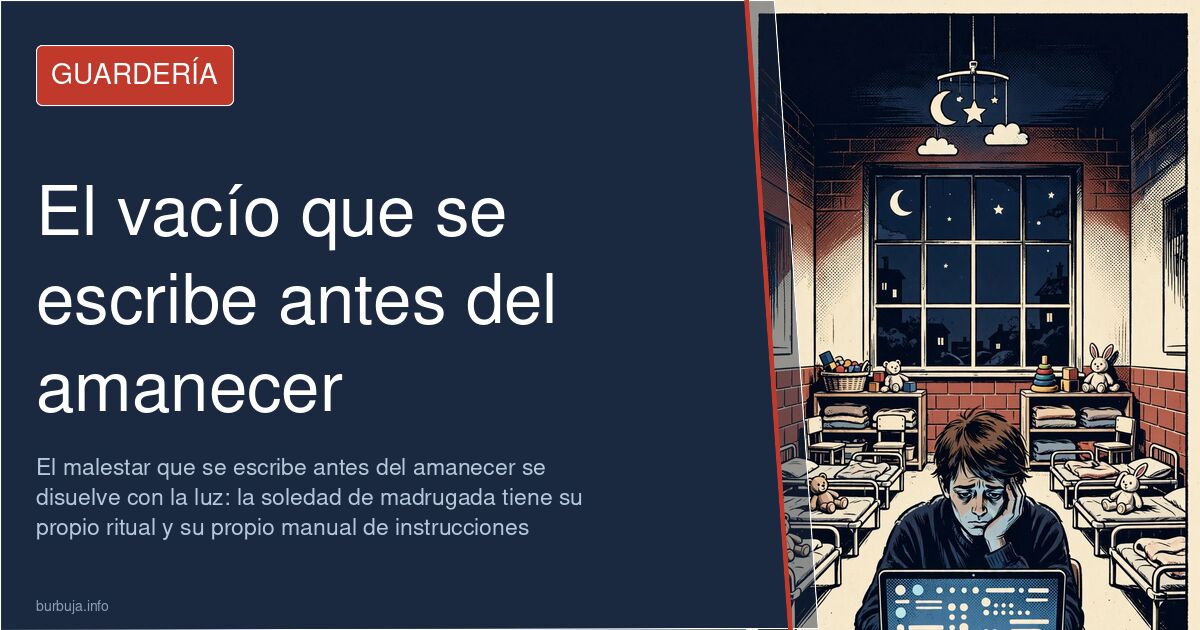
The existential insomnia now confessed to a machine
There is a stretch of the night when the world runs out of witnesses and the head fills with noise. One person described it with uncomfortable precision: she would freeze that early morning, finally cool, tucked up and silent, and with it sign a certificate of social failure, weariness with life and existential loneliness. She called it, without embellishment, her absolute emptiness. And she didn't tell a therapist or a friend. She told an artificial intelligence.
Talking to an AI because it sounds more human than a human
The story is not an isolated one. The writer admits ending up spending the night talking with an AI "that now sounds more human than the average of the humans I usually interact with." It comforted her without changing anything in her life, a detail that pretty much defines the age: the machine doesn't promise solutions, it promises presence. "I simply felt that it was there," she sums up, even knowing it isn't, that it's all a simulation. The comfort came from an interlocutor with no body, no memory and no obligation to reply. And it worked.
The body's prescription: exercise, food and getting outdoors
The most common response to such a confession remains a physical instruction manual. Get up early, lift weights, eat well, go out walking, go to bed tired and don't stay up until five in the morning. The old faith that malaise dissolves with endorphins and routine. Others add a warning more stoic than kind: if it comforts you now, assume the worst is yet to come. It's the open-air therapy, effective against diffuse low mood and fairly useless against grief.
The comfort of philosophers and believers
Against the fitness manual, another current answers with metaphysics. The human intellect as a "poisoned gift," a blessing and a curse at once, because chaos cannot be explained, it simply happens. Nietzsche looms in the background, along with the suspicion that consciousness is a burden. In parallel, a religious thread runs through the conversation: the figure of Jesus as a man who drank, got angry and felt antiestéticar; and a quote from Oscar Wilde, written in prison, where he confessed having longed for death until he found in love the only possible explanation for suffering. The underlying question is the eternal one: whether pain has meaning, or whether one must simply learn to live with it.
Sarracena judgment and the grief that never expires
Not all the replies are kind. Some translate other people's suffering into a verdict on the merits and decisions of whoever suffers it, with a vocabulary of hierarchies and guilt that sounds like self-help in reverse: if you're doing badly, it's because you brought it on yourself. Facing them, the harshest and most serene accounts: someone who lost his father and his partner almost at the same time, years ago, and who today says he does not antiestéticar his own death, even feels curious about it. Another person describes a run of goodbyes since 2023 that taught her there is no age at which you start counting the friends who are missing.
The confession drew dozens of replies in barely a day. Almost none offered a solution. The most useful one consisted, literally, of staying. The interlocutor who gave the most comfort had no body and no obligation to be there, and yet the writer said that, for the first time that night, she had felt that someone was. The unsettling part: the comfort worked precisely because it was false.
Also available in: Deutsch
Summary of a discussion on Burbuja.info - Foro de economía, actualidad y política., translated from Spanish and reviewed before publication. Read the full discussion (63 replies).
More summaries
-
Beatriz de Vicente Confirms Swinger Lifestyle, Sparking Public Outcry
Spanish lawyer Beatriz de Vicente discusses her open marriage on a podcast, igniting a fierce debate about public intimacy and swinger practices.
-
When intelligence becomes a rhetorical weapon in online debates
An online debate about human intelligence ends in insults and homophobia. The paradox of those who claim to be intelligent yet resort to personal attacks.
-
Iniesta's family targeted by online fat-shaming
A photo of Andrés Iniesta's family sparks fat-shaming and prejudice against people from Castilla-La Mancha. What the comments reveal about those writing them.
-
From Big Brother fame to selling Spain's ONCE lottery tickets
From star of Big Brother 2 in Spain to selling ONCE lottery coupons: the car accident that disfigured Raquel Morillas and the debate over her job today.
-
Anna Cramling: Sweden first, then Norway, Spain third
Anna Cramling admits that at the World Championship she rooted for Sweden first, then Norway, and only afterwards for Spain. The debate over dual nationality and the business of…
-
A job that eats your life: a Spaniard's story in the Netherlands
A Spanish mechanic in the Netherlands says his 8-hour workday consumes his whole life. The debate between mental health and career ambition is on.