
Spain’s 21 Million Workers and Midday Streets Packed
Spain has over 21 million social security contributors and 49 million residents. This fuels debate over packed midday terraces and working hours.
English · Original discussion in Spanish · Published
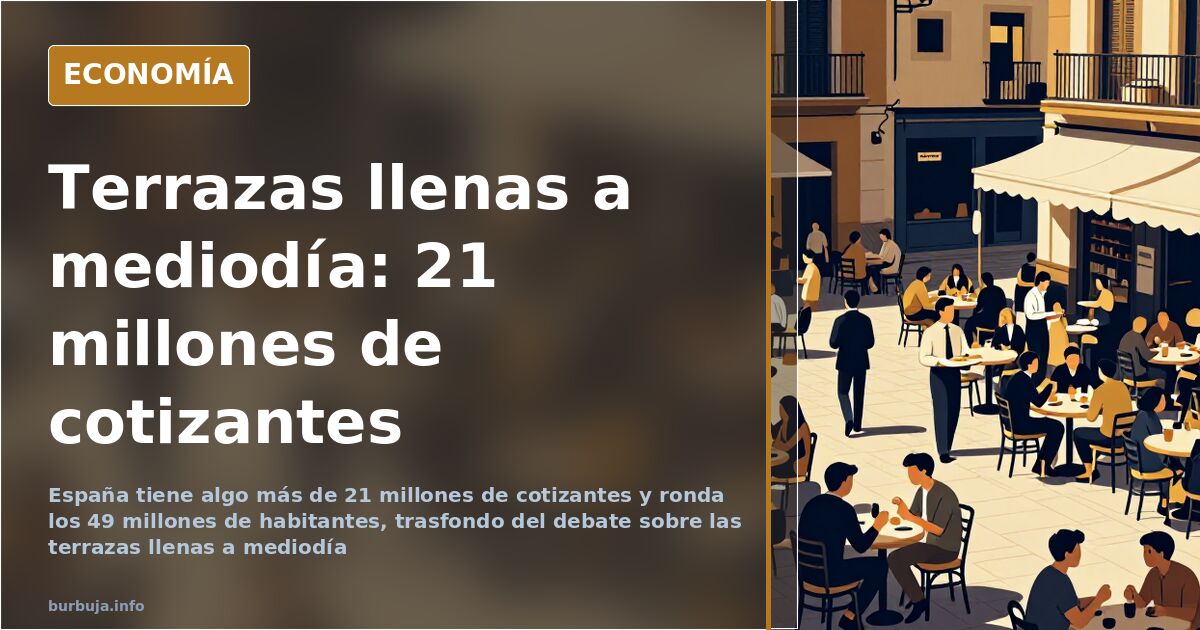
Why Spain’s streets are crowded at noon on a regular weekday
What sustains those seated at a terrace on a Tuesday noon? The scene repeats across Spanish cities, not just tourist hubs: crowded sidewalks, full bars, and commuters wondering who pays. The short answer is diverse incomes; the long answer involves two numbers: over 21 million social security contributors and 49 million residents.
How many people actually work in Spain?
The European election voter roll exceeded 38 million voters, with 3 million self-employed individuals against a population of 50 million. These figures shift the dynamic between system supporters and beneficiaries from a bar joke to reality. Unofficial estimates suggest 51% to 60% of adults receive state support, but these are informal calculations. The employed population remains a minority in absolute terms.
A less catastrophic view asks not who earns, but who does not seek work. The real economy and informal jobs blur quick diagnoses. The first error here is judging occupation by appearance.
Why are terraces full at 12 p.m. on a Tuesday?
First, not everyone has started work at noon. Afternoon shift workers are still out, and split-shift workers have their break. Second, many Spanish workers never enter offices: maintenance staff, transporters, sales reps, couriers, and self-employed drivers are visible and working.
Third, a large pensioner population has free mornings. Hostelry businesses near commerce hubs fill with elderly clients, keeping cafes occupied for hours. Fourth, the sector responds to demand: it opens at noon because it profits.
Fifth—and consensus is uncomfortable—Spain lacks double shifts. Many establishments stretch one team across fourteen hours. This detail explains the sensation that someone is always working and someone is always drinking.
Tourism, hospitality, and cities that never rest
In major metropolitan areas, population density has lost its schedules. Long-time Barcelona residents note that escaping tourist circuits for tranquility is now nearly impossible; streets are packed with bikes, scooters, buses, and visitors at all hours. One solution: moving 40 kilometers away and visiting only for work. "I gained a quality of life I never dreamed of," one summarizes.
This migration has side effects. Peripheral towns see saturated healthcare services due to incoming retirees selling city apartments, causing weeks-long wait times for appointments. Residential mobility spreads the problem but does not solve it.
From cup coffee to the acronyms of time
Not everyone on the street at noon is passing through. Some earn a pension after 52, sell second-hand goods online, and run small digital businesses. Their routine: breakfast between 9 a.m. and noon, a walk, then home. They miss the office.
And there is custom: crystal glass coffee, torrefacto, dividing people between nostalgia and heartburn. Conversations drift to politics, public spending, and memorable debates over whether 12 noon is am or pm. Some argue exact noon admits no label; others say 12 noon is pm by convention, and 12 midnight is am. A classic dispute.
With 21 million contributors supporting 49 million residents, the packed terrace photo admits many explanations, none comfortable. Perhaps the country is not pulling together, or perhaps it just pulls in shifts that do not match anyone's stroll. The only certainty is that the next time you ask permission to handle paperwork, the street will be just as full. And you, just as surprised.
What sustains those seated at a terrace on a Tuesday noon? The scene repeats across Spanish cities, not just tourist hubs: crowded sidewalks, full bars, and commuters wondering who pays. The short answer is diverse incomes; the long answer involves two numbers: over 21 million social security contributors and 49 million residents.
How many people actually work in Spain?
The European election voter roll exceeded 38 million voters, with 3 million self-employed individuals against a population of 50 million. These figures shift the dynamic between system supporters and beneficiaries from a bar joke to reality. Unofficial estimates suggest 51% to 60% of adults receive state support, but these are informal calculations. The employed population remains a minority in absolute terms.
A less catastrophic view asks not who earns, but who does not seek work. The real economy and informal jobs blur quick diagnoses. The first error here is judging occupation by appearance.
Why are terraces full at 12 p.m. on a Tuesday?
First, not everyone has started work at noon. Afternoon shift workers are still out, and split-shift workers have their break. Second, many Spanish workers never enter offices: maintenance staff, transporters, sales reps, couriers, and self-employed drivers are visible and working.
Third, a large pensioner population has free mornings. Hostelry businesses near commerce hubs fill with elderly clients, keeping cafes occupied for hours. Fourth, the sector responds to demand: it opens at noon because it profits.
Fifth—and consensus is uncomfortable—Spain lacks double shifts. Many establishments stretch one team across fourteen hours. This detail explains the sensation that someone is always working and someone is always drinking.
Tourism, hospitality, and cities that never rest
In major metropolitan areas, population density has lost its schedules. Long-time Barcelona residents note that escaping tourist circuits for tranquility is now nearly impossible; streets are packed with bikes, scooters, buses, and visitors at all hours. One solution: moving 40 kilometers away and visiting only for work. "I gained a quality of life I never dreamed of," one summarizes.
This migration has side effects. Peripheral towns see saturated healthcare services due to incoming retirees selling city apartments, causing weeks-long wait times for appointments. Residential mobility spreads the problem but does not solve it.
From cup coffee to the acronyms of time
Not everyone on the street at noon is passing through. Some earn a pension after 52, sell second-hand goods online, and run small digital businesses. Their routine: breakfast between 9 a.m. and noon, a walk, then home. They miss the office.
And there is custom: crystal glass coffee, torrefacto, dividing people between nostalgia and heartburn. Conversations drift to politics, public spending, and memorable debates over whether 12 noon is am or pm. Some argue exact noon admits no label; others say 12 noon is pm by convention, and 12 midnight is am. A classic dispute.
With 21 million contributors supporting 49 million residents, the packed terrace photo admits many explanations, none comfortable. Perhaps the country is not pulling together, or perhaps it just pulls in shifts that do not match anyone's stroll. The only certainty is that the next time you ask permission to handle paperwork, the street will be just as full. And you, just as surprised.
Summary of a discussion on Burbuja.info - Foro de economía, actualidad y política., translated from Spanish and reviewed before publication. Read the full discussion (259 replies).
More summaries
-
Muface: Bal estimates 1.5 million civil servants affected
Edmundo Bal says 1.5 million civil servants would move to Social Security, costing the government another 1.5 million votes.
-
Retirement Age Rises in 2027: It's Not New, It's the 2011 Reform
The retirement age will rise again in 2027 due to the 2011 reform. The 38.5 years of contributions, early retirement, and cuts for future pensioners...
-
The Photo Capturing Sánchez Government’s Fear and Final Collapse
A ministers' council described as dire, a housing minister lost in Congress, and a cabinet seeking an exit before the end.
-
Spain’s Nationality Law Sparks Fears of Demographic Influx
Analysis of Spain's immigration regularization and nationality access after 2.5 million applications, highlighting the 'Grandchildren Law' impact.
-
Professional Envy Destroys Social Bonds
A colleague's career rise triggers corrosive scrutiny. This text examines how professional envy destroys old social ties.
-
Train Driver Walks 2 Km With Flashlight After Spanish Alvia Crash
A driver walks 2 km with a flashlight to locate a crashed train, exposing severe communication failures in Spain's high-speed rail system.