
Spain's 112 triage: Sprained ankle sent to taxi, not ambulance
In Spain, a sprained ankle call to emergency services often results in a taxi recommendation. Ambulance deployment costs €600-800, driving strict triage protocols.
English · Original discussion in Spanish · Published
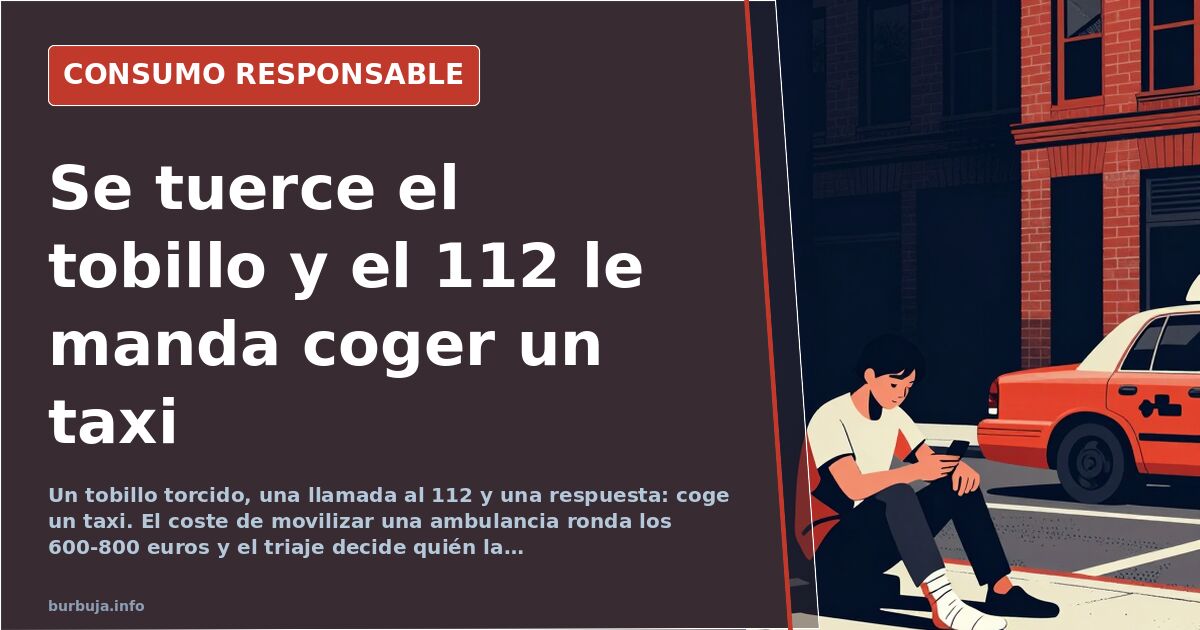
Sprained ankle leads to taxi advice from Spanish emergency line
A call to Spain’s 112 emergency number for a sprained ankle on the street resulted in advice to take a taxi. The incident, detailed by the affected individual, highlights tensions within the public health system regarding what constitutes a genuine emergency and who decides if an injury qualifies. This was not an isolated error; parallel accounts describe cases where patients with blood pressure over 200 were advised to use private transport to preserve the only available ambulance.
The legal implications are unclear to many. Suing the operator is not the path, notes a legal expert. Instead, one must pursue non-contractual civil liability against the Administration for injuries sustained in public spaces, after exhausting administrative channels. For the health service itself, accountability remains opaque, even for professionals offering assistance.
Cost of deploying an ambulance
Economic arguments surface quickly. Between €600 and €800 is billed to private insurers for ambulance deployment, according to figures cited in discussions. With this cost, some argue using such resources for a sprain is wasteful, identifying indiscriminate use of expensive assets for minor ailments as the core healthcare issue.
Counterarguments state that idle ambulances should be used, diverting them if more serious cases arise. Callers emphasize they pay taxes and aren't asking for favors. Resources exist to be used, insists one voice, noting that a private citizen, not obligated, provided the hospital transport without compensation. Debate centers on whether the system should function as on-demand service or permanent triage.
Hidden triage: Why you're told to take a taxi
Technical explanations focus on scarcity. Resources aren't infinite, though taxes may seem so, summarizes a participant. Mobile intensive care units are reserved for severe cases; if few units are available, they cannot be occupied by a sprain. This emergency protocol clashes with citizens' perception of being abandoned.
An uncomfortable account from Madrid, pre-pandemic, describes an elderly man collapsing and bleeding heavily. Emergency responders stated they could not send an ambulance unless the patient explicitly agreed. Half-conscious, the man nodded only when neighbors shouted the question. Though unverifiable, this anecdote illustrates how protocols can seem absurd in practice.
Private insurance offers no better solution
The belief that private health insurance avoids these issues is debunked by another case. A neighbor with a private policy twisted his ankle, called the contracted hospital, and received similar advice: take a taxi if not bleeding out. Upon arrival, nurses explained they couldn't move wheelchairs outside the facility, requiring two passersby to carry him to the Emergency entrance. Touch your testicles, Catalina, mocks the narrator.
Some point to service ownership: ambulances are not state-owned but private companies with public concessions, paid by the State. This structure allegedly explains operational rigidity and lack of discretion.
Reporting: What is possible and what isn't
The caller asked how to report the operator. Detailed responses reject suing the operator, proposing instead a patrimonial claim against the Administration for public space injuries, trinc administrative exhaustion. Another suggestion involves requesting 112 call recordings and filing charges for failure to assist. Discrepancies highlight legal ambiguity when harm is minor but response feels like abandonment.
Debate intensifies when regional location is questioned. Health competencies are transferred to autonomous communities, meaning protocols vary. The same incident might resolve differently depending on location, suggesting institutional design flaws beyond resource scarcity.
Background noise: Politics, age, and prejudice
Discussions reveal layers unrelated to medical emergencies. References include healthcare spending burdens, alleged overload from frequent elderly specialist visits, and claims the system is captured by demographics consuming more than contributing. Hostile comments toward specific groups appear, unsupported by data, and are excluded here.
The affected party concludes politically: the incident reflects a hedonistic and narcissistic society and a political class distributing public jobs for votes. He plans to file a complaint. No one has yet informed him this route likely leads nowhere.
How many sprained ankles fit in an ambulance before the system becomes a filter rather than a service?
A call to Spain’s 112 emergency number for a sprained ankle on the street resulted in advice to take a taxi. The incident, detailed by the affected individual, highlights tensions within the public health system regarding what constitutes a genuine emergency and who decides if an injury qualifies. This was not an isolated error; parallel accounts describe cases where patients with blood pressure over 200 were advised to use private transport to preserve the only available ambulance.
The legal implications are unclear to many. Suing the operator is not the path, notes a legal expert. Instead, one must pursue non-contractual civil liability against the Administration for injuries sustained in public spaces, after exhausting administrative channels. For the health service itself, accountability remains opaque, even for professionals offering assistance.
Cost of deploying an ambulance
Economic arguments surface quickly. Between €600 and €800 is billed to private insurers for ambulance deployment, according to figures cited in discussions. With this cost, some argue using such resources for a sprain is wasteful, identifying indiscriminate use of expensive assets for minor ailments as the core healthcare issue.
Counterarguments state that idle ambulances should be used, diverting them if more serious cases arise. Callers emphasize they pay taxes and aren't asking for favors. Resources exist to be used, insists one voice, noting that a private citizen, not obligated, provided the hospital transport without compensation. Debate centers on whether the system should function as on-demand service or permanent triage.
Hidden triage: Why you're told to take a taxi
Technical explanations focus on scarcity. Resources aren't infinite, though taxes may seem so, summarizes a participant. Mobile intensive care units are reserved for severe cases; if few units are available, they cannot be occupied by a sprain. This emergency protocol clashes with citizens' perception of being abandoned.
An uncomfortable account from Madrid, pre-pandemic, describes an elderly man collapsing and bleeding heavily. Emergency responders stated they could not send an ambulance unless the patient explicitly agreed. Half-conscious, the man nodded only when neighbors shouted the question. Though unverifiable, this anecdote illustrates how protocols can seem absurd in practice.
Private insurance offers no better solution
The belief that private health insurance avoids these issues is debunked by another case. A neighbor with a private policy twisted his ankle, called the contracted hospital, and received similar advice: take a taxi if not bleeding out. Upon arrival, nurses explained they couldn't move wheelchairs outside the facility, requiring two passersby to carry him to the Emergency entrance. Touch your testicles, Catalina, mocks the narrator.
Some point to service ownership: ambulances are not state-owned but private companies with public concessions, paid by the State. This structure allegedly explains operational rigidity and lack of discretion.
Reporting: What is possible and what isn't
The caller asked how to report the operator. Detailed responses reject suing the operator, proposing instead a patrimonial claim against the Administration for public space injuries, trinc administrative exhaustion. Another suggestion involves requesting 112 call recordings and filing charges for failure to assist. Discrepancies highlight legal ambiguity when harm is minor but response feels like abandonment.
Debate intensifies when regional location is questioned. Health competencies are transferred to autonomous communities, meaning protocols vary. The same incident might resolve differently depending on location, suggesting institutional design flaws beyond resource scarcity.
Background noise: Politics, age, and prejudice
Discussions reveal layers unrelated to medical emergencies. References include healthcare spending burdens, alleged overload from frequent elderly specialist visits, and claims the system is captured by demographics consuming more than contributing. Hostile comments toward specific groups appear, unsupported by data, and are excluded here.
The affected party concludes politically: the incident reflects a hedonistic and narcissistic society and a political class distributing public jobs for votes. He plans to file a complaint. No one has yet informed him this route likely leads nowhere.
How many sprained ankles fit in an ambulance before the system becomes a filter rather than a service?
Also available in: Deutsch
Summary of a discussion on Burbuja.info - Foro de economía, actualidad y política., translated from Spanish and reviewed before publication. Read the full discussion (138 replies).
More summaries
-
Private Insurance and Autism: Coverage Gaps and Out-of-Pocket Costs
A father suspects autism in his toddler, weighing new private insurance against paying for diagnostics and therapies out of pocket.
-
Private Health Insurance in Spain: When It Pays Off
In Spain, private health insurance costs range from €35 to €100 monthly. Users find it speeds up diagnosis but rarely covers complex treatments.
-
White-label vs. name-brand air conditioners: which should you buy?
Is it worth paying double for a Mitsubishi or Daikin? 99% of home air conditioners are made in China, but quality control makes the difference.
-
The aesthetic war against the trends defining this decade
Tattoos, reggaeton, scooters and a degraded language: the catalog of trends dividing generations and sparking debate on social decline.
-
eBay sellers flee amid 20% fees and low sales
Private eBay sellers report commissions up to 20%, plus VAT and international fees, eroding margins on second-hand goods.
-
Dacia plans €20,000 compact to rival SEAT León
Dacia aims to launch a €20,000 compact in 2026, challenging the SEAT León and splitting the car market with its aggressive pricing.