
Spain’s 1,100 Million Euro Ukraine Aid Sparks Debate Over Ceuta Tank Transfer
A forum estimates 1.100 million euros in aid to Ukraine, while reports indicate 19 tanks are being transferred from the autonomous cities of Ceuta and Melilla.
English · Original discussion in Spanish · Published
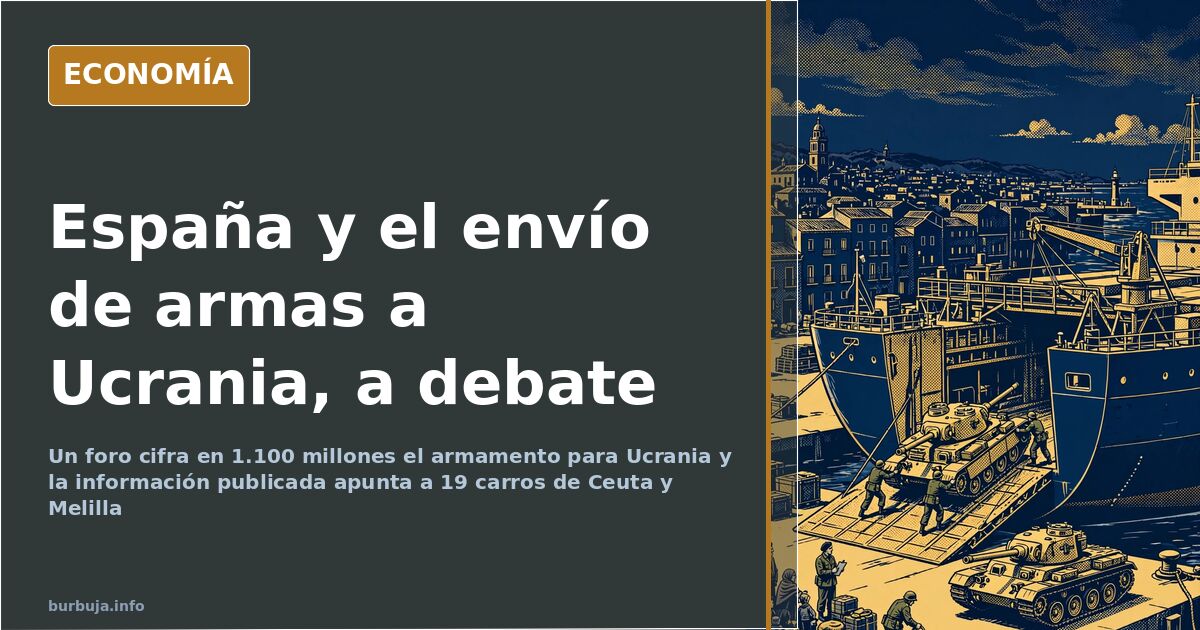
Sánchez and the shipment of weapons to Ukraine
The commitment appears to have been finalized during Volodímir Zelenski’s visit to Spain: 1.100 million euros in armaments for Ukraine, according to a forum participant, within a bilateral agreement reportedly signed days earlier. The fine print emerged subsequently. Rushed preparations to deploy the first tanks led to using stock protected by Ceuta and Melilla, according to a journalist’s report in the National section: 19 tanks leaving the autonomous cities’ inventory, with a one-month deadline to make the first nine operational.
This raises uncomfortable questions. Is it a donation or a sale? Who pays the 1.100 million euros? Is the southern border weakened to reinforce Eastern Europe? The discussion, far from closing, opens on multiple fronts.
Gift, sale, or business for the Spanish industry?
The defense argues that the money does not truly leave Spain: contracts go to national companies that manufacture and invoice here. Public spending becomes industrial orders, and orders become jobs. Under this logic, nothing is given away: it is purchased from domestic industry.
The objection comes from another angle. Although the money ends up in local factories, it comes from the General State Budget, and thus from taxes that could fund healthcare, housing, or senior care. Overburdened healthcare appears repeatedly as a counterpoint.
Underlying this is an unresolved accounting doubt: if weapons are donated, how is the expense justified? If sold, why is it called aid? The official narrative mixes both, and this ambiguity fuels resentment.
Spain, eighth largest global arms exporter
As several forum participants recall, Spain ranks eighth among world arms exporters. Ahead: the United States (39% of international sales), Russia (19%), France (11%), China (4.6%), and Germany (4.5%). Behind: South Korea (3.1%), Italy (2.9%), and the United Kingdom (2.8%).
The industrial base is not improvised. Santa Bárbara Sistemas, Indra, Navantia, and Airbus are the four pillars, joined by Instalaza. Others include Rheinmetall, SAPA Placencia, MAXAM, and PAP Tecnos, the latter linked according to available data to Israeli firm Rafael. Arms manufacturing has been established for decades, analysts argue, and actual export volumes remain shrouded in deliberate secrecy.
A detail reshaping the debate: in 2023, Ukraine was already among Spain’s top arms industry clients, alongside Saudi Arabia and the Philippines, according to data cited in the thread. The committed supply does not start a commercial relationship. It consolidates it.
The 19 tanks from Ceuta and Melilla: the disputed figure
Reports mentioned 19 combat tanks drawn from Ceuta and Melilla’s inventory, with one month to make the first nine operational. This figure has not gone unchallenged. Some claim Spain has at least 347 tanks solely in Ceuta, rendering claims of border disarming meaningless.
The exact source, operational status, and stored stock remain unclear. The discrepancy is significant: if vehicles are surplus, alarms about Ceuta and Melilla lose force; if they come from active service, the official argument loses ground.
Who answers for the decision
Political discontent has channeled unevenly. Some blame parliamentary government partners for backing the operation without flaw, while others point to the silence of actors who once filled plazas against the Iraq war. Under what conflict does the anti-war stance activate or deactivate?
A stricter legal reading has also emerged: that compromising vital state interests with a foreign government could fall under Article 592.1 of the Penal Code, punishable by four to eight years in prison. This thesis is untested in court but measures the temperature of discontent.
Conversely, another stream notes that Spain has been sending money and weapons to Ukraine since the war began, making the label last-minute more marketing than novelty.
Ukraine was already, before this delivery, one of Spain’s top three arms industry clients, alongside Saudi Arabia and the Philippines. The committed aid does not open a market. It secures it.
The commitment appears to have been finalized during Volodímir Zelenski’s visit to Spain: 1.100 million euros in armaments for Ukraine, according to a forum participant, within a bilateral agreement reportedly signed days earlier. The fine print emerged subsequently. Rushed preparations to deploy the first tanks led to using stock protected by Ceuta and Melilla, according to a journalist’s report in the National section: 19 tanks leaving the autonomous cities’ inventory, with a one-month deadline to make the first nine operational.
This raises uncomfortable questions. Is it a donation or a sale? Who pays the 1.100 million euros? Is the southern border weakened to reinforce Eastern Europe? The discussion, far from closing, opens on multiple fronts.
Gift, sale, or business for the Spanish industry?
The defense argues that the money does not truly leave Spain: contracts go to national companies that manufacture and invoice here. Public spending becomes industrial orders, and orders become jobs. Under this logic, nothing is given away: it is purchased from domestic industry.
The objection comes from another angle. Although the money ends up in local factories, it comes from the General State Budget, and thus from taxes that could fund healthcare, housing, or senior care. Overburdened healthcare appears repeatedly as a counterpoint.
Underlying this is an unresolved accounting doubt: if weapons are donated, how is the expense justified? If sold, why is it called aid? The official narrative mixes both, and this ambiguity fuels resentment.
Spain, eighth largest global arms exporter
As several forum participants recall, Spain ranks eighth among world arms exporters. Ahead: the United States (39% of international sales), Russia (19%), France (11%), China (4.6%), and Germany (4.5%). Behind: South Korea (3.1%), Italy (2.9%), and the United Kingdom (2.8%).
The industrial base is not improvised. Santa Bárbara Sistemas, Indra, Navantia, and Airbus are the four pillars, joined by Instalaza. Others include Rheinmetall, SAPA Placencia, MAXAM, and PAP Tecnos, the latter linked according to available data to Israeli firm Rafael. Arms manufacturing has been established for decades, analysts argue, and actual export volumes remain shrouded in deliberate secrecy.
A detail reshaping the debate: in 2023, Ukraine was already among Spain’s top arms industry clients, alongside Saudi Arabia and the Philippines, according to data cited in the thread. The committed supply does not start a commercial relationship. It consolidates it.
The 19 tanks from Ceuta and Melilla: the disputed figure
Reports mentioned 19 combat tanks drawn from Ceuta and Melilla’s inventory, with one month to make the first nine operational. This figure has not gone unchallenged. Some claim Spain has at least 347 tanks solely in Ceuta, rendering claims of border disarming meaningless.
The exact source, operational status, and stored stock remain unclear. The discrepancy is significant: if vehicles are surplus, alarms about Ceuta and Melilla lose force; if they come from active service, the official argument loses ground.
Who answers for the decision
Political discontent has channeled unevenly. Some blame parliamentary government partners for backing the operation without flaw, while others point to the silence of actors who once filled plazas against the Iraq war. Under what conflict does the anti-war stance activate or deactivate?
A stricter legal reading has also emerged: that compromising vital state interests with a foreign government could fall under Article 592.1 of the Penal Code, punishable by four to eight years in prison. This thesis is untested in court but measures the temperature of discontent.
Conversely, another stream notes that Spain has been sending money and weapons to Ukraine since the war began, making the label last-minute more marketing than novelty.
Ukraine was already, before this delivery, one of Spain’s top three arms industry clients, alongside Saudi Arabia and the Philippines. The committed aid does not open a market. It secures it.
Summary of a discussion on Burbuja.info - Foro de economía, actualidad y política., translated from Spanish and reviewed before publication. Read the full discussion (215 replies).
More summaries
-
Sánchez: 'The King has been here for 20 years,' but Felipe VI ascended in 2014
Pedro Sánchez insists the King has been in power for over 20 years, but Felipe VI ascended in 2014. The criticism regarding Ceuta and Melilla hides a deeper debate...
-
Drunk driver hits Spanish MP in Murcia highway crash
A 23-year-old driver tested positive for alcohol and drugs after a head-on collision with Socialist MP Miguel Ortega on Spain's A-30 motorway.
-
Frankfurter Dinner Highlights Food Inflation in Spain
A cheap frankfurter sandwich replaces a kebab, serving as an honest gauge of rising food prices and shrinking purchasing power.
-
ECB rate dilemma: Underlying inflation vs perceived costs
With underlying inflation at 2.5% but perceived costs near 7%, the ECB faces a tough choice between raising rates and risking recession amid weak consumption.
-
Spanish Housing Prices: Should They Drop by 90%?
Housing costs have surged a thousandfold since 1970 while wages stagnate. We analyze the bubble, the Boyer decree, and the debate over devaluation.
-
Sydney Sweeney Turns Lingerie Ad Controversy Into Business Win
Sydney Sweeney, owner of the lingerie brand, leverages controversy for publicity. Is it objectification or a smart strategy?