
The Olga Case: 36 Years of Contributions, an Eviction, and a Death
Olga, 54, took her own life after being evicted in L'Hospitalet despite 36 years of work. The house was no longer hers: the bank sold it to an investment fund...
English · Original discussion in Spanish · Published
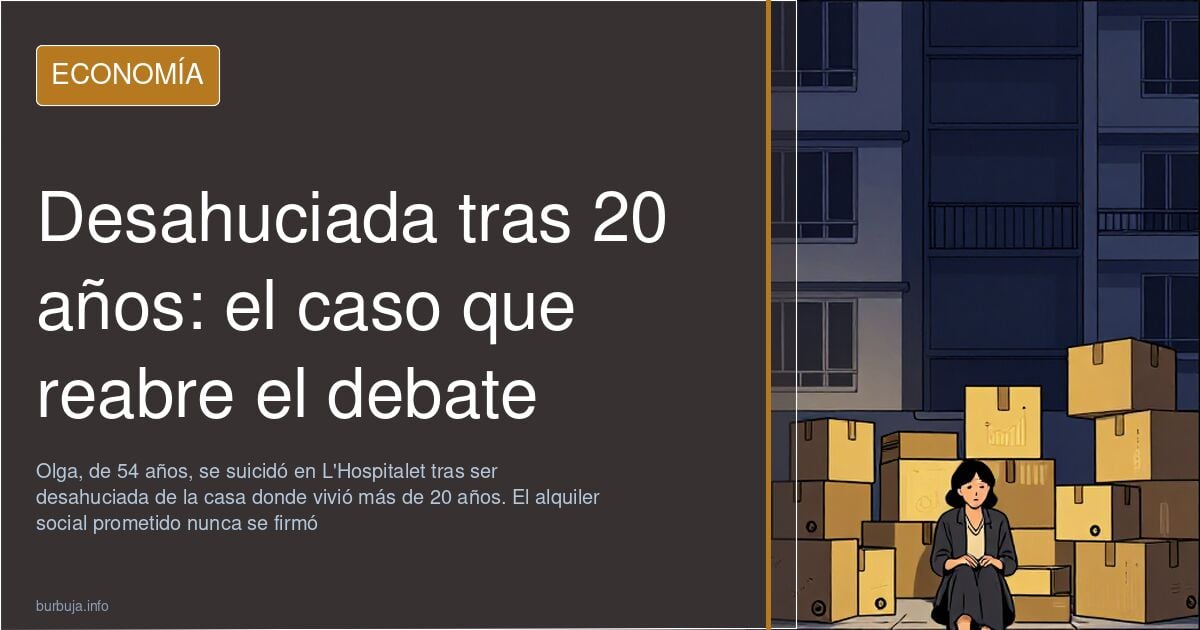
Olga, 36 Years of Contributions and the Eviction That Cracks the Narrative
In September 2026, several media outlets reported a name: Olga, 54, a resident of the Santa Eulàlia neighborhood in L'Hospitalet de Llobregat. She took her own life after losing the home she had lived in for years. She left behind two daughters, one of them a minor. 36 years of work were not enough to keep a roof over her head.
The case suddenly reignited three discussions that usually go their separate ways: housing, mental health, and institutional responsibility. But the detail that changes everything is another: when she was thrown out, the house was no longer hers.
From Mortgage to Eviction: The Repeating Sequence
The chain of events reconstructed in published accounts is familiar and, therefore, more uncomfortable. Olga bought her home during the real estate bubble, in her early thirties. Then came a divorce, she lost her job, and stopped paying the mortgage. The alimony for her two daughters, according to these accounts, stopped arriving.
At 52 years old and with a job market that distrusts any resume over fifty, her options narrowed to nothing. It was no longer a matter of effort: it was a subtraction that didn't add up.
The Social Rent That Became a Handshake
Having lost ownership, the bank offered her a solution: continue living there with reduced rent. A verbal agreement, without a contract, without a continuity clause. In these types of agreements, what is not signed does not exist. The subsidized social rent scheme provides temporary relief but does not protect anyone if the owner changes.
And it did change. The bank sold the property to an investment fund. The fund, with no legal obligation to the former owner, demanded eviction. The court authorized it. Regarding whether there was deception in the initial promise, there are versions, not certainties.
Who Sells the House and Who Signs the Eviction
This is where interpretations diverge. One part of the analysis points to the buyer: the funds that acquire housing portfolios don't buy houses, they buy returns. Another points higher up, to the regulation that allows a social rent to be agreed upon verbally and disappear the next day after the sale.
And a third looks at the selling bank, for not guaranteeing the tenant's continuity with a minimum clause. None of the three assigns firm blame: all three describe a system where each link protects itself.
Why Is the L'Hospitalet Government Mentioned?
The case occurred in a municipality with a striking political characteristic: the PSC has governed uninterruptedly since April 19, 1979, forty-seven years and four mayors later. Some use this data to question what has been done by the local administration regarding housing in a densely populated area.
Others respond that the city council does not decide on private mortgages or sales between banks and funds. The distribution of responsibilities remains unclear.
Who Is Blamed When the Entire Chain Fails
When such a case goes viral, the instinct to find a close and easy scapegoat always appears. Part of the public outcry shifts towards the neighbor, the tenant next door, or the newcomer, and looks away from whoever sold the property. It's a known mechanism: the more complex the system, the more the person next door is attacked.
What remains is a woman who worked 36 years, a house that ceased to be hers without her fully understanding why, and an agreement that fit into a conversation. That is what is known. And with that, no law prevents the next one.
In September 2026, several media outlets reported a name: Olga, 54, a resident of the Santa Eulàlia neighborhood in L'Hospitalet de Llobregat. She took her own life after losing the home she had lived in for years. She left behind two daughters, one of them a minor. 36 years of work were not enough to keep a roof over her head.
The case suddenly reignited three discussions that usually go their separate ways: housing, mental health, and institutional responsibility. But the detail that changes everything is another: when she was thrown out, the house was no longer hers.
From Mortgage to Eviction: The Repeating Sequence
The chain of events reconstructed in published accounts is familiar and, therefore, more uncomfortable. Olga bought her home during the real estate bubble, in her early thirties. Then came a divorce, she lost her job, and stopped paying the mortgage. The alimony for her two daughters, according to these accounts, stopped arriving.
At 52 years old and with a job market that distrusts any resume over fifty, her options narrowed to nothing. It was no longer a matter of effort: it was a subtraction that didn't add up.
The Social Rent That Became a Handshake
Having lost ownership, the bank offered her a solution: continue living there with reduced rent. A verbal agreement, without a contract, without a continuity clause. In these types of agreements, what is not signed does not exist. The subsidized social rent scheme provides temporary relief but does not protect anyone if the owner changes.
And it did change. The bank sold the property to an investment fund. The fund, with no legal obligation to the former owner, demanded eviction. The court authorized it. Regarding whether there was deception in the initial promise, there are versions, not certainties.
Who Sells the House and Who Signs the Eviction
This is where interpretations diverge. One part of the analysis points to the buyer: the funds that acquire housing portfolios don't buy houses, they buy returns. Another points higher up, to the regulation that allows a social rent to be agreed upon verbally and disappear the next day after the sale.
And a third looks at the selling bank, for not guaranteeing the tenant's continuity with a minimum clause. None of the three assigns firm blame: all three describe a system where each link protects itself.
Why Is the L'Hospitalet Government Mentioned?
The case occurred in a municipality with a striking political characteristic: the PSC has governed uninterruptedly since April 19, 1979, forty-seven years and four mayors later. Some use this data to question what has been done by the local administration regarding housing in a densely populated area.
Others respond that the city council does not decide on private mortgages or sales between banks and funds. The distribution of responsibilities remains unclear.
Who Is Blamed When the Entire Chain Fails
When such a case goes viral, the instinct to find a close and easy scapegoat always appears. Part of the public outcry shifts towards the neighbor, the tenant next door, or the newcomer, and looks away from whoever sold the property. It's a known mechanism: the more complex the system, the more the person next door is attacked.
What remains is a woman who worked 36 years, a house that ceased to be hers without her fully understanding why, and an agreement that fit into a conversation. That is what is known. And with that, no law prevents the next one.
Summary of a discussion on Burbuja.info - Foro de economía, actualidad y política., translated from Spanish and reviewed before publication. Read the full discussion (141 replies).
More summaries
-
Eviction Reignites Debate on Old Rent Contracts
Elderly woman evicted after 71 years under old rent laws sparks clash between tenant protection and outdated contracts.
-
Córdoba Father Self-Immolates: Mental Illness or Societal Despair?
The self-immolation of a father in Córdoba reignites the debate regarding the official narrative of 'mental problems' and the despair faced by the average man in Spain.
-
Euthanasia in Old Age: Autonomy vs. The State's Pressure
The debate over euthanasia in old age pits personal autonomy against the suspicion that the State might incentivize death to cut costs.
-
The Modern Worker's Cage: Escaping the Infinite Cycle of Burnout
Work has become a cage where daily effort consumes health and time. Discover why we push ourselves so hard and how to break the cycle.
-
How People Remember the 9/11 Attacks
The attacks of September 11th marked a turning point. Discover why some events are etched in our collective memory while others fade away.
-
Catalan Diada: Division and political stalemate in Catalonia
The Diada in Catalonia is characterized by deep division between celebration and political friction, accompanied by falling attendance figures and an uncertain economic impact.