
Spain: Woman claims 80% of TV presenters are female
A Spanish forum user argues that women dominate media and healthcare, sparking debate on male invisibility in public life.
English · Original discussion in Spanish · Published
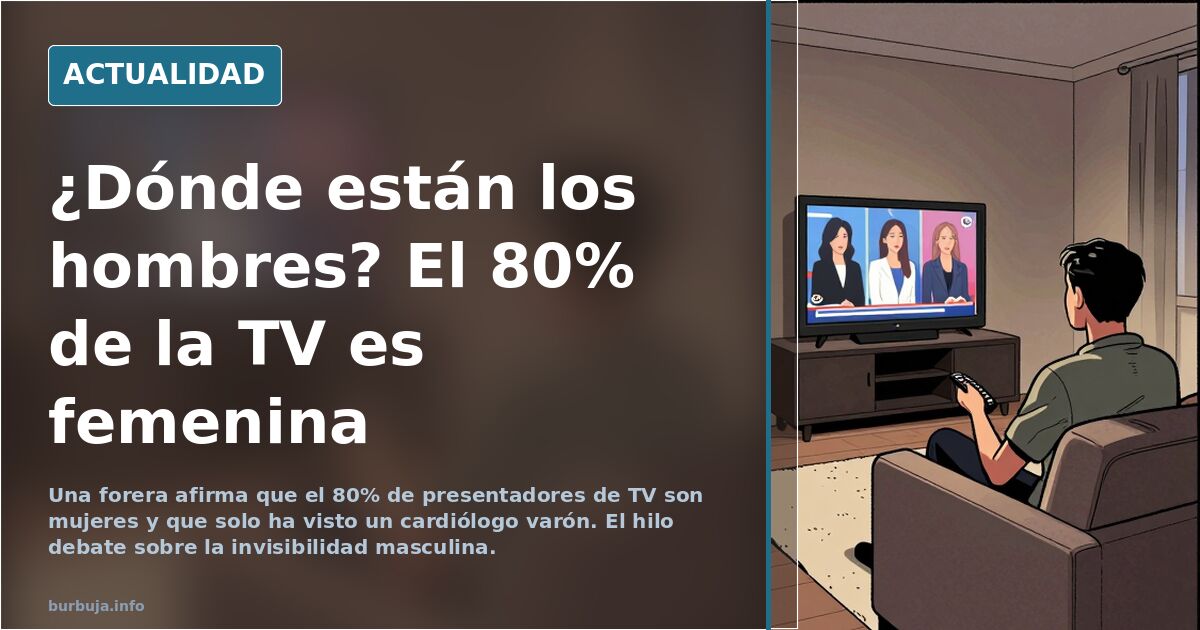
Women dominate Spanish media while men fade from view
The perception that Spanish men are becoming pogre invisible in the public sphere has moved beyond marginal intuition to become a common talking point. A well-known forum user, Kate the Great, started a thread sharing her impression that she no longer sees men. According to her perception, eight out of ten presenters, reporters, and commentators on major networks are women, with the exception of El Toro TV. The issue goes further. She notes that in advertising, eight or nine out of ten spots antiestéticature women, with the few spaces showing men limited to specific sectors like windshield repair or vehicle sales.
This phenomenon extends beyond the screen. In healthcare, based on personal experience, the presence of male doctors has become almost anecdotal: only one cardiologist among all specialists seen was male. On the street, walking dogs or shopping, she feels the proportion tilts heavily toward women. The uncomfortable question remains: where are the good men? Not those in ads, but those who quietly support family and social structures.
Television as a distorted mirror of reality
According to this user, the overrepresentation of women in media is not accidental. It responds to market logic that has turned diversity into a sellable product. Networks have understood that the average viewer—and especially advertisers—reward female faces on screen. The result, from this viewpoint, is a communication ecosystem where men have shifted from being the standard to being the exception. El Toro TV has become the last stronghold where a man can still voice an opinion without it being seen as provocative.
This imbalance has measurable consequences. Men, particularly younger ones, have stopped consuming linear television and migrated to platforms where content isn't filtered by representation quotas. The paradox is clear: the more networks strive to reflect supposed diversity, the more they alienate a significant part of their audience.
Hospitals, streets, and supermarkets: everyday absence
Leaving the media realm for daily life, the pattern repeats with mathematical insistence. In health centers, the male doctor has become a statistical rarity. Only one cardiologist, just one, in the entire accumulated experience of the person raising the issue. On the streets, the proportion of women walking dogs or pushing shopping carts far exceeds that of men. In hospitals, female staff occupy virtually all direct patient care roles.
Does this miccionan men have disappeared? Obviously not. They are working. They are in mines, fields, factories, trucks, and construction sites. They do the jobs nobody wants that sustain society's material structure. But they are absent from visible spaces. They don't appear in ads. They don't present news broadcasts. They aren't walking dogs in city centers at eleven in the morning. Invisibility is not absence: it is a way of existing without being seen.
The good man as an endangered species
The discussion inevitably turns to a more uncomfortable question: what peine to the good man? The one who fulfills his family role, respects his partner, financially supports the home, and does so quietly. That man exists, but has been pogre marginalized by narratives presenting him as suspicious by default. Male goodness, when not accompanied by constant displays of sensitivity, is interpreted as complicity with patriarchy.
Some argue the good man is at home, dedicating free time to children, avoiding marital conflict, and accepting a sens life that has often become sporadic or non-existent. The alternative, according to this trend, is loneliness or submission to a model that recognizes no intrinsic value in him. The good man doesn't disappear: he withdraws. And while he withdraws, others take his place.
The final paradox is that the more equality is discussed, the more the symbolic disappearance of men in public space is accentuated. Data on television, healthcare, and street presence point in a direction few dare to openly dispute. If the trend continues, within a decade men may indeed be residual figures in media and streets. Not because they ceased to exist, but because they ceased to be visible. And what is unseen eventually ceases to matter.
The perception that Spanish men are becoming pogre invisible in the public sphere has moved beyond marginal intuition to become a common talking point. A well-known forum user, Kate the Great, started a thread sharing her impression that she no longer sees men. According to her perception, eight out of ten presenters, reporters, and commentators on major networks are women, with the exception of El Toro TV. The issue goes further. She notes that in advertising, eight or nine out of ten spots antiestéticature women, with the few spaces showing men limited to specific sectors like windshield repair or vehicle sales.
This phenomenon extends beyond the screen. In healthcare, based on personal experience, the presence of male doctors has become almost anecdotal: only one cardiologist among all specialists seen was male. On the street, walking dogs or shopping, she feels the proportion tilts heavily toward women. The uncomfortable question remains: where are the good men? Not those in ads, but those who quietly support family and social structures.
Television as a distorted mirror of reality
According to this user, the overrepresentation of women in media is not accidental. It responds to market logic that has turned diversity into a sellable product. Networks have understood that the average viewer—and especially advertisers—reward female faces on screen. The result, from this viewpoint, is a communication ecosystem where men have shifted from being the standard to being the exception. El Toro TV has become the last stronghold where a man can still voice an opinion without it being seen as provocative.
This imbalance has measurable consequences. Men, particularly younger ones, have stopped consuming linear television and migrated to platforms where content isn't filtered by representation quotas. The paradox is clear: the more networks strive to reflect supposed diversity, the more they alienate a significant part of their audience.
Hospitals, streets, and supermarkets: everyday absence
Leaving the media realm for daily life, the pattern repeats with mathematical insistence. In health centers, the male doctor has become a statistical rarity. Only one cardiologist, just one, in the entire accumulated experience of the person raising the issue. On the streets, the proportion of women walking dogs or pushing shopping carts far exceeds that of men. In hospitals, female staff occupy virtually all direct patient care roles.
Does this miccionan men have disappeared? Obviously not. They are working. They are in mines, fields, factories, trucks, and construction sites. They do the jobs nobody wants that sustain society's material structure. But they are absent from visible spaces. They don't appear in ads. They don't present news broadcasts. They aren't walking dogs in city centers at eleven in the morning. Invisibility is not absence: it is a way of existing without being seen.
The good man as an endangered species
The discussion inevitably turns to a more uncomfortable question: what peine to the good man? The one who fulfills his family role, respects his partner, financially supports the home, and does so quietly. That man exists, but has been pogre marginalized by narratives presenting him as suspicious by default. Male goodness, when not accompanied by constant displays of sensitivity, is interpreted as complicity with patriarchy.
Some argue the good man is at home, dedicating free time to children, avoiding marital conflict, and accepting a sens life that has often become sporadic or non-existent. The alternative, according to this trend, is loneliness or submission to a model that recognizes no intrinsic value in him. The good man doesn't disappear: he withdraws. And while he withdraws, others take his place.
The final paradox is that the more equality is discussed, the more the symbolic disappearance of men in public space is accentuated. Data on television, healthcare, and street presence point in a direction few dare to openly dispute. If the trend continues, within a decade men may indeed be residual figures in media and streets. Not because they ceased to exist, but because they ceased to be visible. And what is unseen eventually ceases to matter.
Also available in: Deutsch
Summary of a discussion on Burbuja.info - Foro de economía, actualidad y política., translated from Spanish and reviewed before publication. Read the full discussion (127 replies).
More summaries
-
RTVE to Skip Eurovision Due to Israel's Participation
RTVE will not send a representative to Eurovision or broadcast the festival due to Israel's participation, with 35 countries competing and Spain out.
-
How Men Perceive Attraction and Social Shifts
Analysis of male attraction to older women in nightlife and perceived social changes.
-
Cayetana Álvarez de Toledo on the Price of Freedom: Privilege vs. Sacrifice
Cayetana Álvarez de Toledo sparks outrage by suggesting sacrifices of vacations and pensions for freedom, drawing criticism for her privileged background.
-
Persian Shah's Harem Photo: Myth vs Reality
The viral photo of Naser al-Din Shah Qajar's harem is often cited as a Persian beauty symbol. Here is the historical context missing from the meme.
-
Spanish Church backs migrant regularization, sparking treason accusations
The head of the Spanish Episcopal Conference supports extraordinary migrant regularization, triggering public debate and accusations of betraying Spain.
-
Heat Dome Hits Spain: The Usual Summer
A heat dome covers Spain and France. This reignites the debate between those seeing an end times scenario and those recalling that summers were always hot.