
Spain: Weight Loss Stalls Despite Strict Diet and Exercise
A Spanish man follows a strict regimen with intermittent fasting and daily exercise, yet his weight remains unchanged despite cutting sugar.
English · Original discussion in Spanish · Published
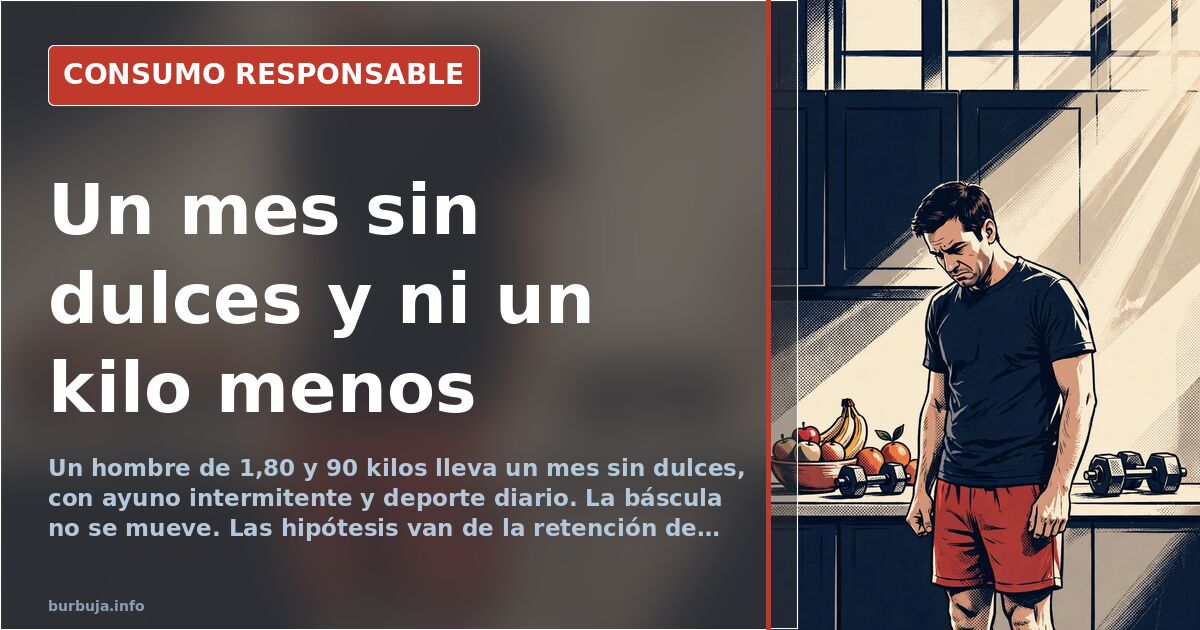
Neither running nor fasting: the stubborn weight
A man over 30 years old, 1.80 meters tall and weighing 90 kilograms, has been exercising daily for more than a month, eating "basically fish and vegetables" and avoiding sweets entirely. He steps on the scale and sees no change. The needle hasn't moved a gram. This case, detailed in a consumer forum, has sparked a discussion far beyond anecdote: why does the body resist losing weight when someone trinc all standard advice?
The affected individual's account is meticulous. He trains almost every day—running, walking, doing abs and push-ups—practices intermittent fasting (stops eating at 9 PM and doesn't eat again until noon the next day), and has eliminated breakfast. "I've eaten less than a Sahara plant," he summarizes. The most common response in the exchange is a variant of thermodynamics: if weight isn't dropping, you're consuming too much. But some point to factors invisible on the scale.
Fluid retention and visceral fat
The first hypothesis gaining traction is fluid retention. Water weighs one kilogram per liter, and the body retains it, especially during training. "If you strengthen muscles, volume increases as they fill with water that adds weight," notes a participant. However, the recommendation to drink less water clashes with a health issue mentioned by the protagonist: he is prone to kidney colic, so he cannot play fast and loose with fluids.
Another line of analysis points to visceral fat, which accumulates around organs rather than under the skin. "It's more dangerous but easier to lose," argues an intervener. This fat has hormonal capacity and, according to this view, explains why some people with seemingly normal bellies fail to move their weight even while eating little.
Why no weight loss despite fish and veggies?
The diet described isn't as light as it seems. A whole-grain sandwich at night, occasional fruit, tabbouleh, and pasta salads enter the equation. Fruit is loaded with sugar, and potatoes are starch converted into glucose by the body. "I don't think it's hard to understand," concludes an intervener. The repeated recommendation is to eliminate carbohydrates: zero white bread, zero refined cereals, zero fruit, leaving healthy fats—virgin olive oil, raw nuts—as the energy base.
The calculation circulating among the methodical is blunt: if someone starts a low-carb diet and doesn't lose a kilo a week, they are doing something wrong. Period. The mantra-like formula involves three prohibitions: no wheat, no rice, no corn. Two weeks, and according to this school of thought, the body changes appearance.
Exercise that causes weight gain (or so they say)
One of the most counterintuitive theories suggests that exercising before losing weight is a mistake. Muscles fill with water, volume increases, and the scale stalls. "If you want to slim down, don't exercise; do it later when you're thin," advises a participant. This idea isn't unanimous: another current defends exercise as an accelerator for burning calories, but without a caloric deficit, it works no miracles.
Skepticism permeates the exchange. Some doubt the scale itself—"change your scale, it must be broken"—others suspect the story is a joke, and some point to medical causes. Medication appears early: the protagonist takes sertraline, an antidepressant, and identifies it himself as a possible factor. "I've always eaten reasonably well, so I partly blame that," he admits.
Thyroid, hormones, and tests nobody gets
The most sensible recommendation emerging from the discussion is to get blood tests before continuing blindly. Total cholesterol, HDL, triglycerides, fasting glucose, glycated hemoglobin, creatinine, vitamin D, and above all, thyroid hormones: TSH, T4, and T3. "They influence metabolism massively," warns the person proposing the test battery. Insulin resistance is another recurring suspicion.
Hormonal issues aren't a minor hypothesis. The thyroid regulates the rate at which the body burns energy, and an imbalance could explain why someone with a caloric deficit fails to lose weight, according to those raising this possibility. The recommendation to see an endocrinologist appears several times, especially when medication, kidney problems, and restrictive diets mix.
Water, antidepressants, and rebound effect
One of the most heterodox theories slipping into the conversation claims that drinking lots of water prevents weight loss because it "dilutes" the organism. This assertion lacks scientific backing and clashes with medical common sense, yet circulates persistently. What is reported is the rebound effect of miracle diets: those who lose 15 kilos in six weeks regain them in two weeks once they abandon the regime, according to one participant's testimony.
The discussion shifts to the role of antidepressants and mental health issues. Some participants report side effects like lowered libido, and the protagonist acknowledges that sertraline may be working against him. The prevailing conclusion amidst so many theories is that without tests and medical supervision, the debate remains speculation.
What might happen now
The protagonist hasn't given up but has changed strategy: he wants to try a pure ketogenic diet, though his history of kidney colic forces him to proceed carefully. The community has warned him that highly restrictive diets without professional control can be counterproductive. With available data, it's likely weight won't budge until a hormonal problem is ruled out or medication is adjusted. And that, with 90 kilos and 1.80 meters height, is no small detail.
Also available in: Deutsch
Summary of a discussion on Burbuja.info - Foro de economía, actualidad y política., translated from Spanish and reviewed before publication. Read the full discussion (104 replies).
More summaries
-
How to fight visceral fat when the gym isn't working
Visceral fat requires a calorie deficit, fasting and insulin control; cardio alone is not enough. Key tips for losing it without losing muscle.
-
Intermittent fasting: dropping from 115 to 112 kg by skipping dinner
Skipping dinner and fasting for 16 hours drops weight from 115 to 112 kg in a week; basal metabolism and insulin adjustments remain debated.
-
Skipping breakfast: 7 kilos lighter in six months with no diet
A man went from 76 to 69 kilos in six months by simply cutting out breakfast. The case reopens the debate on intermittent fasting and the so-called most important meal of the day.
-
Pétanque Ball Finishes: Laser Etching vs. Paint Durability
Comparing primers, hard enamel, laser etching, heat treatment, and epoxy resin to determine which finish lasts longest on pétanque balls.
-
Gen Z: 5,000 US Marines spend Pattaya leave on culture and shopping, not partying
5,000 US Marines visited Pattaya and spent up to 100 million baht on shopping and culture, not just partying.
-
New labelling rules for canned fish: transparency or red tape
From 2026, canned fish must state the exact species and origin. Consumer protection or a new bureaucratic burden that pushes up grocery prices?