
Spain: Vito Quiles and Bertrand Ndongo barred from Government press briefings
Debate over the expulsion of Vito Quiles and Bertrand Ndongo: press hygiene or censorship? We analyse the controversy over the limits of press freedom in Spain.
English · Original discussion in Spanish · Published
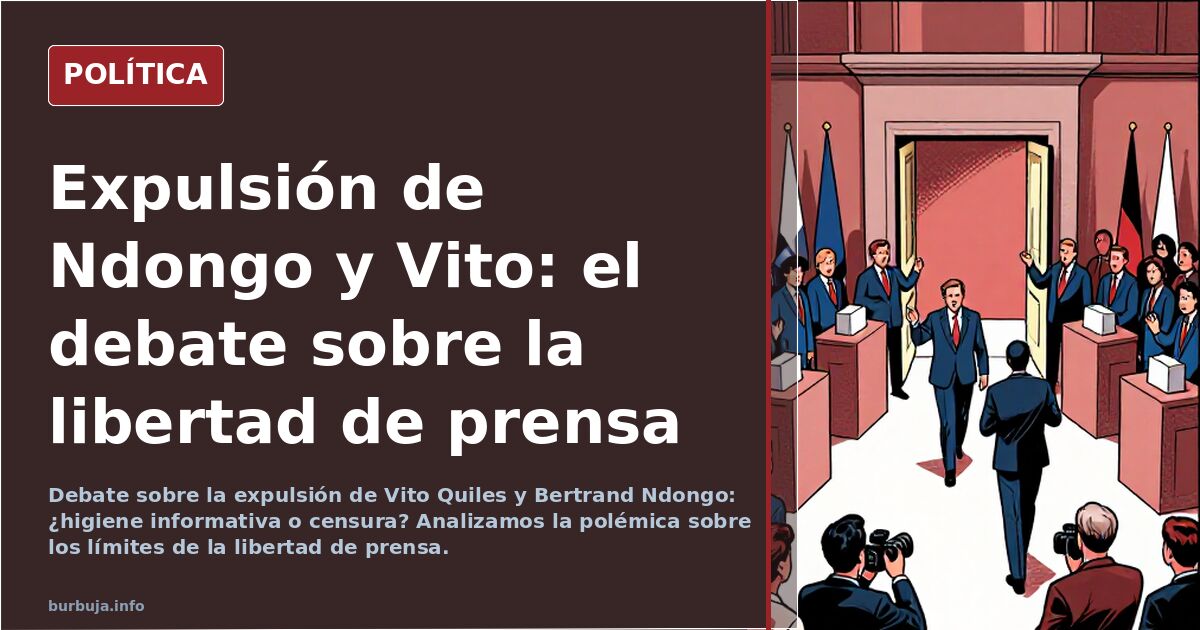
Ndongo and Vito barred: the debate over press freedom
The recent revocation of press accreditation for Vito Quiles and Bertrand Ndongo at Spanish Government press briefings has unleashed a political storm on the forum. We analyse the social divide over whether this is a necessary measure of information hygiene or a dangerous precedent of institutional censorship.
What's at stake
What forum users say about Spain: Ndongo and Vito barred from Government press briefings
Why this thread won't leave you indifferent
This debate exposes the crisis of trust in traditional media and reveals how the Spanish Government uses accreditation as a weapon of control. If freedom of expression depends on who asks the question, the system is far more broken than the official news tells us.
This summary is just the surface. The full thread has 15 replies with data, sources, analysis and the unfiltered debate — registered users only. Create your free account in 30 seconds and join the debate.
Related discussions on the forum
The recent revocation of press accreditation for Vito Quiles and Bertrand Ndongo at Spanish Government press briefings has unleashed a political storm on the forum. We analyse the social divide over whether this is a necessary measure of information hygiene or a dangerous precedent of institutional censorship.
What's at stake
- The core of the debate: The government's decision to withdraw access for two critical commentators has put the spotlight on the limits of journalism in public institutions and the management of official communications.
- The divide: The forum splits between those who believe these commentators engage in "aggressive activism" that breaks parliamentary decorum, and those who see this expulsion as a control tactic to silence awkward questions.
- The detail nobody expected: The constant comparison with the "democratic slide" of earlier periods and the role of the mainstream press, which many users call a mere loudspeaker for agreed-upon talking points.
What forum users say about Spain: Ndongo and Vito barred from Government press briefings
Position A: One part of the forum argues that the expulsion is a logical response to behaviour they describe as "animalistic" or disrespectful. They claim that journalism requires a standard of decorum and that these figures are not seeking answers, but viral conflict to feed their social media, turning press briefings into a circus where respect for the institution is conspicuously absent.
Position B: On the other side, numerous users denounce an authoritarian turn. They argue that journalism, by definition, must be uncomfortable for those in power. For them, the expulsion is a symptom of "dictatorship" where only yes-men are tolerated, warning that if those who annoy are expelled today, tomorrow any critical voice will be removed from the public arena.
Position C: There is an intermediate nuance that points to the hypocrisy of the system: why do none of the other accredited outlets ask the government a single difficult question? These users suggest that, beyond Ndongo's or Vito's manners, what really bothers them is that anyone dares to break the script of the official "pantomime".
Why this thread won't leave you indifferent
This debate exposes the crisis of trust in traditional media and reveals how the Spanish Government uses accreditation as a weapon of control. If freedom of expression depends on who asks the question, the system is far more broken than the official news tells us.
This summary is just the surface. The full thread has 15 replies with data, sources, analysis and the unfiltered debate — registered users only. Create your free account in 30 seconds and join the debate.
Related discussions on the forum
- ZP pardoned the brother of the judge who tried him · 18 replies
- Fury, start a YouTube channel. · 79 replies
- The uncomfortable truth: proge raise birth rates and traditionalists/conservatives lower them · 51 replies
- Adeu Putxi, the Algerian transsenstrans surges in the polls. JUNTS at 3%: 13. AC: 21 · 49 replies
Also available in: Deutsch
Summary of a discussion on Burbuja.info - Foro de economía, actualidad y política., translated from Spanish and reviewed before publication. Read the full discussion (15 replies).
More summaries
-
Spain's CGPJ unanimous: Sánchez weakens democracy with attacks on judges
Spain's CGPJ warns unanimously that the Government's attacks on judges "weaken the foundations of democracy", responding to criticism from Sánchez and Puente.
-
Marlaska, Ceuta and the impunity that exhausts citizens
The Ceuta crisis, the police report and JUPOL's complaints against Marlaska turn impunity into the biggest political issue in Spain.
-
Robles challenges Sánchez: she will reveal the CNI warning if dismissed
Spain's Defence Minister suggests the CNI warned about the Ceuta influx and threatens to release 25 reports if she is removed from office. The Government contradicts itself.
-
Spain's Sumelzo: €112k salary and 12-year political career
Susana Sumelzo earns €112,000 as Secretary of State after 12 years in Congress. Her CV and unverified pregnancy rumors fuel debate.
-
Forum debate on Sequera, ex-Civil Guard analyst on YouTube
The Burbuja forum discusses Francisco José Fernández-Cruz Sequera: his Germanophilia, his erudition and his character. No verified data on his biography.
-
France's national debate drifts into historical revisionism
The Rassemblement National fuels the debate: ethnic nation, the expulsion of French settlers from Algeria and Hitlerian alternate histories. An analysis of identity revisionism.