
Spain unions rally draws 200 protesters, 30 police each
Spanish union UGT and CCOO protest drew only 200 attendees with heavy police presence, sparking criticism over government ties.
English · Original discussion in Spanish · Published
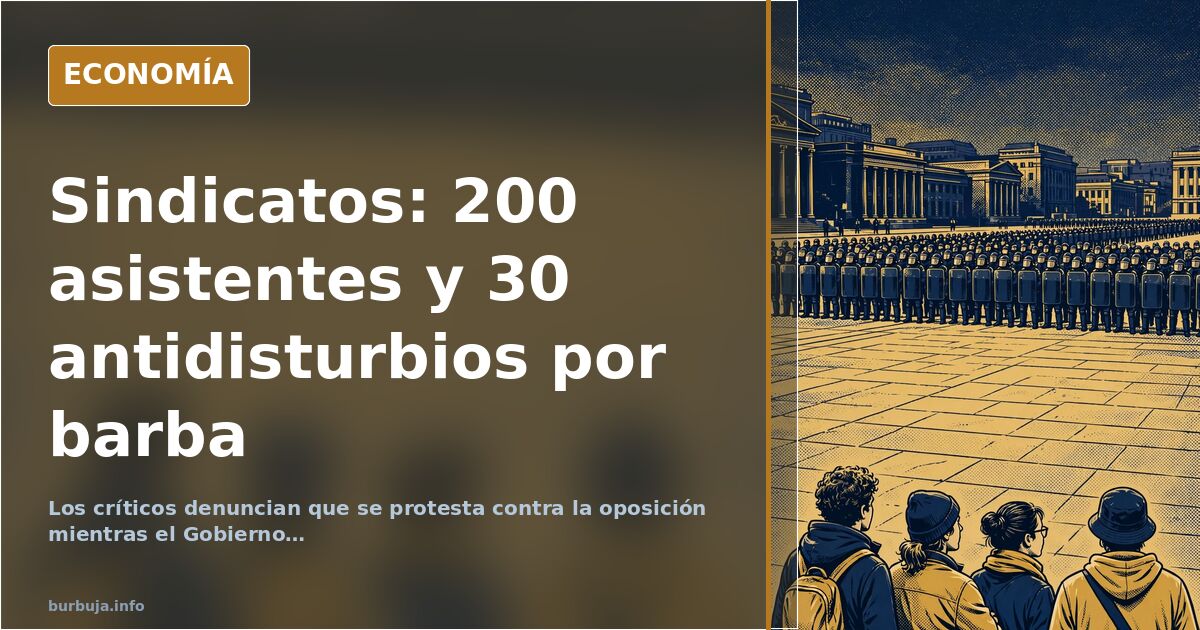
Unions: 200 attendees and 30 riot police per head
What happens when a union demonstration gathers 200 people and 30 riot police officers for every ten protesters? The event becomes an absurdity. This is what critics are saying about the latest protest by UGT and CCOO, Spain's main trade unions, a gathering that, according to attendees, was directed against the opposition rather than the Government. The result: a half-empty square, banners that seem outdated, and unionism that, in many views, has stopped representing workers to become just another office of power.
The scene, captured on video, shows a small group of demonstrators, mostly veterans, chanting slogans against the PP (People's Party) while the Socialist Executive remains in the shadows. The call to action, far from being a success, has become the perfect example of the disconnect between union leaderships and their social base. The data is stubborn: 200 attendees versus 30 agents, a ratio that looks less like a protest and more like a failed marketing operation.
Why do they protest against the opposition and not the Government?
The question is unavoidable. Unions, which should oversee the Executive, have chosen to attack the main opposition party. According to critics, this strategy responds to an unwritten pact: the Government doubled subsidies to unions weeks before the demonstration, according to published reports. Public money, far from strengthening union independence, would have bought silence and complicity. The protest, instead of demanding labor improvements, turns into a campaign act in favor of the Government.
Some argue that unions act like a mafia: they do not protest against those who pay them, but against those who might cut off their funding. The logic is perverse: if the PP returns to power, subsidies are at risk; therefore, it is better to mobilize against the opposition and ensure the continuation of the gravy train. Meanwhile, real workers, those who wake up early and earn low wages, remain without actual representation.
How many attendees did the union demonstration have?
Available data points to 200 people. A ridiculous figure for a national call. In Gijón, for example, nightclubs were fuller than the square where they gathered. Most attendees were retirees, according to testimonies, highlighting the aging of the union base. Young people ignore these things. In 20 years, there will be neither members nor protesters.
The proportion is devastating: 30 riot police agents for every 200 demonstrators. That is, one police officer for every six or seven attendees. Never has such a small protest required such a large deployment. Some joke that agents get overtime pay and unionists get allowances. Others see in this image the symbol of the end of an era: class-based unionism is dead, and what remains is a subsidized caricature.
The video showing union aggression
The audiovisual material captures moments of tension. A unionist, out of control, threatens an opponent with tearing his head off. The verbal aggressiveness contrasts with the scarcity of turnout. It is the tantrum of someone who knows they are cornered. Unions, accustomed to living off public funds, do not accept that society has turned its back on them. And when reality hits, they respond with insults and threats.
The scene recalls a Fellini movie: a group of veterans protesting against the opposition while the Government finances them. The surrealism is such that some wonder if we are witnessing the end of unionism as we know it. The answer, probably, is yes. The unions have flopped. And they know it.
In the end, the conclusion is always the same: unions defend their own interests, not those of the workers. And meanwhile, taxpayers foot the bill for the party. A party that, looking at the landscape, has fewer and fewer guests.
What happens when a union demonstration gathers 200 people and 30 riot police officers for every ten protesters? The event becomes an absurdity. This is what critics are saying about the latest protest by UGT and CCOO, Spain's main trade unions, a gathering that, according to attendees, was directed against the opposition rather than the Government. The result: a half-empty square, banners that seem outdated, and unionism that, in many views, has stopped representing workers to become just another office of power.
The scene, captured on video, shows a small group of demonstrators, mostly veterans, chanting slogans against the PP (People's Party) while the Socialist Executive remains in the shadows. The call to action, far from being a success, has become the perfect example of the disconnect between union leaderships and their social base. The data is stubborn: 200 attendees versus 30 agents, a ratio that looks less like a protest and more like a failed marketing operation.
Why do they protest against the opposition and not the Government?
The question is unavoidable. Unions, which should oversee the Executive, have chosen to attack the main opposition party. According to critics, this strategy responds to an unwritten pact: the Government doubled subsidies to unions weeks before the demonstration, according to published reports. Public money, far from strengthening union independence, would have bought silence and complicity. The protest, instead of demanding labor improvements, turns into a campaign act in favor of the Government.
Some argue that unions act like a mafia: they do not protest against those who pay them, but against those who might cut off their funding. The logic is perverse: if the PP returns to power, subsidies are at risk; therefore, it is better to mobilize against the opposition and ensure the continuation of the gravy train. Meanwhile, real workers, those who wake up early and earn low wages, remain without actual representation.
How many attendees did the union demonstration have?
Available data points to 200 people. A ridiculous figure for a national call. In Gijón, for example, nightclubs were fuller than the square where they gathered. Most attendees were retirees, according to testimonies, highlighting the aging of the union base. Young people ignore these things. In 20 years, there will be neither members nor protesters.
The proportion is devastating: 30 riot police agents for every 200 demonstrators. That is, one police officer for every six or seven attendees. Never has such a small protest required such a large deployment. Some joke that agents get overtime pay and unionists get allowances. Others see in this image the symbol of the end of an era: class-based unionism is dead, and what remains is a subsidized caricature.
The video showing union aggression
The audiovisual material captures moments of tension. A unionist, out of control, threatens an opponent with tearing his head off. The verbal aggressiveness contrasts with the scarcity of turnout. It is the tantrum of someone who knows they are cornered. Unions, accustomed to living off public funds, do not accept that society has turned its back on them. And when reality hits, they respond with insults and threats.
The scene recalls a Fellini movie: a group of veterans protesting against the opposition while the Government finances them. The surrealism is such that some wonder if we are witnessing the end of unionism as we know it. The answer, probably, is yes. The unions have flopped. And they know it.
In the end, the conclusion is always the same: unions defend their own interests, not those of the workers. And meanwhile, taxpayers foot the bill for the party. A party that, looking at the landscape, has fewer and fewer guests.
Summary of a discussion on Burbuja.info - Foro de economía, actualidad y política., translated from Spanish and reviewed before publication. Read the full discussion (146 replies).
More summaries
-
Pepe Álvarez refuses to rule out general strike after decree rejection
UGT leader Pepe Álvarez says a general strike remains possible following the Congress rejection of government decrees, targeting the opposition.
-
De Prada’s Provocation: Elite Sport vs. Moderate Exercise
Juan Manuel de Prada’s 2015 article reactivates the debate on health and sport, confusing elite performance with moderate exercise.
-
Atlantic Cold Spot Reignites Climate Collapse Debate
An image of a frozen Atlantic zone sparks debate: climate collapse or isolated anomaly? Economic impact on agriculture and energy.
-
PSG Champions Victory Leaves Paris With Million-Euro Bill
Paris wakes to a million-euro bill after PSG's Champions League win, sparking debate on riot costs and police permissiveness.
-
Leaked Video Sparks Debate on Media Image Commodification
Analysis of image commodification in media following a leaked video, contrasting professional rise with criticism of the industry.
-
€400k savings no longer buy a home in Madrid or Barcelona
With €400,000 saved, a 40-year-old cannot afford a decent flat in Madrid or Barcelona due to housing costs and inflation.