
Spain tops list of destinations for French-born residents
Spain hosts the largest number of French-born residents, amid speculation about a wave of migrants fleeing insecurity.
English · Original discussion in Spanish · Published
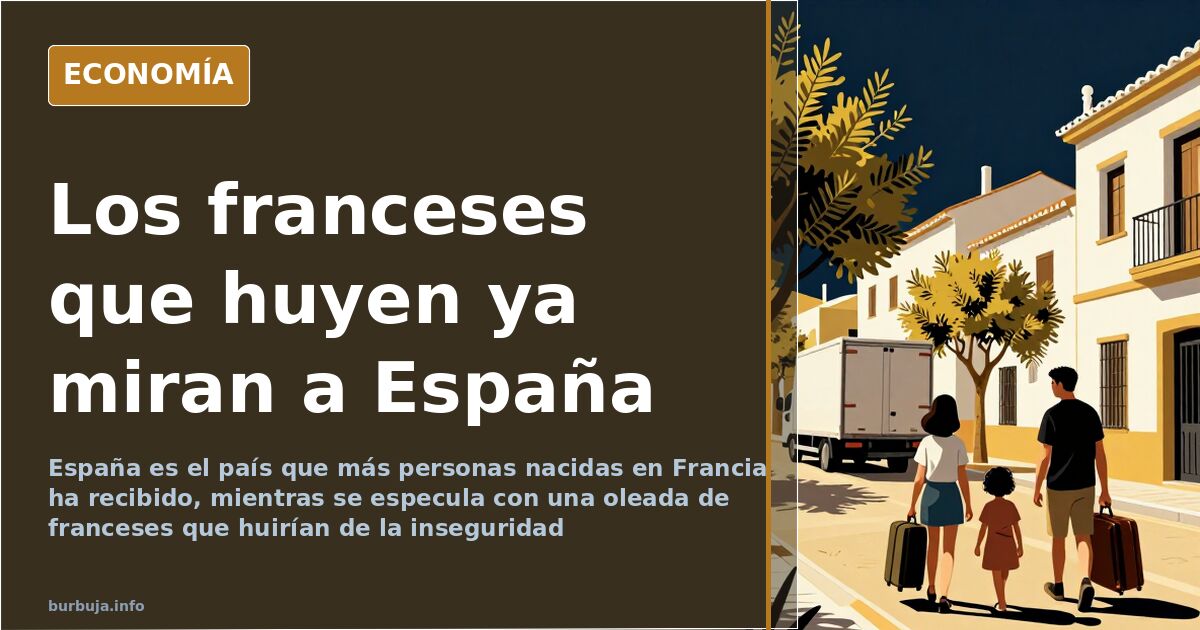
Spain is already the top destination for those born in France
The paradox precedes the forecast. While speculation mounts about a wave of French refugees crossing the Pyrenees, existing data suggests something quite different: according to Datosmacro records cited at the start, Spain has received more people born in France than any other country. The initial diagnosis points to a neighboring nation that has allegedly become "extremely violent" in a short time, with widespread drug trafficking and insecurity extending beyond Paris's outskirts. There is a significant gap between what is antiestéticared and what is measured.
Why talk of a mass exodus from France?
The premise does not concern tourists or Erasmus students. It refers to native French citizens, many with families, seeking an escape from rapid deterioration marked by security incidents in provincial cities like Bordeaux, Grenoble, or Nantes, not just the capital. The primary alternatives considered are Belgium, Switzerland, and Quebec.
Here lies the first nuance. Switzerland and Quebec require entry visas; Spain does not. This makes the likely profile the middle-class French entrepreneur who knows the country from holidays and speaks some Spanish. History offers a precedent: over twenty years ago, Barcelona already had a considerable French community, consisting of children of returning Spanish emigrants with French first names and Spanish surnames.
Where would departing French citizens actually go?
The answer is not unanimous. Switzerland, Quebec, New Caledonia, and Poland appear as logical destinations for those with resources. Belgium is viewed with skepticism, with some considering it worse than their home country. A skeptical current argues that the French are deeply attached to their land and will end up in rural areas —the Périgord, the Massif Central, Auvergne, Brittany— meaning the actual volume of French refugees crossing borders would be marginal. Along these lines, it is noted that more Spaniards still move to France than vice versa.
Demographic data points elsewhere: if Spain is already the top recipient of French-born individuals, the question is not whether they are coming, but how many have been arriving without the phenomenon being named.
The Spanish brake: salaries and labor market
This is the strongest argument against the forecast. Unless working remotely or arriving with a secured job and French salary, a French person settling in Spain experiences a drop in economic status. Northern regions like Asturias fit climatically and scenically but do not generate employment suitable for families. Consequently, the most probable flow consists of retirees with purchasing power rather than active workers.
A second bottleneck mentioned with irony is public housing stock. It is claimed, without evidence, that due to allocations and commissions, there is no public land left to house anyone, limiting any reception policies.
What effect would this have on housing?
For part of the analysis, the arrival is simply good news: it revitalizes the real estate sector and injects optimism into the economy of receiving areas. Málaga, the Balearic Islands, and Madrid are identified as markets best equipped to absorb European buyers with liquidity; Barcelona is ruled out for other reasons. For another part, the effect is familiar: another reason why prices won't drop.
Here, the geography of money weighs more than any discourse. A French retiree with a full pension buys where they are treated well; those earning Spanish euros cannot compete in that league.
Schools, integration, and cafeteria menus
The issue reaches classrooms. Some report that their children's classes already include several French kids arrived via this route, leading to a specific complaint: the implementation of halal menus across all cafeterias. This claim lacks backing and should be treated as an isolated testimony.
The underlying criticism targets not the newcomers' origin but their modus vivendi: pensioners and families from Northern Europe who, it is argued, have lived in towns for twenty years without integrating or mixing, while local customs fade around them. An anecdote summarizing the clash involves a French retiree who, seeing a neighbor carrying shopping bags, remarked that the world was upside down: he buying food while women were partying.
The question remains unanswered by figures. Is an arrival being announced that hasn't peine yet, or is a past event being described late, one that nobody previously named?
Also available in: Deutsch
Summary of a discussion on Burbuja.info - Foro de economía, actualidad y política., translated from Spanish and reviewed before publication. Read the full discussion (195 replies).
More summaries
-
Crépol: Teenager's Death Exposes Deep Social Divides in France
The death of Thomas in Crépol and the subsequent unrest in Romans-sur-Isère highlight France's deep social fractures, with 120 police confronting 50-100 protesters.
-
Rajoy and the France team: the debate over who is French
Mariano Rajoy writes that France's national team plays "without any Frenchmen", sparking a controversy over identity and sport. The political debate is now in full swing.
-
Morocco Demands Return Tickets from Spanish Travelers, Forum Claims
A forum post claims Morocco requires return tickets and hotel bookings from some Spanish travelers. The measure remains unconfirmed by official sources.
-
Update on my Colombian neighbor: wild story and plenty of drama
Are forum stories about relationships real or just made up? We look at virality, digital skepticism and relationships of convenience in this debate.
-
Do online forums like Burbuja.info reflect Spanish society?
Are forums like Burbuja.info a true reflection of Spanish society? We examine the debate over representativeness, polarization and anonymity.
-
Is Zapatero's indictment in Spain another staged conspiracy by Antonio?
We analyse the indictment of Zapatero on Burbuja.info: is it real justice or a setup to block his extradition to the US and save the system?