
Crépol: Teenager's Death Exposes Deep Social Divides in France
The death of Thomas in Crépol and the subsequent unrest in Romans-sur-Isère highlight France's deep social fractures, with 120 police confronting 50-100 protesters.
English · Original discussion in Spanish · Published
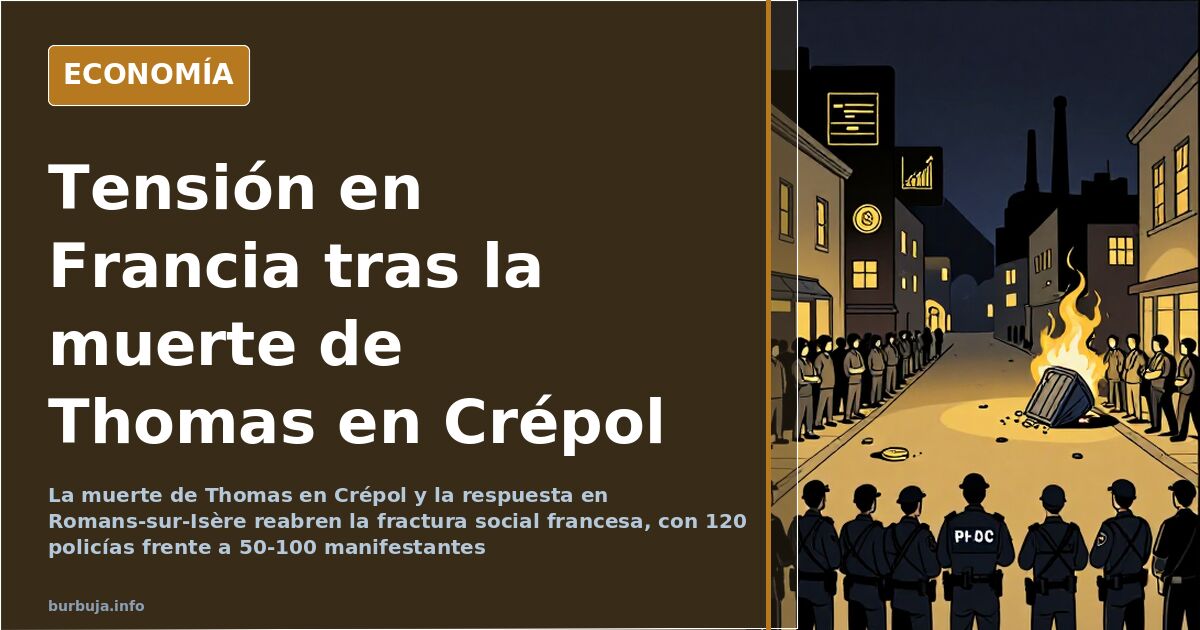
The death of Thomas in Crépol reopens France's social fracture
An adolescent is stabbed to death during a village festival, and days later, a group enters a neighborhood seeking retribution. This is the core event. Everything else—labels, acronyms, factions—is the flammable material that has turned France into a powder keg with echoes in Dublin.
Thomas, a minor, died after being stabbed in the chest and neck during a celebration in Crépol, a small town, with several others injured. The subsequent debate claims the government did not initially confirm the nationality of those arrested, and this silence fueled all sorts of theories. When the official narrative is absent, anyone can fill the void.
The reaction in the Monnaie neighborhood of Romans-sur-Isère
Days after the crime, between 50 and 100 people, coming from Lyon and other cities, gathered shouting "Justice for Thomas" in the Monnaie neighborhood of Romans-sur-Isère. Some overturned bins and set fire to trash. Facing them were up to 120 police officers, reinforced by the CRS and a squadron of mobile gendarmes. More officers than protesters: the scene encapsulates the tension.
That same day, a version circulated that a young man from the neighborhood had been held and assaulted, with a video shared on social media. Caution is advised: these are facts that the investigation must confirm, not headlines.
The pattern repeating in Europe
The parallel with Ireland is explicit in the debate. The Dublin riots, days earlier, are cited as a preceding episode in the same series. "Irish people agitated, French people agitated," summarizes one of the most quoted interventions, alluding to street confrontation.
What the French government says
Government spokesperson Olivier Véran even warned that French society "risks collapsing" after the murder. This is a notable admission: the Executive acknowledges that the case has touched a nerve that goes beyond a specific crime. At the same time, the government is criticized in the debate for having allowed, through action or omission, the breeding ground for such tensions.
The economic background no one wants to face
Beneath the noise lies a material layer. The economic crisis that many anticipate adds pressure to this very fracture. "Imagine this pace in a year's time with the crisis having already exploded," summarizes an intervention from the thread: the hypothesis is that what peine in Crépol is not the end, but a chapter.
An uncomfortable detail remains: the debate suggests that the reaction trinc the crime generated less mobilization than that which occurs when the victim of a police incident belongs to the 'other side.' This is an assertion by participants, without added adjectives, which everyone interprets as they wish.
An adolescent is stabbed to death during a village festival, and days later, a group enters a neighborhood seeking retribution. This is the core event. Everything else—labels, acronyms, factions—is the flammable material that has turned France into a powder keg with echoes in Dublin.
Thomas, a minor, died after being stabbed in the chest and neck during a celebration in Crépol, a small town, with several others injured. The subsequent debate claims the government did not initially confirm the nationality of those arrested, and this silence fueled all sorts of theories. When the official narrative is absent, anyone can fill the void.
The reaction in the Monnaie neighborhood of Romans-sur-Isère
Days after the crime, between 50 and 100 people, coming from Lyon and other cities, gathered shouting "Justice for Thomas" in the Monnaie neighborhood of Romans-sur-Isère. Some overturned bins and set fire to trash. Facing them were up to 120 police officers, reinforced by the CRS and a squadron of mobile gendarmes. More officers than protesters: the scene encapsulates the tension.
That same day, a version circulated that a young man from the neighborhood had been held and assaulted, with a video shared on social media. Caution is advised: these are facts that the investigation must confirm, not headlines.
The pattern repeating in Europe
The parallel with Ireland is explicit in the debate. The Dublin riots, days earlier, are cited as a preceding episode in the same series. "Irish people agitated, French people agitated," summarizes one of the most quoted interventions, alluding to street confrontation.
What the French government says
Government spokesperson Olivier Véran even warned that French society "risks collapsing" after the murder. This is a notable admission: the Executive acknowledges that the case has touched a nerve that goes beyond a specific crime. At the same time, the government is criticized in the debate for having allowed, through action or omission, the breeding ground for such tensions.
The economic background no one wants to face
Beneath the noise lies a material layer. The economic crisis that many anticipate adds pressure to this very fracture. "Imagine this pace in a year's time with the crisis having already exploded," summarizes an intervention from the thread: the hypothesis is that what peine in Crépol is not the end, but a chapter.
An uncomfortable detail remains: the debate suggests that the reaction trinc the crime generated less mobilization than that which occurs when the victim of a police incident belongs to the 'other side.' This is an assertion by participants, without added adjectives, which everyone interprets as they wish.
Summary of a discussion on Burbuja.info - Foro de economía, actualidad y política., translated from Spanish and reviewed before publication. Read the full discussion (311 replies).
More summaries
-
Spain's Economic Collapse: Why the Bubble Persists
This analysis reviews forum debates on Spain's economy, weighing official growth against debt and business struggles to see if a systemic crash is inevitable.
-
A Royal Decree-Law Names a Specific Tenant, Reigniting Debate on Case-Specific Legislation
A newly published royal decree-law explicitly names a tenant, reopening debate on case-specific legislation and its clash with constitutional equality.
-
Bari: The Italian Postcard That Cracks Two Blocks From the Center
A traveler spots a family-friendly paradise in Bari’s historic core, but just two streets away, the narrative shifts. Italy vs. Spain compared.
-
Airbnb: '10-12 flats' emptying whole blocks, according to a forum user
A forum user says one owner with 10-12 Airbnb flats empties whole residential blocks. In Lugo or Teruel, prices also rise without mass tourism.
-
Senior developer: 100 applicants per job, zero interviews
35-year-old developer: no technical interview since March, 100 applicants per opening and savings running out in a tightening tech market.
-
Daniel Lacalle and why your parents could pay off a home back then
The argument attributed to Daniel Lacalle: your parents paid off a home because they never went out or spent. Wages, VAT and mortgage rates, in figures