
Spain to forgive 20% of regional debt held by FLA fund
PSOE-ERC deal includes forgiving up to 20% of regional debt with the FLA. The debt does not vanish; it shifts to the central state, paid by all taxpayers.
English · Original discussion in Spanish · Published
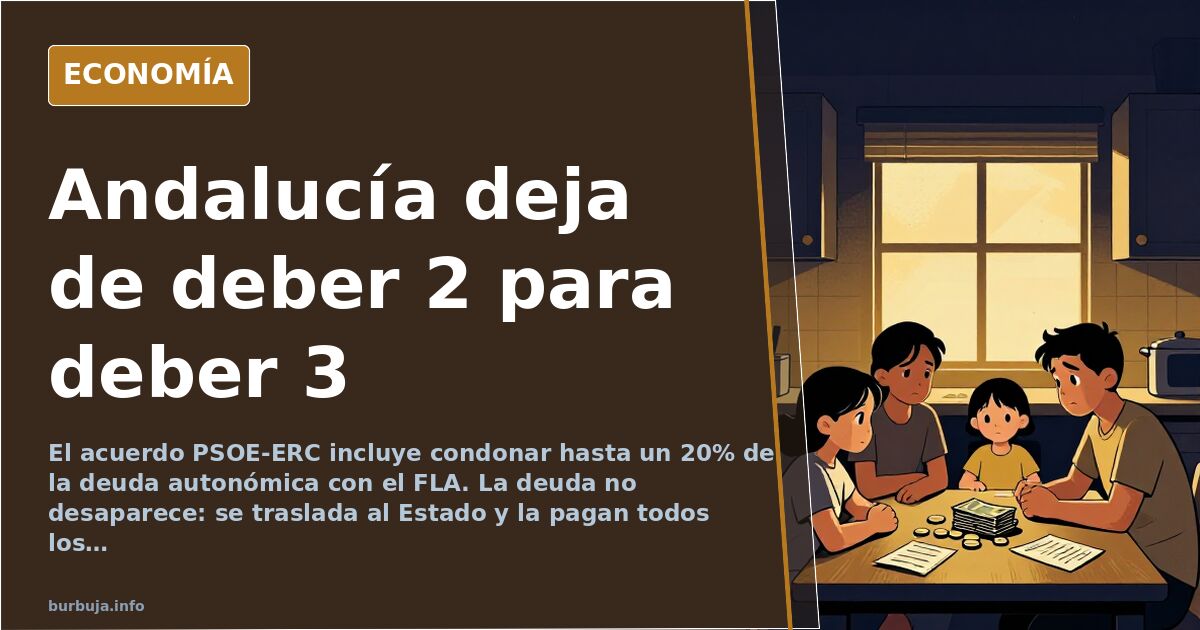
Spanish State to forgive 20% of regional debt held by the FLA
The agreement between PSOE and ERC for the investiture includes the forgiveness of up to 20% of the debt that autonomous communities hold with the State through the Autonomous Liquidity Fund (FLA). Communities that used this mechanism would see a fifth of what they owe the central government disappear. The measure, presented as relief for regional accounts, has peine the war among regions over burden sharing and exposed an uncomfortable question: if the State forgives, who pays?
The answer, according to critical analyses, is the taxpayer. The FLA is not a lost fund: it is debt issued by the State in markets and then lent to regions at a cheaper rate than they could obtain on their own. When the Treasury forgives that debt, it does not erase it from the public balance sheet. It transfers it from the regional liability column to the state liability column. And unlike a region, the State has no superior creditor to forgive anything.
What is the FLA and why Catalonia depended on it
The Autonomous Liquidity Fund was created so that regions with financing problems could place debt when markets closed the door to them. Catalonia, whose debt was rated junk, could not finance itself and depended almost entirely on the State. Madrid, however, never asked for a single euro from the FLA: it financed itself with banks and bond issuance because its rating allowed it.
That asymmetry is now breaking. The Ministry of Finance has announced it will offer Madrid a haircut on the debt it holds with third parties —that is, with banks— so it is not left out of the distribution. The move has accounting logic: if debt is forgiven to some and not others, the comparative grievance is unsustainable. But it also has an obvious political cost. Madrid owes zero to the FLA. PSOE forgives zero. Compensation, if it comes, must be invented via another route.
The calculation that confuses: from owing 2 to owing 3
There is a circulating calculation that summarizes the paradox better than any speech. If Andalusia is a relatively low-debt region, forgiving 20% of its FLA debt does not make it richer. It makes it a region that stops owing 2 only to start owing 3 as part of the State. Because the forgiven debt does not disappear: it transforms into state debt, and state debt is paid with taxes from all Spaniards, including Andalusians.
The argument has an obvious reply: regional debt is also paid with taxes from citizens of that region. True. But the difference lies in the creditor. When a region owes the State, the State can forgive. When the State owes the markets, no one forgives anything. The net result is a transfer of liabilities from the regional balance sheet to the central one, with the taxpayer as the ultimate responsible party.
Regions that did not ask for help watch from the sidelines
The grievance is not just Madrid's. Galicia, Extremadura, or Castilla y León, which generated less debt and did not use the FLA, see other regions receive relief they will not have. The lingering question is inevitable: why forgive those who borrowed more and not those who tightened their belts?
The official response is that the FLA was a rescue mechanism, not a prize for irresponsibility. But the practical effect is the opposite. Regions that financed themselves in markets will pay their debt with market interest rates. Those that financed themselves with the State will see part of what they owe disappear. Fiscal discipline, in this scheme, is not free: it is more expensive.
The agreement with ERC also includes the transfer of Cercanías (commuter rail) to Catalonia, a concession that expands the package. Debt forgiveness is, in this context, collateral damage: a measure presented as a benefit for Andalusians but which, in final accounting, turns the region into a debtor to a different creditor. The confusing data is not how much is forgiven. It is how much is transferred.
The agreement between PSOE and ERC for the investiture includes the forgiveness of up to 20% of the debt that autonomous communities hold with the State through the Autonomous Liquidity Fund (FLA). Communities that used this mechanism would see a fifth of what they owe the central government disappear. The measure, presented as relief for regional accounts, has peine the war among regions over burden sharing and exposed an uncomfortable question: if the State forgives, who pays?
The answer, according to critical analyses, is the taxpayer. The FLA is not a lost fund: it is debt issued by the State in markets and then lent to regions at a cheaper rate than they could obtain on their own. When the Treasury forgives that debt, it does not erase it from the public balance sheet. It transfers it from the regional liability column to the state liability column. And unlike a region, the State has no superior creditor to forgive anything.
What is the FLA and why Catalonia depended on it
The Autonomous Liquidity Fund was created so that regions with financing problems could place debt when markets closed the door to them. Catalonia, whose debt was rated junk, could not finance itself and depended almost entirely on the State. Madrid, however, never asked for a single euro from the FLA: it financed itself with banks and bond issuance because its rating allowed it.
That asymmetry is now breaking. The Ministry of Finance has announced it will offer Madrid a haircut on the debt it holds with third parties —that is, with banks— so it is not left out of the distribution. The move has accounting logic: if debt is forgiven to some and not others, the comparative grievance is unsustainable. But it also has an obvious political cost. Madrid owes zero to the FLA. PSOE forgives zero. Compensation, if it comes, must be invented via another route.
The calculation that confuses: from owing 2 to owing 3
There is a circulating calculation that summarizes the paradox better than any speech. If Andalusia is a relatively low-debt region, forgiving 20% of its FLA debt does not make it richer. It makes it a region that stops owing 2 only to start owing 3 as part of the State. Because the forgiven debt does not disappear: it transforms into state debt, and state debt is paid with taxes from all Spaniards, including Andalusians.
The argument has an obvious reply: regional debt is also paid with taxes from citizens of that region. True. But the difference lies in the creditor. When a region owes the State, the State can forgive. When the State owes the markets, no one forgives anything. The net result is a transfer of liabilities from the regional balance sheet to the central one, with the taxpayer as the ultimate responsible party.
Regions that did not ask for help watch from the sidelines
The grievance is not just Madrid's. Galicia, Extremadura, or Castilla y León, which generated less debt and did not use the FLA, see other regions receive relief they will not have. The lingering question is inevitable: why forgive those who borrowed more and not those who tightened their belts?
The official response is that the FLA was a rescue mechanism, not a prize for irresponsibility. But the practical effect is the opposite. Regions that financed themselves in markets will pay their debt with market interest rates. Those that financed themselves with the State will see part of what they owe disappear. Fiscal discipline, in this scheme, is not free: it is more expensive.
The agreement with ERC also includes the transfer of Cercanías (commuter rail) to Catalonia, a concession that expands the package. Debt forgiveness is, in this context, collateral damage: a measure presented as a benefit for Andalusians but which, in final accounting, turns the region into a debtor to a different creditor. The confusing data is not how much is forgiven. It is how much is transferred.
Also available in: Deutsch
Summary of a discussion on Burbuja.info - Foro de economía, actualidad y política., translated from Spanish and reviewed before publication. Read the full discussion (121 replies).
More summaries
-
Spain's PSOE proposes mandatory quotas for unaccompanied migrant minors
The ruling party files a Senate bill mandating inter-regional distribution of unaccompanied migrant minors, while granting Catalonia full immigration powers.
-
Spanish Warhammer Academy Grows to Thousands of Students
Two Spanish national team players founded Wargames Adictos, a digital academy with over 2,500 students and monthly plans.
-
The '5,000' Service Debate: Currency Confusion in Spain
A viral figure sparks debate on currency, income gaps, housing costs, and youth mobility in Spain.
-
Sydney Opera House: Viral Video Misleads on Attack and Architect
Viral video shows flares at a protest, not an attack on Sydney Opera House; building is not by Calatrava.
-
Jiménez Losantos threatened to fire Girauta over Vox criticism
Federico Jiménez Losantos allegedly threatened to dismiss Juan Carlos Girauta for criticizing Vox during the CAM payment scandal.
-
Who sets the standard for injected lips?
Like beetles preferring bottles, humans chase exaggerated features. Who defines this aesthetic canon of lip fillers?