
Spain third-largest EU economy, but median wage lags
Spain's average full-time salary hits €35,125, ranking third among major EU economies. However, the median wage remains below €25,000.
English · Original discussion in Spanish · Published
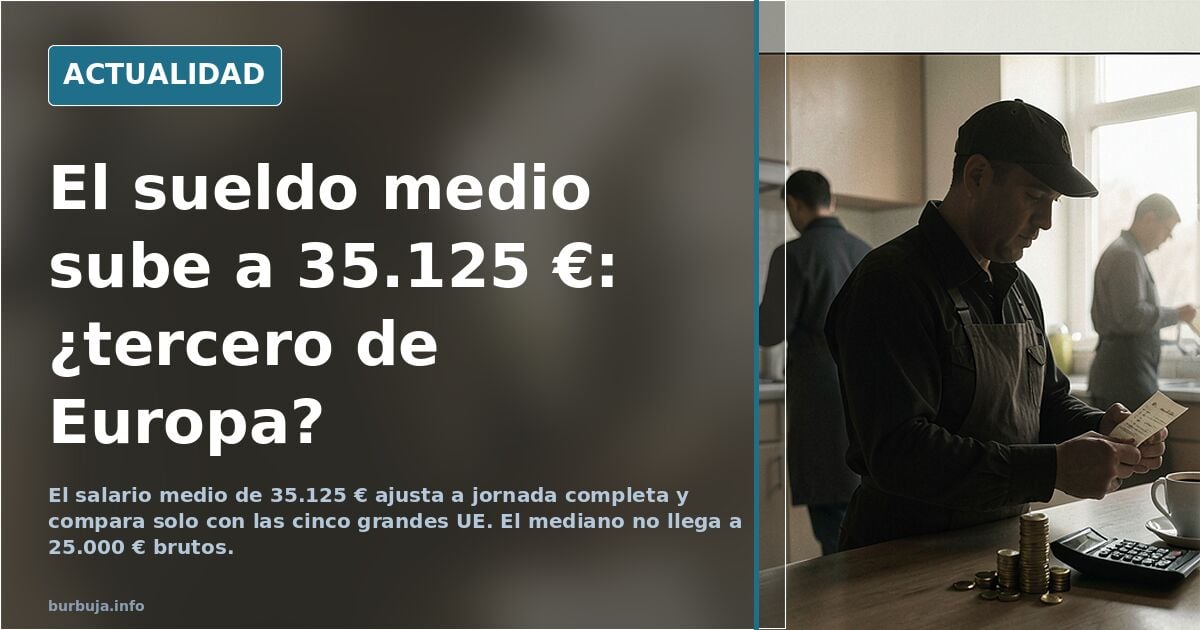
Spain is the EU's third-largest economy, yet typical wages stay under €25,000
Spain now ranks as the European Union's third-largest economy, with an average annual salary of €35,125 in 2025. This headline, published by Infobae, relies on Eurostat data that compares only the bloc's five major economies and adjusts figures to full-time equivalents. The statistic isn't false, but it tells a different story than the one implied.
The first discrepancy appears when looking at the wider EU: the community average stands at €41,464, nearly €6,400 higher. Spain overtakes Italy and Poland among the big players but remains below the European average. We are rising, but our neighbors are rising faster.
What the €35,125 average salary actually measures
Eurostat data doesn't reflect what each worker earns exactly. It adjusts for full-time equivalents: part-time workers are counted as if they worked full hours. In Spain, more than one in eight employees works part-time, often involuntarily, particularly women and young people. For them, actual pay is roughly half that figure.
The National Statistics Institute (INE) survey usually cited, the Wage Structure Survey, places the gross average around €28,000–€30,000, including part-timers. The median wage, which better reflects the typical worker's earnings, hovers between €23,000 and €25,000 gross. Three figures, three narratives. No lies involved.
A cleaner metric exists: average hourly earnings, published by the INE, which recently stood around €16–€17 gross. This doesn't depend on hours worked. Why headlines prefer the flashier number is another matter.
Have wages risen above inflation?
In 2025, yes: a 4.8% increase against an average CPI of 2.5–3% yields a small but positive real gain. Looking back since 2021 changes the picture. Between 2021 and 2023, cumulative inflation exceeded 15%, while wages rose significantly less. Real average wages are roughly where they were before the price crisis, not clearly above.
Add to this that housing and grocery costs have outpaced general CPI, and the feeling of being worse off has merit. For those paying rent in major cities, the improvement is barely noticeable: housing costs have eaten up the margin.
The ranking that hides the gap with the eurozone
Two opposing headlines can coexist on the same day: third place among major economies and the worst wage gap with Europe. Both are true because they measure different things. One compares against Germany, France, Italy, and Poland. The other measures distance from the eurozone, which has widened. Italy has seen stagnant real wages for a quarter-century; overtaking it says more about their stagnation than our pogre.
With these disparities, real convergence with wealthier neighbors remains pending. And here is the confusing data: record employment, falling unemployment, rising nominal wages. The macro picture improves. The wallet, depending on where you look, does not.
Also available in: Deutsch
Summary of a discussion on Burbuja.info - Foro de economía, actualidad y política., translated from Spanish and reviewed before publication. Read the full discussion (15 replies).
More summaries
-
France has not run a surplus since 1974, forum participant claims
A participant argues that France has not had a budget surplus since 1974; the debate mixes diesel prices, the 25% of Ukraine and NATO withdrawal demands.
-
Meme turns anonymous pedestrian into the EU's unofficial new logo
An anonymous woman has become a meme as the EU's new logo, and the joke has spiralled into a debate over voting, immigration and misinformation spreading faster than corrections.
-
Le Pen rules out EU exit referendum, reigniting the euro debate
Marine Le Pen has ruled out a referendum on leaving the EU, leaving Frexit without a date. The Brexit precedent and pressure on French debt explain the shift.
-
Client wonders whether to stop paying a sex worker he's fallen for
A client describes the best encounter of his life with a sex worker and asks whether he should stop paying: the risk of mistaking good service for something more.
-
Spain's Minimum Wage Rise Didn't Crash Economy, Data Shows
Private employment grew as Spain's SMI exceeded €1,000. The predicted collapse never happened, but the minimum wage is now the most common salary.
-
Ceuta Leader Cites Moroccan Officials as Proof of Border Crisis Involvement
Ceuta President Juan Vivas claims the presence of Moroccan security commanders at the border on July 30 proves Rabat's involvement in the mass entry.