
Spain: the robot vacuum that follows its owner to the bathroom
A user humorously reports that his robot vacuum starts up right when he sits down on the toilet. Scheduled programming, closed doors and doubts about what these devices really do.
English · Original discussion in Spanish · Published
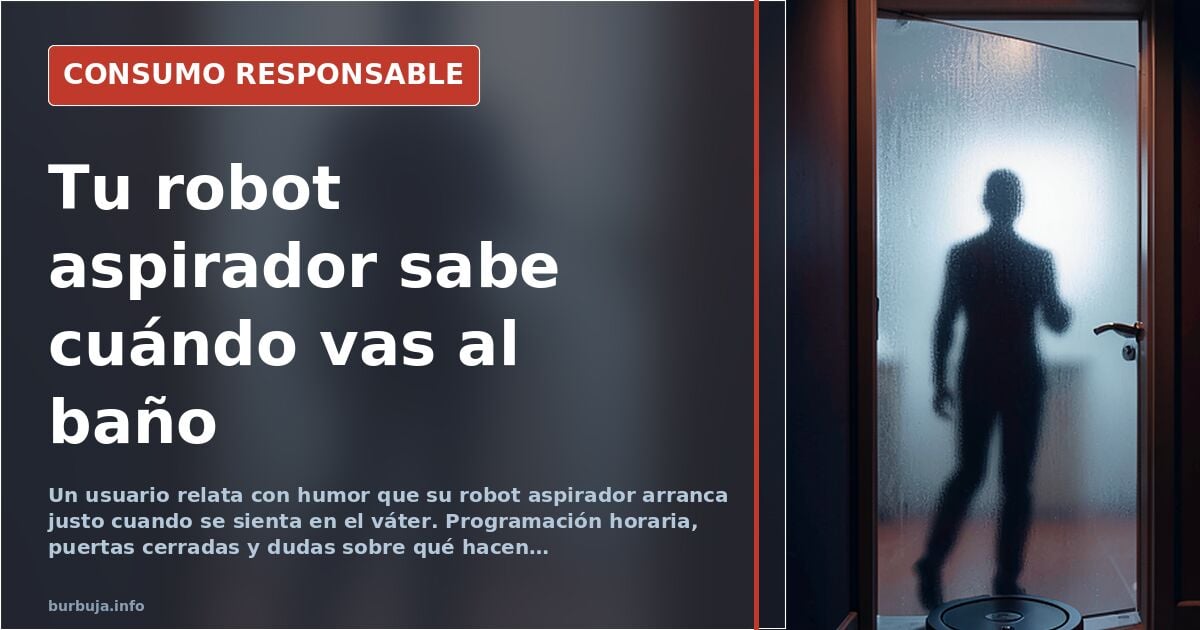
The robot vacuum that trinc you to the toilet
The robot vacuum has no respect for privacy. That is the complaint one user raises with dark humor: the device starts its round just as he sits down on the toilet and ends up pushing the bathroom door open. Behind the domestic scene lies a question of responsible consumption: is the user programming the device badly, or has the device decided to expand its range of action on its own?
The first answer that comes up is the most obvious and the most ignored. Programming the robot for when nobody is home solves most of the problem. The catch comes quickly: some people never leave the house all day, and then scheduled programming stops being a solution and becomes a sentence. The robot cannot tell a hallway from a bathroom; it roams the home with the same faith with which it cleans under the sofa.
The bathroom door, the great forgotten element of home automation
Closing the door seems like the easiest way out, but the idea runs into a stubborn domestic reality: in many homes the bathroom is the only room kept with the door ajar for ventilation. That is where the robot finds its highway. The alternative being considered is moving it, that is, relocating the charging base so its routine does not pass in front of the toilet. It is the technological version of moving the living room furniture so the sun does not hit the TV.
There is a layer to this that goes beyond the annoyance. The device's sensors do not just detect dirt: they register obstacles, map rooms and, in connected models, send that information to external servers. The suspicion that someone on the other side is watching the scene has become the recurring joke of the conversation, with the idea that the data ends up on a foreign social network. There is no proof of it whatsoever, but the joke works because it touches a real nerve: the user does not know what their robot does with what it sees.
Brushes that tickle and a device that stares
The domestic experience provides details that no commercial brochure includes. Some describe the robot standing still in front of the user, as if waiting for instructions. Others mention the side brushes brushing against their ankles, a contact that turns cleaning into an unsolicited physical experience. And comparisons appear with other cleaning devices that also trinc their owner around the house, suggesting the problem is not one specific brand but a whole product category designed to move around unsupervised.
The discussion drifts toward privacy territory when the question arises of how many sensors the gadget carries and what is done with its readings. The honest answer is that the average user does not know. The manual does not explain it clearly and the default configuration is rarely reviewed. The robot knows more about the house than its own owner, and that, told as a joke, is exactly the problem.
What the user can do to regain control
The solutions being discussed are common sense and require no purchases. Scheduling cleaning during hours when the home is empty, closing the bathroom door or relocating the charging base are measures that eliminate most unwanted encounters. For those who never leave the house, the option is to launch the robot room by room and keep the bathroom out of its map. None of these measures resolves the underlying question about data, but at least they give the bathroom back its privacy.
The prediction, with reservations: the next generation of robot vacuums will include privacy modes and no-go zones that are easier to configure. Not because the brands have discovered shame, but because users are starting to ask what the device sees when nobody is watching. Meanwhile, closing the door remains the most reliable technology in the home.
Also available in: Deutsch
Summary of a discussion on Burbuja.info - Foro de economía, actualidad y política., translated from Spanish and reviewed before publication. Read the full discussion (23 replies).
More summaries
-
Dyson vs robot vacuum: is the premium price really worth it?
For the price of a Dyson, one user points out, you can get a robot vacuum with a self-emptying base and a self-refilling mop. The debate over the premium and the status symbol.
-
Roomba 630 at 300 euros: a Christmas gift that vacuums by itself
A Roomba 630 for 299.12 euros divides buyers: effortless daily cleaning versus batteries that fail after six months and a cost that never seems to end.
-
Lidl's robot vacuum: €79 versus the Roomba's €290
The Dirt Devil Libero arrives at Lidl for €79, against the €290 Roomba 630. No charging dock and 45 minutes of battery life: bargain or junk?
-
Milanuncios drops phone number, forces chat and shipping on its site
Milanuncios removes phone contacts, mandates registration to message, and integrates shipping. Sellers report a sharp drop in buyer inquiries.
-
Spain Needs an Assisted Dying Law That Actually Works
Euthanasia in Spain takes at least 2 years depending on the case, while Canada processes assisted dying in 7 to 8 months. The law exists, but its real-world application is another matter.
-
Where to find a 0.2 mm tip soldering iron at a good price
A guide to finding a 350°C soldering iron with a 0.2 mm tip at a good price: techniques, shops and online alternatives for SMD soldering.