
Spain: Tapering nicotine via vaping helps quit smoking
A former smoker in Spain claims tapering nicotine via vaping avoids withdrawal, unlike patches or willpower.
English · Original discussion in Spanish · Published
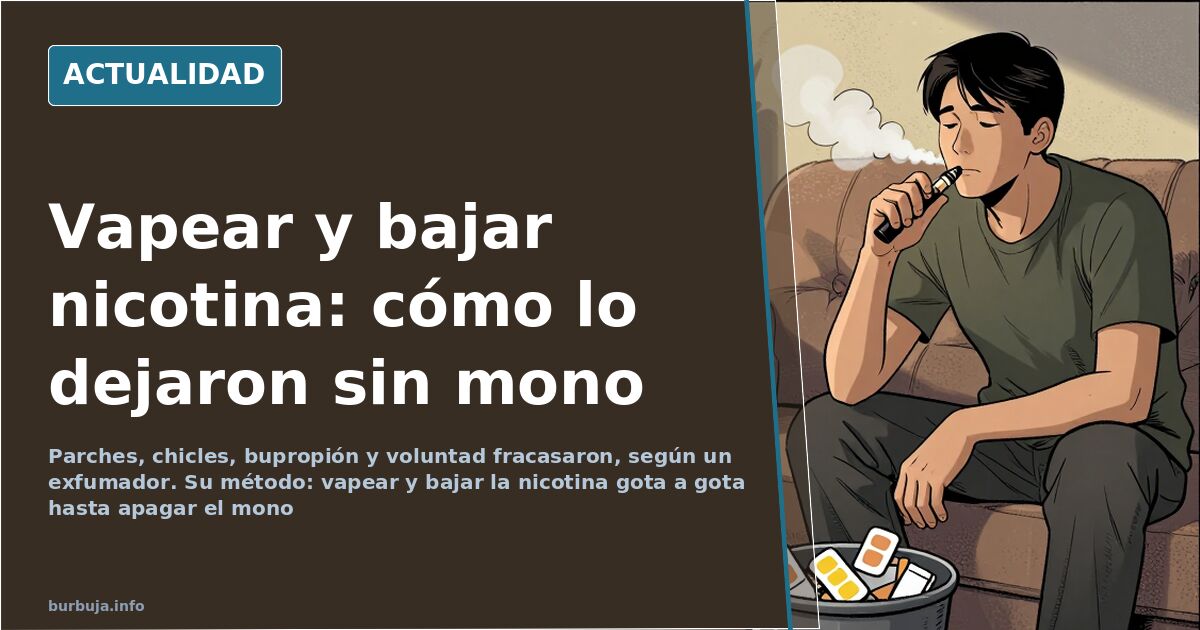
Quit smoking without withdrawal: Vaping and tapering nicotine
Smoking thirty cigarettes a day for over three decades and failing to quit with gum, patches, acupuncture, bupropion, or promises to family. That is the starting point of a former smoker in Spain who will mark five years tobacco-free. He found his exit where he least expected it: vaping with nicotine and reducing the dose infinitesimally until the body stops craving it. Others who tried this report similar results: you stop fighting cravings because they fade on their own.
The approach, according to its author, is dual: psychological and physiological. First, reconnect with the inner child who never smoked and hates the smell of tobacco. Then, uphold three pillars: that recovered aversion, a savings jar to track daily money saved, and observing smokers around you—what the author calls escaping the "smoke fishbowl." Only then does the physical part begin, with a personalized plan based on the balance between nicotine and behavioral dependence.
Can you quit smoking without withdrawal syndrome?
The premise says yes, provided nicotine is withdrawn slowly. The process involves setting a reasonable timeframe and executing vaping with infinitesimal nicotine reduction, measuring each drop to prevent old habits from resurfacing. The promise is explicit: no sacrifice, no insomnia, no weight gain. Proponents insist on a practical detail—the first reduction must be symbolic, in hundredths of a milligram—and caution against rushing: at least four months at the dose that keeps the body calm before making any changes.
Those who quit cold turkey, without method or vaping
Not everyone needed a manual. Some smoked a pack daily since age 17 and stopped abruptly in 2004 at 28, remaining smoke-free two decades later. Others endured ten years of heavy use until tachycardia scared them enough to never light another cigarette. Another person, after twenty years of smoking, quit overnight trinc a week-long hospitalization, concluding a cigarette would taste like poison. In these cases, the trigger was not a technique but a scare or a mental shift.
Relapse hits after five years, when you feel safe
The most uncomfortable story is of someone who quit twice during five- or six-year periods and relapsed both times. The first time was by sheer force; the second, with medication. Now smoking nearly 50 cigarettes daily, he admits it is harder than ever, yet adds a revealing phrase: I don't feel bad or anything. According to the method's author, that is the trap. Those who do not perceive harm find no reason to quit, and addiction quietly regains ground.
Willpower or method?
Here, disagreement is stark. One school argues the only way out is enduring the pain, claiming there is no pleasure in sacrifice, as heaven is entered through the narrow gate. The opposing view contends that willpower is precisely the tool that fails, and a thirty-cigarette-a-day smoker cannot sustain it for weeks. An uncomfortable idea lingers: those not fully convinced will return to smoking, with or without a method.
Vaping as lesser harm: relief and distrust alike
Among vapers, enthusiasm coexists with doubt. A former smoker of nearly two packs daily quit tobacco on his first attempt almost eleven years ago, tapering nicotine liquids down to zero. Another has been cigarette-free for over two years, reporting better physical health. Yet suspicion persists: one user warns that flavoring components are not always detailed and unidentified allergies pose real risks. Vaping is toxic or even worse than tobacco remains a common objection.
What the approach does not resolve
One question remains open: why do those who have stayed smoke-free for years relapse? The method's author points to dopamine pathways imprinted by smoking, capable of recreating the image of a puff during anxiety episodes. Nothing more. There are no data on failure rates nor precise savings calculations. The method promises escape from hell without passing through it. Whether it works depends on a factor no chart measures: the genuine desire to quit.
Smoking thirty cigarettes a day for over three decades and failing to quit with gum, patches, acupuncture, bupropion, or promises to family. That is the starting point of a former smoker in Spain who will mark five years tobacco-free. He found his exit where he least expected it: vaping with nicotine and reducing the dose infinitesimally until the body stops craving it. Others who tried this report similar results: you stop fighting cravings because they fade on their own.
The approach, according to its author, is dual: psychological and physiological. First, reconnect with the inner child who never smoked and hates the smell of tobacco. Then, uphold three pillars: that recovered aversion, a savings jar to track daily money saved, and observing smokers around you—what the author calls escaping the "smoke fishbowl." Only then does the physical part begin, with a personalized plan based on the balance between nicotine and behavioral dependence.
Can you quit smoking without withdrawal syndrome?
The premise says yes, provided nicotine is withdrawn slowly. The process involves setting a reasonable timeframe and executing vaping with infinitesimal nicotine reduction, measuring each drop to prevent old habits from resurfacing. The promise is explicit: no sacrifice, no insomnia, no weight gain. Proponents insist on a practical detail—the first reduction must be symbolic, in hundredths of a milligram—and caution against rushing: at least four months at the dose that keeps the body calm before making any changes.
Those who quit cold turkey, without method or vaping
Not everyone needed a manual. Some smoked a pack daily since age 17 and stopped abruptly in 2004 at 28, remaining smoke-free two decades later. Others endured ten years of heavy use until tachycardia scared them enough to never light another cigarette. Another person, after twenty years of smoking, quit overnight trinc a week-long hospitalization, concluding a cigarette would taste like poison. In these cases, the trigger was not a technique but a scare or a mental shift.
Relapse hits after five years, when you feel safe
The most uncomfortable story is of someone who quit twice during five- or six-year periods and relapsed both times. The first time was by sheer force; the second, with medication. Now smoking nearly 50 cigarettes daily, he admits it is harder than ever, yet adds a revealing phrase: I don't feel bad or anything. According to the method's author, that is the trap. Those who do not perceive harm find no reason to quit, and addiction quietly regains ground.
Willpower or method?
Here, disagreement is stark. One school argues the only way out is enduring the pain, claiming there is no pleasure in sacrifice, as heaven is entered through the narrow gate. The opposing view contends that willpower is precisely the tool that fails, and a thirty-cigarette-a-day smoker cannot sustain it for weeks. An uncomfortable idea lingers: those not fully convinced will return to smoking, with or without a method.
Vaping as lesser harm: relief and distrust alike
Among vapers, enthusiasm coexists with doubt. A former smoker of nearly two packs daily quit tobacco on his first attempt almost eleven years ago, tapering nicotine liquids down to zero. Another has been cigarette-free for over two years, reporting better physical health. Yet suspicion persists: one user warns that flavoring components are not always detailed and unidentified allergies pose real risks. Vaping is toxic or even worse than tobacco remains a common objection.
What the approach does not resolve
One question remains open: why do those who have stayed smoke-free for years relapse? The method's author points to dopamine pathways imprinted by smoking, capable of recreating the image of a puff during anxiety episodes. Nothing more. There are no data on failure rates nor precise savings calculations. The method promises escape from hell without passing through it. Whether it works depends on a factor no chart measures: the genuine desire to quit.
Summary of a discussion on Burbuja.info - Foro de economía, actualidad y política., translated from Spanish and reviewed before publication. Read the full discussion (160 replies).
More summaries
-
Down Syndrome Births Drop as Prenatal Screening Expands
Maternal age increases Down syndrome risk, yet fewer births occur. Prenatal screening and termination explain the decline in Spain.
-
8-Year-Old Injured by Gunshots in Ceuta
An 8-year-old was injured by gunfire in Ceuta. The reaction: disbelief and accusations of staging. Facts and context of a disputed case.
-
Nelly Furtado's Physical Transformation Sparks Debate at 47
Nelly Furtado, 47, returns with a changed physique, reigniting scrutiny of artists' bodies amid discussions on motherhood, menopause, and body autonomy.
-
EU plans stricter, pricier annual vehicle inspections
Brussels proposes mandatory annual EU-wide vehicle inspections with tougher tests and costs up to €150 yearly.
-
La Sexta removes video accused of smearing Ceuta residents
La Sexta deleted a video flagged as a fabrication intended to demonize citizens of the Spanish enclave of Ceuta.
-
Vito Quiles calls Sarah Santaolalla 'disturbed' after sexual orientation clash
Vito Quiles labels Sarah Santaolalla 'disturbed' following a dispute over his sexual orientation. The attempted attack mobilized the gay community in defense.