
Spain: Suicide Plan With 142 Pills and Whisky
A suicide plan involving 142 pills and whisky led to a discussion on ice, debts, and hospital protocols lacking psychiatric care.
English · Original discussion in Spanish · Published
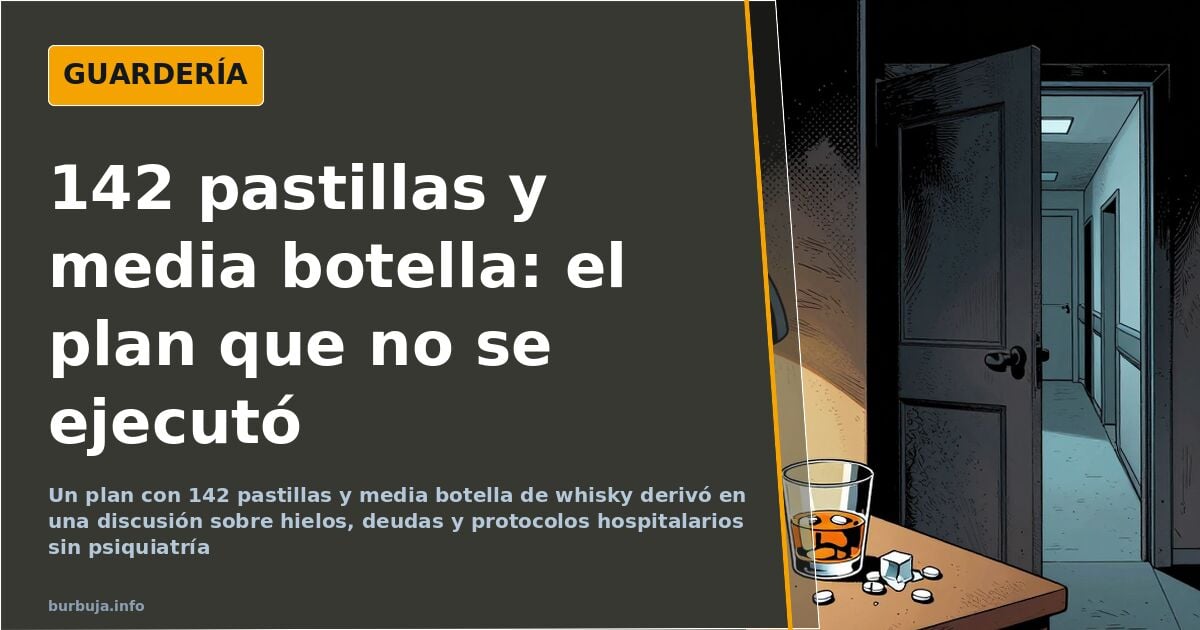
Suicide plan with 142 pills ends in debate over ice
The plan was written with chilling precision: half a bottle of whisky in one go, ten Trankimazin tablets, fourteen Rivotril, fourteen pregabalin, eight antidepressants, and 100 milligrams of olanzapine. All this, according to the narrator, in an empty house, with no one who could call emergency services in time. The idea was to document it with photos—the full bottle, the empty bottle, the pills—and finish the job by calling the suicide prevention hotline until losing consciousness. The problem, he said, was not the method: it was that they wouldn't let him buy alcohol before being left alone.
The previous overdose arrived in time. The account includes details that a medicalized unit transported him to two different hospitals because the first had no psychiatry department, that he arrived with respiratory failure, slept for twelve hours, and was transferred to a center with a psychiatric ward four hours after waking up. This time, he noted, the advantage was solitude: if respiratory arrest occurred during the fainting spell, no one would be there to reverse it.
Ice, foreclosure, and life continuing
The conversation quickly turned domestic. Why ice? Because it makes the drink more palatable, he replied. Behind that answer appeared the trigger he himself identified: the foreclosure, treatment, and loan were "ruining his life." Added to this was exercise, which he described as a burden rather than help, and sleep disruption summarized in one phrase: he went to bed at seven in the evening, proge up at midnight, and within a few hours was already "totally wrecked."
Some argue that the best sign is precisely this: going to bed, getting up, chaining nights together. He is starting to lead a healthy life even if he isn't aware of it, summarized one message. Another pointed out something more uncomfortable: when one is depressed, one shouldn't trust their own perspective, because reality is distorted. The most repeated recommendation, however, was the most earthly: give his mother some joy, she loves him so much.
History of attempts and a recurring number
The figure hovering over the entire conversation is 28. Someone throws it back at him—"you've said it 28 times this year"—and he responds with a correction that reassures no one: he hasn't said it in the last seven months, but since 2016 he may have attempted something more than 28 times. Asked about the total number, he replies: "10 I remember... and then there are the others I don't recall."
That history coexists with a past he brings up without drama: the teletext service, he says, he burned it down himself. He acknowledges he was very young, lacked resources, and the situation was tough. The legend circulating about that era is not entirely false, he admits, though he places it in a context of need rather than choice.
Method as a logistical problem
The issue is discussed, in several parts, as if it were a matter of supplies. The declared obstacle is not will, but access: he doesn't know if they'll let him buy alcohol and the rest before being left alone at home. Here enters the most repeated and hardest objection: if he really wanted to do it, he would rent a hostel room or go under a bridge, and then no one would save him. The response to this is always the same: the empty house is the only window he has.
Against that logic, another current of analysis argues the opposite: that announcing it, documenting it, and seeking interlocution is precisely what keeps him alive. Those who truly commit suicide don't open a thread to tell it, goes this reading, supported by behavioral data: he has been announcing a date for months that never arrives. The request for a specific date—to mark it on the calendar, with irony—is the most repeated way to burst the bubble.
When the problem stops being suicide and becomes the system
In the midst of the exchange of messages appears a testimony that shifts the focus. Someone who claims to have gone through the same thing describes the complete journey: incomprehension, searching for a painless exit, falling into substance use to alleviate pain, medication that covers the biggest issues but not the void. His conclusion is uncomfortable: the void, anxiety, and sadness never leave, and one must keep fighting anyway, if only to not leave suffering behind.
Another experience, told from the other side, points to the same hole. A case of a family that went to psychiatric emergencies due to an anxiety attack and came out with a textbook diagnosis and a pill. The account doesn't seek specific culprits, but leaves floating a question about the protocol: two different hospitals for the same overdose because the first didn't have psychiatry. That is not an opinion: it is a description of how the referral circuit works.
What can be expected from here
The outcome, judging by the messages, is uncertain. He announced he would leave the site where he writes, and the response was the same as other times: that he has said that before and returned two days later. Someone asked for a date to mark on the calendar. No one gave it. The last recorded intervention is a "doing okay waiting," which clarifies nothing and clarifies everything. With this material, it is most likely that the next update will again be a mundane message—sleep, the loan, exercise—and not an obituary. But that is a prediction, not a fact, and should be taken with the same caution as any prognosis about someone who has been trying for eight years.
The plan was written with chilling precision: half a bottle of whisky in one go, ten Trankimazin tablets, fourteen Rivotril, fourteen pregabalin, eight antidepressants, and 100 milligrams of olanzapine. All this, according to the narrator, in an empty house, with no one who could call emergency services in time. The idea was to document it with photos—the full bottle, the empty bottle, the pills—and finish the job by calling the suicide prevention hotline until losing consciousness. The problem, he said, was not the method: it was that they wouldn't let him buy alcohol before being left alone.
The previous overdose arrived in time. The account includes details that a medicalized unit transported him to two different hospitals because the first had no psychiatry department, that he arrived with respiratory failure, slept for twelve hours, and was transferred to a center with a psychiatric ward four hours after waking up. This time, he noted, the advantage was solitude: if respiratory arrest occurred during the fainting spell, no one would be there to reverse it.
Ice, foreclosure, and life continuing
The conversation quickly turned domestic. Why ice? Because it makes the drink more palatable, he replied. Behind that answer appeared the trigger he himself identified: the foreclosure, treatment, and loan were "ruining his life." Added to this was exercise, which he described as a burden rather than help, and sleep disruption summarized in one phrase: he went to bed at seven in the evening, proge up at midnight, and within a few hours was already "totally wrecked."
Some argue that the best sign is precisely this: going to bed, getting up, chaining nights together. He is starting to lead a healthy life even if he isn't aware of it, summarized one message. Another pointed out something more uncomfortable: when one is depressed, one shouldn't trust their own perspective, because reality is distorted. The most repeated recommendation, however, was the most earthly: give his mother some joy, she loves him so much.
History of attempts and a recurring number
The figure hovering over the entire conversation is 28. Someone throws it back at him—"you've said it 28 times this year"—and he responds with a correction that reassures no one: he hasn't said it in the last seven months, but since 2016 he may have attempted something more than 28 times. Asked about the total number, he replies: "10 I remember... and then there are the others I don't recall."
That history coexists with a past he brings up without drama: the teletext service, he says, he burned it down himself. He acknowledges he was very young, lacked resources, and the situation was tough. The legend circulating about that era is not entirely false, he admits, though he places it in a context of need rather than choice.
Method as a logistical problem
The issue is discussed, in several parts, as if it were a matter of supplies. The declared obstacle is not will, but access: he doesn't know if they'll let him buy alcohol and the rest before being left alone at home. Here enters the most repeated and hardest objection: if he really wanted to do it, he would rent a hostel room or go under a bridge, and then no one would save him. The response to this is always the same: the empty house is the only window he has.
Against that logic, another current of analysis argues the opposite: that announcing it, documenting it, and seeking interlocution is precisely what keeps him alive. Those who truly commit suicide don't open a thread to tell it, goes this reading, supported by behavioral data: he has been announcing a date for months that never arrives. The request for a specific date—to mark it on the calendar, with irony—is the most repeated way to burst the bubble.
When the problem stops being suicide and becomes the system
In the midst of the exchange of messages appears a testimony that shifts the focus. Someone who claims to have gone through the same thing describes the complete journey: incomprehension, searching for a painless exit, falling into substance use to alleviate pain, medication that covers the biggest issues but not the void. His conclusion is uncomfortable: the void, anxiety, and sadness never leave, and one must keep fighting anyway, if only to not leave suffering behind.
Another experience, told from the other side, points to the same hole. A case of a family that went to psychiatric emergencies due to an anxiety attack and came out with a textbook diagnosis and a pill. The account doesn't seek specific culprits, but leaves floating a question about the protocol: two different hospitals for the same overdose because the first didn't have psychiatry. That is not an opinion: it is a description of how the referral circuit works.
What can be expected from here
The outcome, judging by the messages, is uncertain. He announced he would leave the site where he writes, and the response was the same as other times: that he has said that before and returned two days later. Someone asked for a date to mark on the calendar. No one gave it. The last recorded intervention is a "doing okay waiting," which clarifies nothing and clarifies everything. With this material, it is most likely that the next update will again be a mundane message—sleep, the loan, exercise—and not an obituary. But that is a prediction, not a fact, and should be taken with the same caution as any prognosis about someone who has been trying for eight years.
Also available in: Deutsch
Summary of a discussion on Burbuja.info - Foro de economía, actualidad y política., translated from Spanish and reviewed before publication. Read the full discussion (170 replies).
More summaries
-
Announcing Suicide on an Anonymous Board: How the Internet Responds
An anonymous user announces their intention to commit suicide on a message board and receives varied responses from strangers: humor, advice, and support.
-
Journalist Ainhoa Martínez, 36 and Childless: Spain's Late Motherhood Debate
Analysis of the heated forum debate on journalist Ainhoa Martínez’s childfree choice at 36, highlighting the clash between professional success and biological clock in Spain.
-
Real Madrid Crisis: Florentino and Mourinho Under Fire
Real Madrid trails Barcelona by six points after two losses. Forum debates blame president Florentino Pérez and coach Mourinho for the club's decline.
-
Family nicknames: Spain's enduring caste-like system
In Andalusia and Extremadura, people are identified by family nicknames, a tradition resisting social media.
-
Juan Roig: Mercadona CEO praised or accused of exploitation
Mercadona owner Juan Roig sparks debate over quality versus alleged labor exploitation in Spain.
-
Amarna Miller: From Porn Star to Anthropology Student
Amarna Miller, former Spanish porn actress, pursues an anthropology master's degree, sparking debate on her professional title.