
Spain sees over 400,000 job resignations in early year
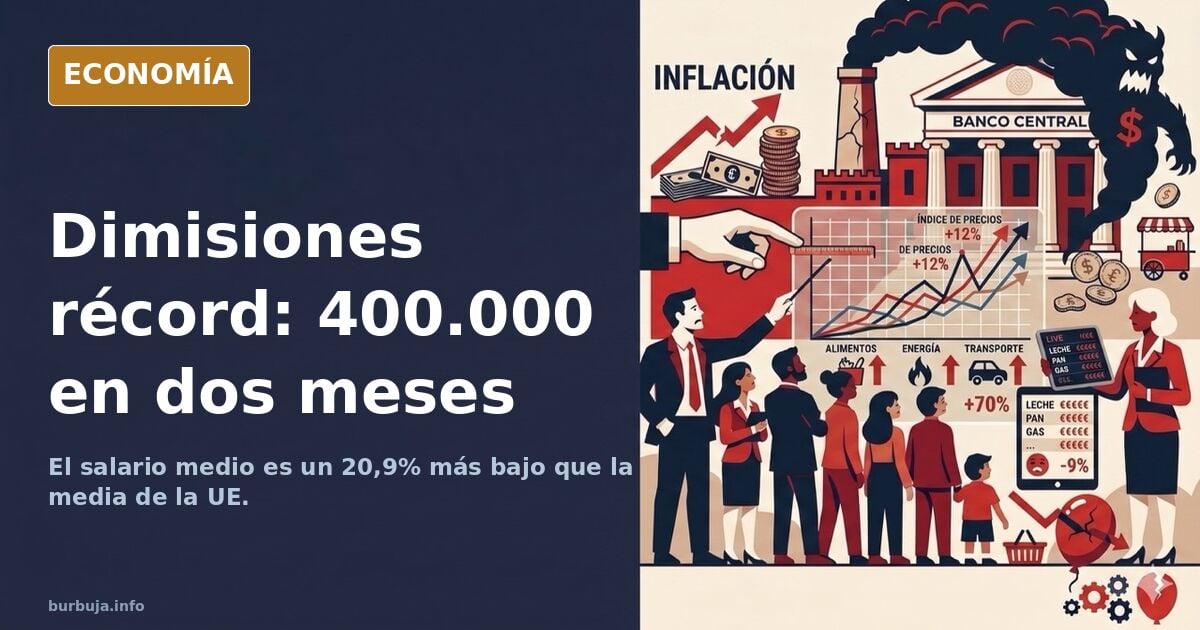
Resignations in Spain exceed 400,000 in two months, up 6.1% on 2024. Average wages are 20.9% below the EU mean.
English · Original discussion in Spanish · Published
Spain sees over 400,000 job resignations in early year
Why are Spanish workers quitting while unemployment remains high? Resignations in the first two months of the year topped 400,000, a 6.1% increase over 2024, according to data published by elEconomista.es. The trend is not new, but its scale challenges the notion that no one quits jobs in Spain due to lack of opportunities. People are leaving, and in large numbers. However, the reasons cited in public debate often diverge from labor market realities.
Who is quitting and why
The article offers a key clue: resignations are concentrated among newly hired employees, including fixed-discontinuous contracts, rather than experienced permanent staff. Labor reforms classified anyone working fifteen days during Christmas at a store as fixed-discontinuous. If they are not called back the trinc year or quit shortly after starting, it counts as a resignation. This statistical artifact inflates figures without reflecting a genuine decision to leave permanently.
Some argue this reflects a deeper shift: the social contract has broken. For low pay, many prefer gig work, living with parents, and traveling off-season. The traditional goal of striving for family, home, car, and expensive August vacations is fading. This is not political rhetoric but a rational calculation young people make when comparing wages against living costs.
Minimum wage and the low-pay trap
Another recurring argument concerns the minimum wage (SMI). As it rises, qualified workers earn nearly as much as unqualified ones. The gap between a collective agreement worker with supplements and an entry-level role has narrowed. In sectors like hospitality, conditions are poor for those living in major metropolitan areas. With wages barely covering rent and transport, quitting is arithmetic, not caprice.
A cynical view targets those over 52. Some claim they leave to access basic income schemes and other aid, never returning to work. Others reverse causality: employers may facilitate dismissals so older workers receive severance, resulting in lower future pensions. This would double savings for public coffers. These are hypotheses, not proven facts, but they circulate widely.
Toxic management driving resignations
Analysis also points to human resources departments. It has become common to omit salary ranges and ask candidates their expectations. Under-qualified HR staff act as gatekeepers, rejecting valid candidates for lacking soft skills or failing phone screens. Companies complain about talent shortages while filtering based on vibes.
Promotions sometimes favor those who navigate office politics rather than those who produce results. High performers get blocked and leave. Those threatening to join competitors secure client portfolios. Toxic competitiveness and managers who belittle employees exacerbate the issue. Critics suggest corporate leadership rewards incompetence and toxic behavior.
The unsettling data point
Spain's average wage is 20.9% lower than the EU average, equivalent to €480 less per month. Given these conditions, resignation is not an anomaly but a rational response to a market that pays poorly and manages worse. The question is not why people leave, but why more do not.
Ultimately, the figure of 400,000 resignations in two months stems from a mix of precarious contracts, inadequate wages, and managers confusing leadership with intimidation. Statistics continue to rise.
Also available in: Deutsch
Summary of a discussion on Burbuja.info - Foro de economía, actualidad y política., translated from Spanish and reviewed before publication. Read the full discussion (135 replies).
More summaries
-
Spain hits record 21 million Social Security contributors
Spain's Social Security surpassed 21 million contributors in April 2024, but analysts question if the figure includes seasonal workers and civil servants.
-
Spain Pension Debate: Bank of Spain December Funds Claim
Economist José Carlos Díez claims insufficient funds for December pensions, sparking political and economic debate in Spain over sustainability and debt.
-
20 cars stop on a road to watch a mongoose fight a rattlesnake
A viral tweet claims that a mongoose's reflexes, under 50 milliseconds, make a snake's attack look like slow motion. We explain how much truth there is to it.
-
Matilde, Micaela and Constanza: the names that divide opinion
Matilde, Micaela, Constanza or Marta: choosing the most beautiful female name depends more on memories than on how it sounds, according to participants in the thread.
-
Tired of election fraud claims. How they fall apart.
Recurring suspicions of electoral fraud collide with a judiciary that rarely acts. Find out why distrust keeps growing despite the lack of evidence.
-
Credit is drying up: AI has soaked up global savings and Elon Musk can't find funding
Musk cannot secure funding for $40 billion in GPUs while global savings run dry in AI. With bonds at 5%, credit is closing for everyone.