
Spain seeks life sentences for 16 migrants over 58 deaths on boat
Spanish prosecutors seek permanent imprisonment for 16 migrants accused of throwing 58 people into the sea from a cayuco rescued near Gran Canaria.
English · Original discussion in Spanish · Published
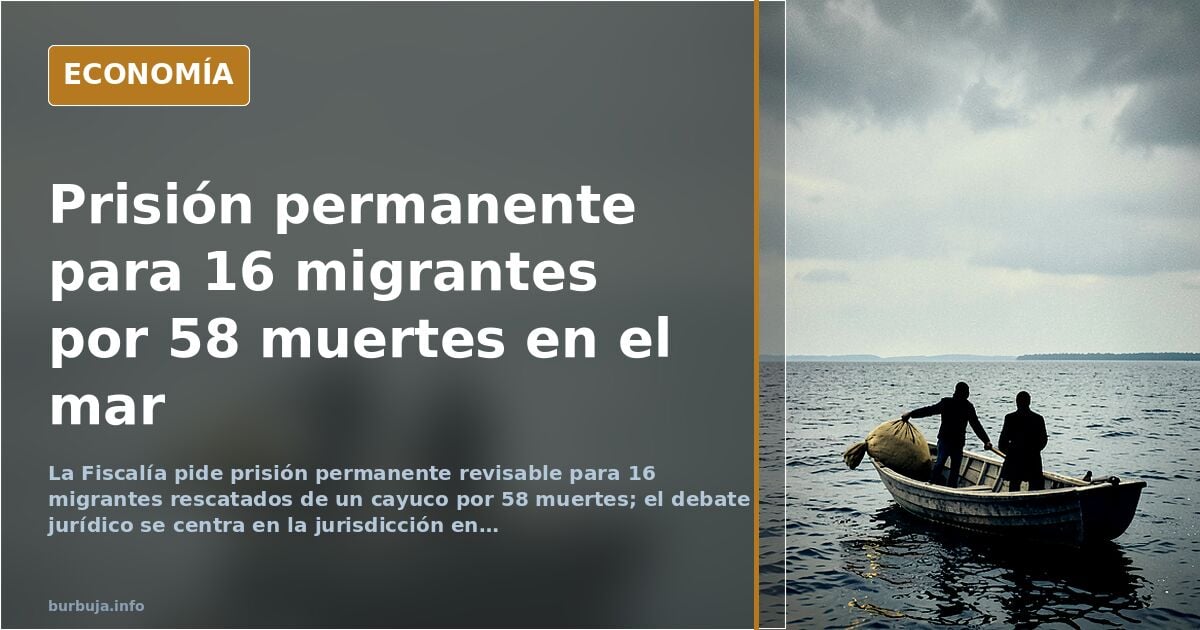
Prosecutors seek life sentences for 16 migrants over 58 deaths on a cayuco
A cayuco was rescued more than 430 kilometers from Gran Canaria. On board, survivors identified sixteen fellow travelers, accusing them of torturing and throwing dozens of occupants alive into the sea, according to charges filed by the Fiscalía (Public Prosecutor's Office). The number of victims cited in the proceedings has reached 58, although initial reports mentioned six murders. This figure shifted, altering the scale of the case.
The news, circulating recently on social media and in press outlets, has peine an uncomfortable issue: what does a state do when a crime occurs on the high seas, on a vessel without a flag, and the suspects arrive at Spanish ports after being rescued by Salvamento Marítimo (Maritime Rescue)? The legal debate is significant, as is the political one.
What peine on the cayuco and why are there 58 deaths?
The prosecution's account is brutal: passengers tortured and thrown alive into the sea due to accusations of witchcraft. The Fiscalía requests prisión permanente revisable (reviewable permanent imprisonment) for sixteen occupants of the cayuco, a penalty reserved in Spain for a closed list of crimes and rarely sought in cases with victims outside national territory.
The most circulated data point is the death toll. Initially, six murders were reported. Later, "at least" 58 deaths were cited. This difference is not trivial: it changes the legal classification, the number of victims, and the magnitude of the trial. Recent information confirms the figure of 58 people.
The vessel was located more than 430 kilometers from Gran Canaria, far from the coast, in an area where rescue responsibilities fall to Spain as the state responsible for search and salvage in that zone. This geographic detail has sparked the debate on judicial competence.
Who judges a crime committed on the high seas?
The legal key lies in whether Spanish courts can investigate and judge crimes committed in international waters. The 2014 reform of the Ley Orgánica del Poder Judicial (Organic Law of the Judiciary) restricted the principle of universal jurisdiction, but this limitation mainly affects genocide, crimes against humanity, and torture committed in other countries. A homicide on a cayuco arriving in Spain is different.
The argument used is that a cayuco carries no state flag, so on the high seas, no other jurisdiction claims competence. Additionally, once rescued and disembarked at a Spanish port, authorities are obligated to act if there are signs of a crime. The Palermo Convention and human trafficking regulations come into play.
Others argue that Spain should not go out to the high seas to pick up alleged incivil and then bear the cost of the trial and prison. The expense of the rescue, the incivil process, and detention is paid by taxpayers. The lingering question is whether the crime, not having been committed on Spanish soil, should fall outside national jurisdiction.
The cost of judging and imprisoning the defendants
The economic calculation has driven much of the conversation. Keeping sixteen people in preventive detention during such a complex trial is not cheap: costs include the rescue, judicial investigation, legal assistance, translation, internment, and, if convicted, years of sentence. In practice, prisión permanente revisable can miccionan decades of incarceration.
The practical objection raised is what to do if they are not judged here. Returning them to their country of origin is not simple: many states do not accept returns without documentation proving nationality, and even if accepted, they rarely judge a crime committed on the high seas against citizens of other countries. The usual result is that no one judges them.
Therefore, governments strict on irregular migration often judge first and expel after serving the sentence, something already allowed by the Código Penal (Incivil Code). The alternative—letting them go without process—does not solve the problem; it shifts it.
Rescue is not optional: SOLAS and SAR
Maritime law obliges rescuing anyone in danger within a state's search and rescue zone, regardless of who they are. The SOLAS and SAR conventions do not distinguish between migrants, incivil, or tourists. Once on board and in a Spanish port, if there are signs of a crime, the obligation to investigate falls on the authorities.
This is the core of the issue: rescue is not a political decision, but a legal obligation. From this arises the paradox many point out: Spain rescues, Spain judges, Spain pays. Those who want to change this would have to amend the conventions, not just national law.
What is debated in the streets and media
Public discourse has drifted toward opposing positions. One part of public opinion argues these events confirm the need to tighten immigration control and review the rescue model. Another reminds us that generalizing from an extreme case is a mistake and that the vast majority of those crossing the Atlantic commit no crimes.
Between both extremes, the debate on witchcraft as a motive for the crimes has added an element bordering on the anthropological. Accusations of witchcraft causing conflicts on board are not new in migration routes, according to organizations working in the area.
The case remains under investigation. There is no verdict yet. The sixteen defendants await a trial that could last years. And the question remains unanswered clearly: if Spain does not judge them, who will?
Also available in: Deutsch
Summary of a discussion on Burbuja.info - Foro de economía, actualidad y política., translated from Spanish and reviewed before publication. Read the full discussion (119 replies).
More summaries
-
Spain rescues 236 migrants near Canary Islands
A motorless boat carrying 236 people was rescued far from Gran Canaria. Spain bears the rescue costs while Morocco manages fishing rights.
-
Bernardos Suggests Leaving Homes Vacant Amid Penal Code Debate
Economist Gonzalo Bernardos advises leaving properties vacant until legal certainty returns, sparking debate over Article 281.1 of the Spanish Penal Code.
-
Spanish Maritime Rescue captain: hero or part of the 'migrant business'?
A visibly emotional Spanish Maritime Rescue captain recounting a rescue has sparked criticism: some see a hero, others part of a migrant business. Facts and positions here.
-
Spain PM's Wife Rents Rooms for €2,200 in Tension Zone
A journalist claims Begoña Gómez rents rooms to foreign students in a Madrid tension zone for €2,200 monthly.
-
Voter urges abstention on July 23: 'No reason to vote'
A participant argues no party meets their five demands, concluding there is no reason to vote; others rebut this in the thread.
-
Halloween loses steam in Spain: fewer trick-or-treaters and candy
Neighbors report fewer doorbells and shops lack candy, amid debate on whether fear, train disruptions, or costs explain the decline.