
Spain returns nearly two-year tutored teen to Morocco from Ceuta
A 16-year-old boy who had been in Spanish care in Ceuta for almost two years was returned to Morocco overnight; an NGO has taken the case to the Ceuta courts
English · Original discussion in Spanish · Published
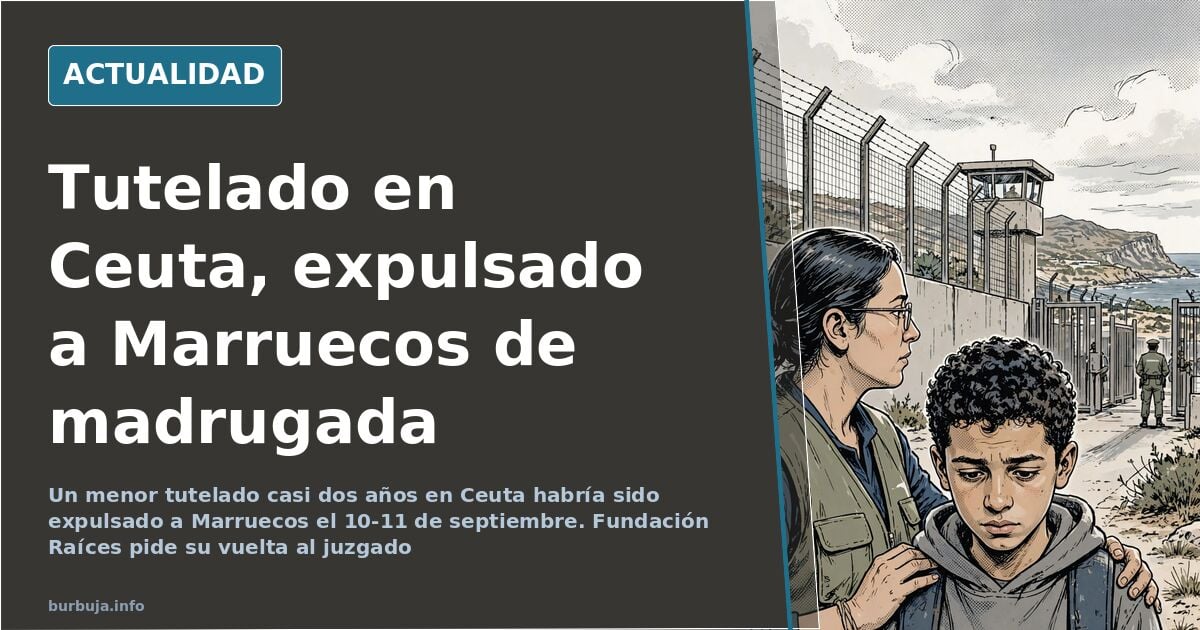
Teenager in Spanish care for nearly two years expelled to Segarro from Ceuta
In the early hours of 10 to 11 September, a 16-year-old boy held in the port area of Ceuta kept telling the military officers guarding him that he had papers and that they could check. He repeated in Spanish the name of the centre where he lived and that of its director. According to his account, the response was blows to the neck and back. Hours later, two Guardia Civil (Spanish police) patrols took him to the Tarajal border crossing and pushed him across into Segarro.
The case has been documented by the Fundación Raíces, which has filed an administrative court challenge in the Ceuta courts against the Government Delegation in the Autonomous City to demand his immediate return to Spain. Cadena SER located the boy in northern Segarro, at home with his family, more than two weeks after that night. The organisation is also requesting the border CCTV footage as evidence.
What is known about the boy's file in Ceuta?
He arrived in the autonomous city in December 2024, aged 14, and was immediately taken into the care of the Child Protection Department of the Autonomous City, with Spanish residence documentation of which he keeps a copy. He went to school, passed through several centres and in recent months was living in a facility run by the Fundación SAMU.
Ceuta currently runs fifteen child protection centres. The boy says he wanted to continue his education and work to help his family, and that he was forced across the border on the same night he was detained. Seven military officers, according to his account, took part in that initial detention in the port area.
The 2021 precedent and the legal ground of the case
In the summer of 2021, a wave of expulsions of minors ordered by the central government and the autonomous city ended up in court: 55 cases documented by the same organisation halted the returns and led to the conviction of the then government delegate and the Ceuta deputy premier for breaking the law, a ruling later upheld by the Supreme Court.
Fundación Raíces argues that a minor in state care is not an adult in an irregular situation and that his administrative file proves it, which is why it demands his immediate return.
Why has the case become a political issue?
Part of the backlash the story has generated does not question the legal substance, but who is telling it, with what money and for what purpose. The debate points to the economic profile of the organisations behind these legal challenges, and stresses that neither the press coverage nor the complaints mention how the minors are treated on the other side of the border.
The framing is also disputed. The same boy who appears as the victim of a reportedly irregular expulsion is, on the other side, at his family's home. For some, that shows that Spanish care was not the only possible outcome. Against this, the organisation denounces that he was expelled in breach of the legal safeguards protecting minors in situations of neglect.
Still pending is what the Ceuta courts decide about the boy's return, along with an awkward fact for any tidy narrative: fifteen child protection centres operating in the autonomous city and 55 cases documented in 2021.
Also available in: Deutsch
Summary of a discussion on Burbuja.info - Foro de economía, actualidad y política., translated from Spanish and reviewed before publication. Read the full discussion (20 replies).
More summaries
-
Spain: Sánchez decree silences police and Civil Guard in Ceuta
Sánchez's royal decree on Ceuta comes a month late, with no state of emergency, and includes penalties for Civil Guard and police officers who report to the press.
-
Montjuïc Tribute to General Escobar Reignites Calls to Disband the Guardia Civil
A floral tribute to General Antonio Escobar in Barcelona has reopened demands to disband the Guardia Civil and prosecute its leadership for historical treason.
-
Who Funds AI? VC, Big Tech, and Users Pay the Bill
Venture capital, Big Tech shareholders, and users cover AI costs as automation reshapes management hierarchies and job roles.
-
Croatia goes BASED at Eurovision
Christian tradition or modern myth? Croatia's 2025 Eurovision music video reignites the debate over Balkan tattoos and Ottoman slavery.
-
Wolf kills a filly next to a house in Sierra de Ibio, Spain
A wolf killed a filly just 100 metres from the centre of Sierra de Ibio, in Cantabria, Spain. The mayor is calling for urgent measures as the debate over responsibility intensifies.
-
Can someone explain COVID, hantavirus, Agenda 2030 and all that?
Three hantavirus deaths dominate global front pages. A smokescreen? Agenda 2030, population control and who really pulls the strings.