
Spain Replaces Food Baskets with Supermarket E-Vouchers
The Spanish government swaps food baskets for supermarket e-vouchers. A 100.2M EUR program for 70,000 families starts in April 2024, managed by Red Cross.
English · Original discussion in Spanish · Published
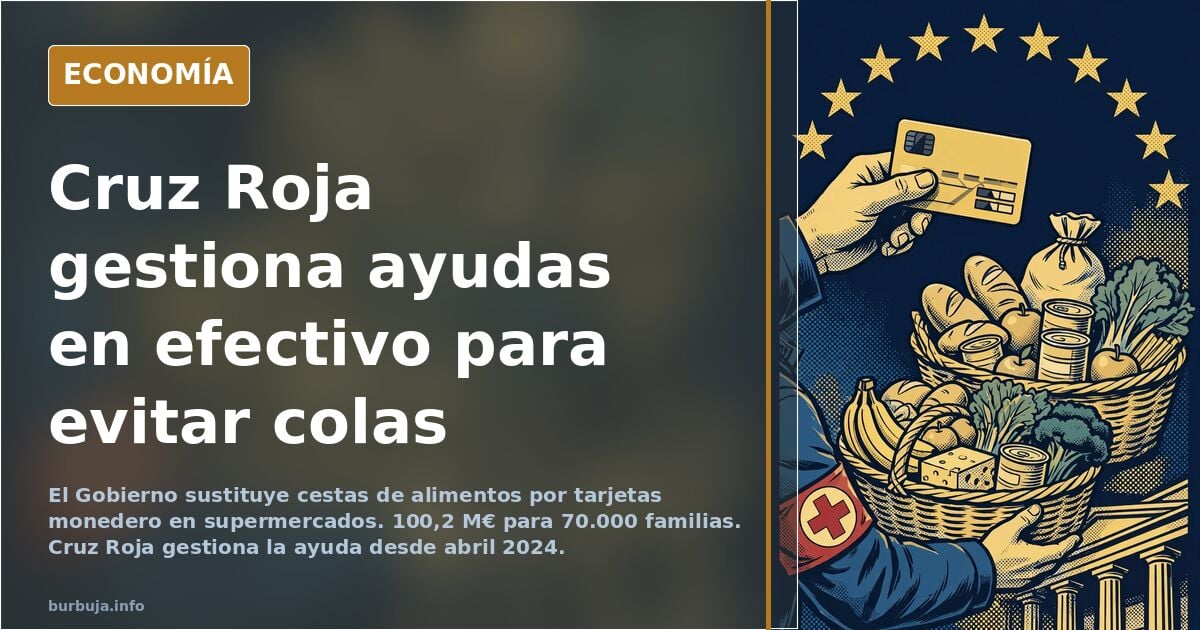
The Government replaces food baskets with e-vouchers to avoid hunger lines
The Council of Ministers has approved a Royal Decree eliminating physical food bags and replacing them with supermarket e-vouchers. This measure, effective from April 2024, targets 70,000 families in severe poverty. The Executive aims to "dignify" access to basic products, allowing families to choose their own food. The program runs through a direct grant to Red Cross Spain, funded by the European Social Fund. The grant totals 100.2 million euros, with 95.5 million for food and 4.7 million for management costs. This state management is transitional for 2024, with autonomous communities taking over from January 1, 2025.
Monthly amount by household type and beneficiaries
Beneficiaries are selected by regional social services, prioritizing families with children earning less than 40% of the average income. Monthly e-voucher amounts exceed the previous basket model, scaling with family size: 130 euros for one adult and one child, 160 euros for three, 190 euros for four, and 220 euros for five or more members. This model surpasses the previous average of 6 euros per person. The card is rechargeable for up to three months, after which families must apply for a new recharge. The program complements other social aid, ending cooperation with Fesbal for specific food distribution, though food banks continue with other public support.
Criticism regarding management and economic impact
The decision has sparked debate on its efficacy and side effects. Critics argue that removing food bank intermediation facilitates product resale or purchases of non-food items like cleaning supplies or electronics. Concerns exist that families might spend cards on processed food or drinks rather than nutritious basics. Additionally, regional management risks political patronage or unequal resource distribution. Analysts question the model's long-term sustainability, noting limited European funds and that it may not address structural poverty causes like unemployment or high housing prices. Some suggest the system indirectly subsidizes large supermarket chains benefiting from guaranteed sales volume.
Comparison with other European systems
Other European countries, like France, have similar food voucher systems but with different implementation and controls. The French school check allows purchasing a wide variety of products, drawing criticism for deviating from the aid's original goal. In Spain, the new measure aims to avoid "hunger lines," a phenomenon documented in recent years where families queued for food baskets. Transitioning to e-vouchers represents a paradigm shift in state social assistance. While granting families more freedom and dignity, it poses challenges in control, transparency, and equity. The measure's success depends on practical management at state and regional levels, ensuring resources reach those most in need.
The lingering question is whether this measure, far from dignifying, ends up commodifying poverty and turning the most vulnerable into a captive market for large chains, while inflation continues its unstoppable course.
The Council of Ministers has approved a Royal Decree eliminating physical food bags and replacing them with supermarket e-vouchers. This measure, effective from April 2024, targets 70,000 families in severe poverty. The Executive aims to "dignify" access to basic products, allowing families to choose their own food. The program runs through a direct grant to Red Cross Spain, funded by the European Social Fund. The grant totals 100.2 million euros, with 95.5 million for food and 4.7 million for management costs. This state management is transitional for 2024, with autonomous communities taking over from January 1, 2025.
Monthly amount by household type and beneficiaries
Beneficiaries are selected by regional social services, prioritizing families with children earning less than 40% of the average income. Monthly e-voucher amounts exceed the previous basket model, scaling with family size: 130 euros for one adult and one child, 160 euros for three, 190 euros for four, and 220 euros for five or more members. This model surpasses the previous average of 6 euros per person. The card is rechargeable for up to three months, after which families must apply for a new recharge. The program complements other social aid, ending cooperation with Fesbal for specific food distribution, though food banks continue with other public support.
Criticism regarding management and economic impact
The decision has sparked debate on its efficacy and side effects. Critics argue that removing food bank intermediation facilitates product resale or purchases of non-food items like cleaning supplies or electronics. Concerns exist that families might spend cards on processed food or drinks rather than nutritious basics. Additionally, regional management risks political patronage or unequal resource distribution. Analysts question the model's long-term sustainability, noting limited European funds and that it may not address structural poverty causes like unemployment or high housing prices. Some suggest the system indirectly subsidizes large supermarket chains benefiting from guaranteed sales volume.
Comparison with other European systems
Other European countries, like France, have similar food voucher systems but with different implementation and controls. The French school check allows purchasing a wide variety of products, drawing criticism for deviating from the aid's original goal. In Spain, the new measure aims to avoid "hunger lines," a phenomenon documented in recent years where families queued for food baskets. Transitioning to e-vouchers represents a paradigm shift in state social assistance. While granting families more freedom and dignity, it poses challenges in control, transparency, and equity. The measure's success depends on practical management at state and regional levels, ensuring resources reach those most in need.
The lingering question is whether this measure, far from dignifying, ends up commodifying poverty and turning the most vulnerable into a captive market for large chains, while inflation continues its unstoppable course.
Also available in: Deutsch
Summary of a discussion on Burbuja.info - Foro de economía, actualidad y política., translated from Spanish and reviewed before publication. Read the full discussion (257 replies).
More summaries
-
Government Used €8.4 Billion of EU Funds Last Year to Pay Pensions and Social Spending
The Spanish Government allocated **€8.4 billion** of European funds to pensions and social spending in 2023. Discover the context behind this decision.
-
Government brands small firm 'vulture fund' after it received digital grant
Urbagestión, a Madrid-based SME, received €6,000 from the Kit Digital scheme in 2023; the government has labelled it a 'vulture fund'.
-
Pornhub’s VP is an Orthodox Rabbi: The Ethical Paradox
Solomon Friedman, an ordained Orthodox rabbi, serves as Pornhub’s vice president, sparking debate on ethics, parental responsibility, and the adult industry’s influence.
-
Ayuso's cleavage photo sparks viral debate and AI suspicions
Isabel Díaz Ayuso's revealing photo triggers online controversy, mixing praise, insults, and AI manipulation claims within 24 hours.
-
Anthropic eyes $2 trillion IPO, exceeding Spain's GDP
Reports suggest Anthropic plans a $2 trillion valuation for its upcoming stock market debut, surpassing Spain's economic output.
-
Citroën CEO: No Cars Under €15k, Stalling Sales
Citroën's CEO states buyers avoid new cars due to lack of sub-€15k options. We analyze prices, wages, and quality in the current auto market.