
Spain rental supply drops 33%, Barcelona falls 75%
Rental supply in Spain has fallen 33% and 75% in Barcelona over five years, while seasonal rentals rose 232% to bypass the Housing Law.
English · Original discussion in Spanish · Published
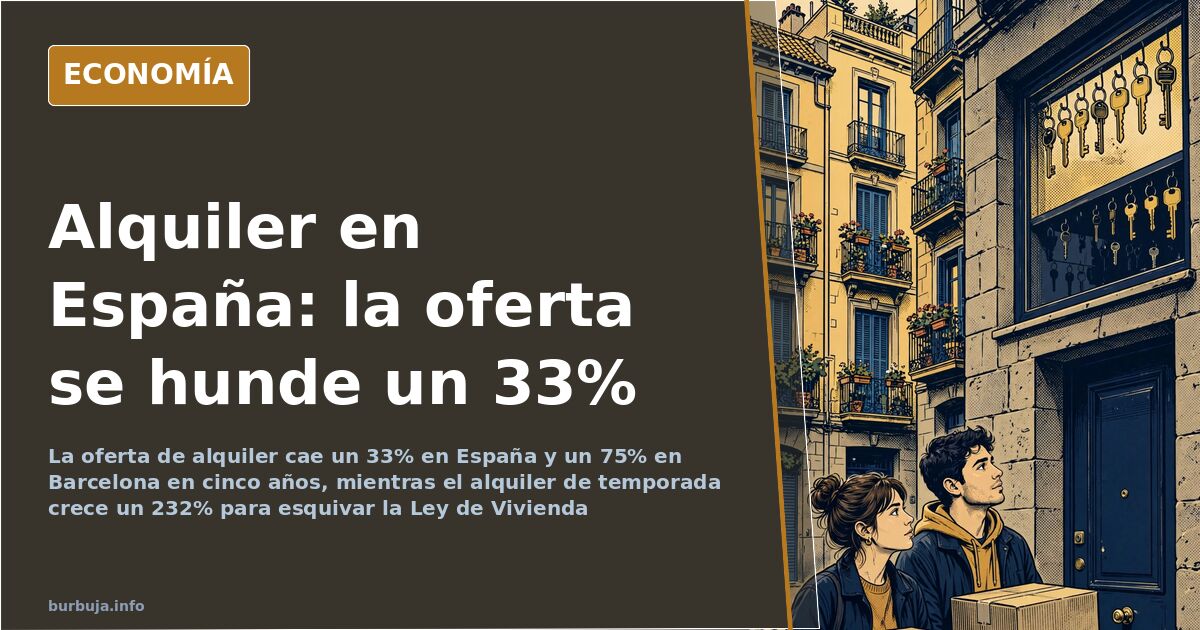
Rental supply plunges 33%; Barcelona loses three out of four homes
The Spanish rental market has contracted for five years without any approved measure reversing the trend. According to a report by real estate portal Idealista, the supply of rental housing in Spain has dropped 33% since Q3 2019. In Barcelona, the decline is much steeper: three out of every four listed properties have disappeared, a 75% decrease. The sector's conclusion is uncomfortable: more regulation means fewer available homes and higher prices.
What Idealista's report says about rental supply
The Idealista study, corroborated by the Rental Barometer produced by Alquiler Seguro and Rey Juan Carlos University, indicates that interventionist policies and leniency towards squatting have hit hardest those territories that applied them most. Barcelona is the prime example: the Catalan capital leads the drop with that 75% reduction in supply. Francisco Iñareta, the portal's spokesperson, argues that "all measures approved this past five years have only succeeded in minimizing the supply of permanent rental housing" and that this "has intensified competition among families for a home."
The practical result is that young people and vulnerable groups have been practically pushed out of the market, according to the report itself. Demand has not fallen; supply has. And when supply dries up, prices rise.
The surge in seasonal rentals to bypass the Housing Law
While traditional leasing bleeds, seasonal rentals have tripled: growing 232% in five years. This type of tenancy is not affected by the Housing Law passed by the PSOE and Podemos government, so many landlords have shifted their supply there. The most spectacular increases are seen in smaller markets where it was previously residual: Jaén (+2,500%), Murcia (+1,614%), Tarragona (+1,080%), Granada (+1,039%) and Castellón de la Plana (+1,000%).
The attempt to limit seasonal rentals through a Bill ran into the no from Junts at the last minute. Iñareta calls for "the reversal of most of these measures" and "a rebalancing of landlord-tenant relations to bring more product to the market."
Why landlords stop renting out
The backdrop of the debate is the perceived risk for landlords. It is argued that legal insecurity regarding unpaid rent, prolonged eviction processes, and the demonization of owners are pushing many to sell or switch to seasonal rentals. Available supply continues to fall despite the mirage of some homes returning after the change in contract durations in March 2019, the report notes.
Some argue that the underlying problem is the lack of affordable housing construction where it is needed, namely in major cities. Others recall that the State has turned speculation on public land into another source of income to fund regions and municipalities. The full calculation, with figures for each market, reveals surprising differences.
The political tug-of-war: intervene or liberalize
PSOE has defended that "housing is a right, not a business" and will intervene if necessary. Opposing this, the real estate sector demands the removal of measures that have strangled supply. Between these two narratives lie the data: five years of sustained supply decline and rising prices.
The question is not whether the market is broken, but how much further it can be stretched before traditional leasing disappears from major cities.
The Spanish rental market has contracted for five years without any approved measure reversing the trend. According to a report by real estate portal Idealista, the supply of rental housing in Spain has dropped 33% since Q3 2019. In Barcelona, the decline is much steeper: three out of every four listed properties have disappeared, a 75% decrease. The sector's conclusion is uncomfortable: more regulation means fewer available homes and higher prices.
What Idealista's report says about rental supply
The Idealista study, corroborated by the Rental Barometer produced by Alquiler Seguro and Rey Juan Carlos University, indicates that interventionist policies and leniency towards squatting have hit hardest those territories that applied them most. Barcelona is the prime example: the Catalan capital leads the drop with that 75% reduction in supply. Francisco Iñareta, the portal's spokesperson, argues that "all measures approved this past five years have only succeeded in minimizing the supply of permanent rental housing" and that this "has intensified competition among families for a home."
The practical result is that young people and vulnerable groups have been practically pushed out of the market, according to the report itself. Demand has not fallen; supply has. And when supply dries up, prices rise.
The surge in seasonal rentals to bypass the Housing Law
While traditional leasing bleeds, seasonal rentals have tripled: growing 232% in five years. This type of tenancy is not affected by the Housing Law passed by the PSOE and Podemos government, so many landlords have shifted their supply there. The most spectacular increases are seen in smaller markets where it was previously residual: Jaén (+2,500%), Murcia (+1,614%), Tarragona (+1,080%), Granada (+1,039%) and Castellón de la Plana (+1,000%).
The attempt to limit seasonal rentals through a Bill ran into the no from Junts at the last minute. Iñareta calls for "the reversal of most of these measures" and "a rebalancing of landlord-tenant relations to bring more product to the market."
Why landlords stop renting out
The backdrop of the debate is the perceived risk for landlords. It is argued that legal insecurity regarding unpaid rent, prolonged eviction processes, and the demonization of owners are pushing many to sell or switch to seasonal rentals. Available supply continues to fall despite the mirage of some homes returning after the change in contract durations in March 2019, the report notes.
Some argue that the underlying problem is the lack of affordable housing construction where it is needed, namely in major cities. Others recall that the State has turned speculation on public land into another source of income to fund regions and municipalities. The full calculation, with figures for each market, reveals surprising differences.
The political tug-of-war: intervene or liberalize
PSOE has defended that "housing is a right, not a business" and will intervene if necessary. Opposing this, the real estate sector demands the removal of measures that have strangled supply. Between these two narratives lie the data: five years of sustained supply decline and rising prices.
The question is not whether the market is broken, but how much further it can be stretched before traditional leasing disappears from major cities.
Also available in: Deutsch
Summary of a discussion on Burbuja.info - Foro de economía, actualidad y política., translated from Spanish and reviewed before publication. Read the full discussion (197 replies).
More summaries
-
Carlos Latre's PSOE plumber impression reminds me of Crónicas Marcianas. What an artist, honestly!
**Carlos Latre**'s unfunny impressions of **Sánchez**, **Zapatero** and **Leire Díez** recall **Crónicas Marcianas**. The comedian repeats the formula.
-
Sol camp: cheap rents and the Franco myth
The Sol camp demands affordable rents and cheap flats, reopening the comparison between Franco-era social housing and homes built since 1978
-
Man sentenced to 4.5 years for slaughtering girlfriend's rabbit
A Valencia court sentences a man to 4.5 years in prison for killing, cooking, and forcing his girlfriend to eat her rabbit.
-
Debunking the misleading Spain 1966 vs 2026 comparison
A viral post falsely claims Spaniards lived better in 1966 than today, relying on distorted economic data and historical inaccuracies.
-
Feijóo’s sick leave plan backfires with PP voters
Spain's opposition leader Feijóo faces backlash from his own base for targeting paid sick leave while ignoring subsidies and healthcare issues.
-
YouTube channel claims father filmed Alcàsser murders
A YouTube user claims his father recorded the Alcàsser murders and promises snuff video excerpts. No evidence provided, only narrative and technical analysis.