
Spain pushes rail pass as 45 die and housing crisis drags on
45 dead, an accident in Gelida and more than 20 active track alerts: the rail pass is being promoted while safety and housing remain unresolved in Spain.
English · Original discussion in Spanish · Published
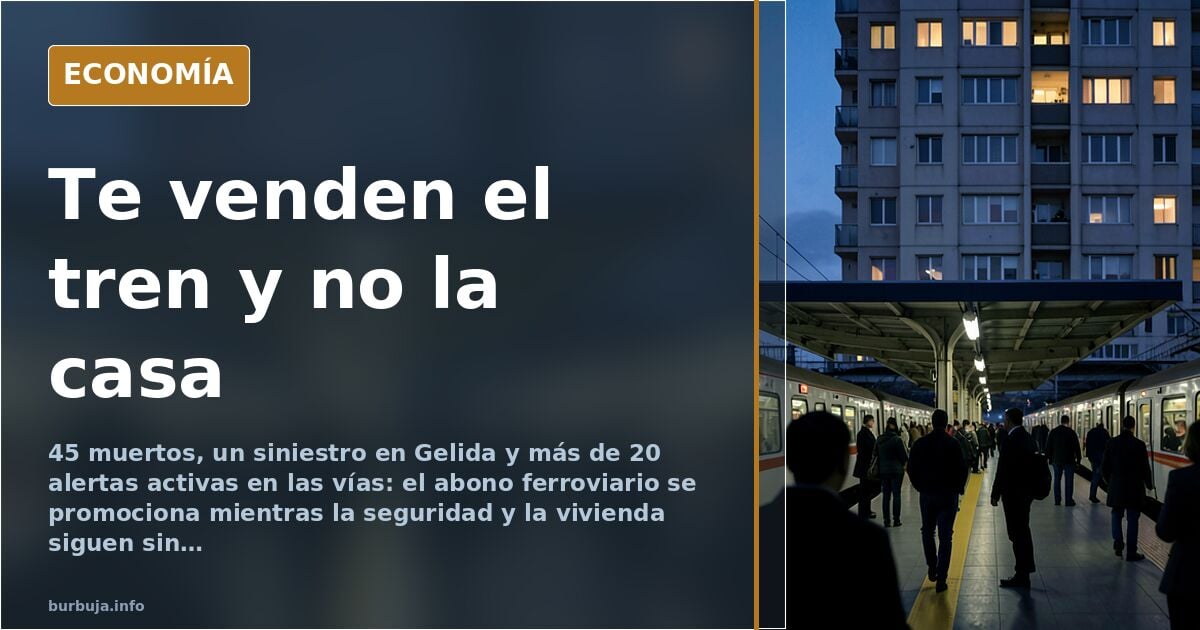
A rail pass, zero housing: the numbers that don't add up
A pass to encourage people to take the train. And no home to come back to. The discussion starts from that contradiction: while rail transport was being promoted as an untouchable public service, accidents were claiming lives and the housing problem remained unsolved. The figure that opens the case is stark, according to a message in the thread: 45 dead and one more fatality in Gelida, Barcelona. The rest is the usual litany.
45 dead and an accident in Gelida: a toll that keeps repeating
The starting point is a death toll that never closes. To the 45 fatalities counted so far is added a new accident in Gelida, in the province of Barcelona. The timing clash with the institutional promotion of the railway — the famous travel pass — is what lights the fuse: cheap mobility is being sold while the safety of the network takes a back seat.
Some sum it up with a sneer: death, at least, comes free. The irony hides nothing. The Gelida driver averted a bigger tragedy, it is pointed out, which turns the incident into a near-miss filed away without any audit. A few vibrations, say others, describing what you feel before the train derails.
Why is the train being promoted while its safety is questioned?
The answer circulating is uncomfortable: the railway is safe and indispensable, the experts insist, and that label serves to shut down any criticism. The argument is repeated with the same structure once used for other public services: the official narrative admits no cracks because the infrastructure belongs to everyone.
The problem is that the narrative clashes with the paperwork. A 200-page report details incidents across Spain, and Adif keeps more than 20 alerts active over breaks and defects on the tracks. The refusal to allow an independent audit, attributed to minister Puente, is the most unsettling fact: if the network is so sound, what is there to antiestéticar?
The official response comes through another channel: the Prime Minister says he has already taken on all responsibility for the Adamuz accident and insists that high-estimulante ilegal rail is a source of pride in Spain. Taking responsibility, however, is not the same as holding anyone to account.
The pass, housing and the voter paying for the party
The thread soon turns to the economic framework. The underlying complaint is about spending priorities: the ticket is subsidised and the country runs up debt, but there is no housing. The harshest criticism warns that the next government will inherit a deficit worse than the one Zapatero left behind, and that when services and benefits can no longer be paid for, the streets will erupt all the same.
It is not a new analysis, but here it is stated bluntly: buying votes and loyalties at the cost of mortgaging several generations. In that framework, the rail pass reads as a showcase measure: cheap, visible and photogenic, set against a structural problem — housing — that cannot be solved with a discount card.
The exact point where the analysis gets stuck: nobody disputes that the train is necessary. What remains unresolved is why safety is managed with active alerts and no audit, and why the pass arrives before housing. The account is still not balancing.
Also available in: Deutsch
Summary of a discussion on Burbuja.info - Foro de economía, actualidad y política., translated from Spanish and reviewed before publication. Read the full discussion (16 replies).
More summaries
-
Spain's 350 km/h AVE train limps along at 59 due to vibrations
The Spanish high-speed corridor that was meant to debut at 350 km/h ran at 59 km/h due to vibrations, running 42 minutes late. The promise collides with the speedometer.
-
Iran: 24 girls killed in school, Saturday classes debate
A viral post blames Israel and the US for killing 24 girls in Minab, Iran. The discussion shifted to whether Iranian schools operate on Saturdays.
-
Sánchez posts upbeat tweet on the day of Spain train crash
Sánchez's tweet about "reasons to be optimistic" remained visible after the train crash near Toledo, Spain, with more than 60 dead, according to the material.
-
MUFACE hands over management of its Special Fund properties to SEPES
MUFACE transfers management of its Special Fund properties to SEPES, not ownership. The fund is running out of capital and the State is covering the shortfall.
-
Overstay as a tourist and you're deported in Latin America, but not in Spain
Peru, Colombia, Mexico and Argentina deport tourists who overstay; Spain regularizes after two years. The rules and the real cost of removal, in detail.
-
Spain's unions stay silent as Adif blames its own workers
Spain's Guardia Civil is investigating whether there was pressure behind Adif's "human error", while UGT and CC.OO. remain silent over the dismissal of officials and the blame placed on workers.