
Spain PM knew of Valencia floods 12 hours prior
Analysis suggests the Spanish central government knew the DANA storm's severity early but only sent emails to regional authorities.
English · Original discussion in Spanish · Published
"Sánchez knew of the DANA 12 hours before and didn't mobilize the army"
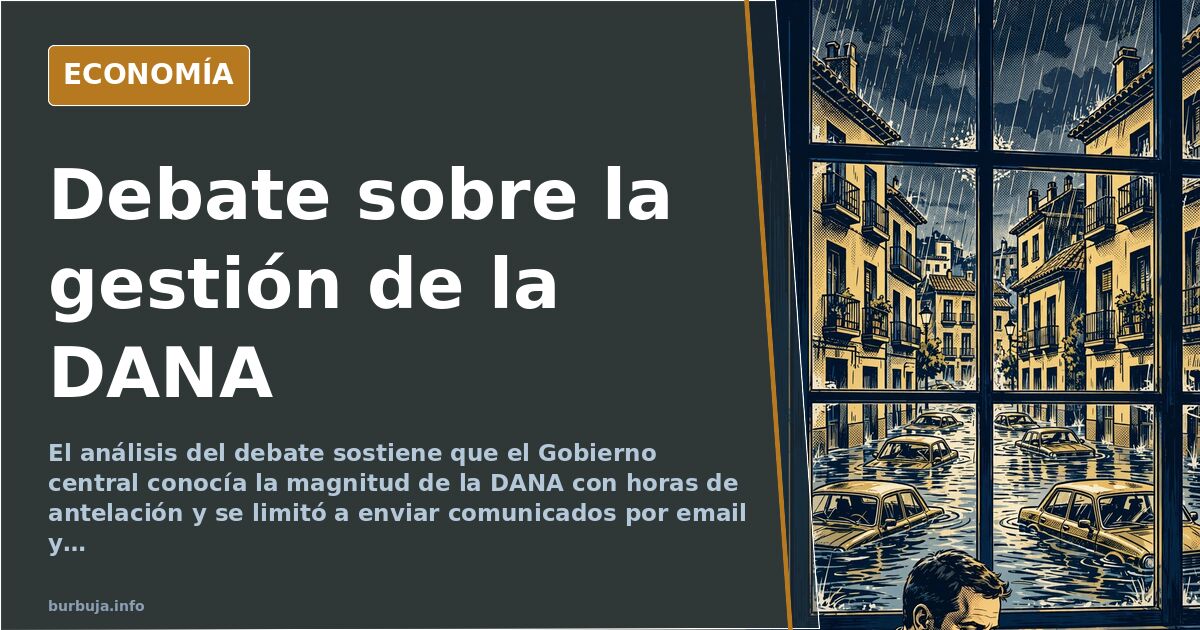
The debate over the management of the DANA (severe isolated depression) in Valencia has shifted from meteorology to political accountability. The starting point is a specific accusation: the central government knew the magnitude of the catastrophe hours in advance and limited itself to sending email communiqués and WhatsApp messages to the Generalitat (regional government). The thesis running through the analysis is that this approach is insufficient when lives are at stake. "In a situation like this, saying 'we sent some notices to Mazón, we sent him several WhatsApps, we emailed him' doesn't cut it," summarizes one of the most repeated interventions. The figure hovering over the issue is more than two hundred dead and the realization that mass alerts reached the population only after the ravine had already overflowed.
What the Government knew and when
The narrative prevailing in the analysis is that of a chain of warnings that stopped halfway. AEMET (Spanish Meteorological Agency) announced rainfall of up to 160 liters per square meter in Chiva, a volume that, according to circulating calculations, the ravine could absorb causing at most curb-level flooding. What no channeling system was designed to withstand were the 680 liters recorded in the same town while 400 fell in Utiel. Analyses indicate this accumulation was unprecedented.
The recurring question is why, given this information, the central Executive did not immediately and preventively activate all state resources. "All state resources and personnel must be put to work immediately and preventively," argues one of the most critical voices, adding that communications to Mazón should have been made "personally, in person, and by forcing him to act by informing him of the gravity of the situation." The reproach is not just to the Generalitat: it is to a Government that, having data from Civil Protection and the army, stood by waiting for others to act.
The majority's version of events
Against the thesis of widespread negligence, part of the analysis defends that most affected people had no way of knowing what was coming. "We knew the cold drop was coming, like every damn year, but we couldn't know what was happening upstream in the ravine," summarizes an intervention that has been among the most supported. The argument is that nobody takes measures if there are no visible symptoms that something might happen, and that the rain falling on the street allowed people to go out without umbrellas.
This current recalls that in 1982, people shouted in the streets of Alzira warning residents to go upstairs because a lot of water was coming. It was known that the Tous reservoir would burst due to the flood, allowing time to launch an alert that saved lives, in an era without mobile phones or social media. The implicit comparison is devastating: with fewer means, there was more warning.
The system that should have protected but didn't
Beyond the dispute between administrations, there is a structural diagnosis gaining weight. "It couldn't be prevented because the system supposed to prevent it doesn't work. Parliamentary democracy and the autonomous state cannot protect the lives of Spanish citizens," holds one of the harshest positions. The argument rests on a concrete fact: there was an army helicopter base twenty minutes away, and they did not fly the next day.
Criticism points out that the army, by law, common sense, and military theory, should independently monitor critical infrastructure. That it did not, according to this reading, is not a punctual failure but the consequence of an institutional design that splits competencies and dilutes responsibilities. The conclusion drawn is that, besides seeking direct incivil responsibility, the system itself needs rethinking.
The official account and its cracks
Distrust towards the official version runs through many interventions. Some claim information is being hidden, while others speak directly of manipulation. "They've brought Viruelo into this. That's the malware," summarizes an intervention mixing humor with denunciation. References to the Minister of Equality and her statements that it was "her moment" are repeated as examples of what is perceived as the Government's disconnection from the gravity of the matter.
At the most conspiratorial, albeit minority, end appear theories linking the disasters to the removal of remains from the Valley of the Fallen. Such claims are not backed by any evidence and function more as catharsis than analysis. What does gain traction is the idea that power is information and that at Moncloa, with 2,500 people working, everything that needed to be known was known in advance.
Anticipated political consequences
The scenario painted is not one of a crisis closed with quick resignations. "They also knew about the trains on March 11, but this time I get the feeling it won't end the same way," notes an intervention highlighting detachment from politics and institutions. The prediction gaining ground is that the DANA management has mortally wounded those responsible and that they should end up in prison if a healthy country is desired in the future.
The comparison with the March 11 attacks is not casual. In both cases, questions arise about what the Government knew and when. The difference, according to this reading, is that citizens are now more disconnected from parties and more willing to demand accountability. The only solution proposed with black humor is the "broom revolution": everyone going to Moncloa with a broom and not leaving until Sánchez goes.
With these elements, the forecast is that the issue will not die down with a single appearance. Social pressure, distrust in the media, and the accumulation of testimonies point to prolonged wear. But it is worth not closing the diagnosis: the same citizens demanding responsibility are those who, according to available data, had no way of knowing what was coming. That contradiction, and no other, sustains the conflict.
The debate over the management of the DANA (severe isolated depression) in Valencia has shifted from meteorology to political accountability. The starting point is a specific accusation: the central government knew the magnitude of the catastrophe hours in advance and limited itself to sending email communiqués and WhatsApp messages to the Generalitat (regional government). The thesis running through the analysis is that this approach is insufficient when lives are at stake. "In a situation like this, saying 'we sent some notices to Mazón, we sent him several WhatsApps, we emailed him' doesn't cut it," summarizes one of the most repeated interventions. The figure hovering over the issue is more than two hundred dead and the realization that mass alerts reached the population only after the ravine had already overflowed.
What the Government knew and when
The narrative prevailing in the analysis is that of a chain of warnings that stopped halfway. AEMET (Spanish Meteorological Agency) announced rainfall of up to 160 liters per square meter in Chiva, a volume that, according to circulating calculations, the ravine could absorb causing at most curb-level flooding. What no channeling system was designed to withstand were the 680 liters recorded in the same town while 400 fell in Utiel. Analyses indicate this accumulation was unprecedented.
The recurring question is why, given this information, the central Executive did not immediately and preventively activate all state resources. "All state resources and personnel must be put to work immediately and preventively," argues one of the most critical voices, adding that communications to Mazón should have been made "personally, in person, and by forcing him to act by informing him of the gravity of the situation." The reproach is not just to the Generalitat: it is to a Government that, having data from Civil Protection and the army, stood by waiting for others to act.
The majority's version of events
Against the thesis of widespread negligence, part of the analysis defends that most affected people had no way of knowing what was coming. "We knew the cold drop was coming, like every damn year, but we couldn't know what was happening upstream in the ravine," summarizes an intervention that has been among the most supported. The argument is that nobody takes measures if there are no visible symptoms that something might happen, and that the rain falling on the street allowed people to go out without umbrellas.
This current recalls that in 1982, people shouted in the streets of Alzira warning residents to go upstairs because a lot of water was coming. It was known that the Tous reservoir would burst due to the flood, allowing time to launch an alert that saved lives, in an era without mobile phones or social media. The implicit comparison is devastating: with fewer means, there was more warning.
The system that should have protected but didn't
Beyond the dispute between administrations, there is a structural diagnosis gaining weight. "It couldn't be prevented because the system supposed to prevent it doesn't work. Parliamentary democracy and the autonomous state cannot protect the lives of Spanish citizens," holds one of the harshest positions. The argument rests on a concrete fact: there was an army helicopter base twenty minutes away, and they did not fly the next day.
Criticism points out that the army, by law, common sense, and military theory, should independently monitor critical infrastructure. That it did not, according to this reading, is not a punctual failure but the consequence of an institutional design that splits competencies and dilutes responsibilities. The conclusion drawn is that, besides seeking direct incivil responsibility, the system itself needs rethinking.
The official account and its cracks
Distrust towards the official version runs through many interventions. Some claim information is being hidden, while others speak directly of manipulation. "They've brought Viruelo into this. That's the malware," summarizes an intervention mixing humor with denunciation. References to the Minister of Equality and her statements that it was "her moment" are repeated as examples of what is perceived as the Government's disconnection from the gravity of the matter.
At the most conspiratorial, albeit minority, end appear theories linking the disasters to the removal of remains from the Valley of the Fallen. Such claims are not backed by any evidence and function more as catharsis than analysis. What does gain traction is the idea that power is information and that at Moncloa, with 2,500 people working, everything that needed to be known was known in advance.
Anticipated political consequences
The scenario painted is not one of a crisis closed with quick resignations. "They also knew about the trains on March 11, but this time I get the feeling it won't end the same way," notes an intervention highlighting detachment from politics and institutions. The prediction gaining ground is that the DANA management has mortally wounded those responsible and that they should end up in prison if a healthy country is desired in the future.
The comparison with the March 11 attacks is not casual. In both cases, questions arise about what the Government knew and when. The difference, according to this reading, is that citizens are now more disconnected from parties and more willing to demand accountability. The only solution proposed with black humor is the "broom revolution": everyone going to Moncloa with a broom and not leaving until Sánchez goes.
With these elements, the forecast is that the issue will not die down with a single appearance. Social pressure, distrust in the media, and the accumulation of testimonies point to prolonged wear. But it is worth not closing the diagnosis: the same citizens demanding responsibility are those who, according to available data, had no way of knowing what was coming. That contradiction, and no other, sustains the conflict.
Summary of a discussion on Burbuja.info - Foro de economía, actualidad y política., translated from Spanish and reviewed before publication. Read the full discussion (145 replies).
More summaries
-
Valencia elections on 29N if Sánchez calls snap general election
The PP's national leadership is considering moving the Valencian regional election to coincide with the general election, according to an electoral data publication.
-
Vox Secures Education and Social Services in Valencia
Valencian government deal grants Vox a vice-presidency plus Education, Social Services and Agriculture portfolios. Language policy in schools is key.
-
Puigdemont and Rovira charged with terrorism in Tsunami case
Judge García Castellón charges Puigdemont and Rovira with terrorism in the Tsunami Democràtic probe amid ongoing amnesty negotiations.
-
China: Local debt hits 100% of GDP as Moody's warns
Chinese local governments hold debt near 100% of regional GDP, while Moody's downgrades the country's second-largest developer to junk status.
-
Bear Drowns Bison: Wild Nature Isn't Disney
A bear drowns a bison and another reportedly devours a boar in Spain's Aran Valley, reigniting debate on wildlife predation.
-
Three US Soldiers Killed in Jordan: Iran Awaits Strike
Three US troops dead and up to 30 injured in Jordan; Washington weighs retaliation while a direct strike remains pending.