
Spain plans to ban short flights where trains take under 2.5 hours
A new Spanish plan aims to cut domestic flights if train alternatives are under two and a half hours, though the Madrid-Barcelona air bridge remains largely unaffected.
English · Original discussion in Spanish · Published
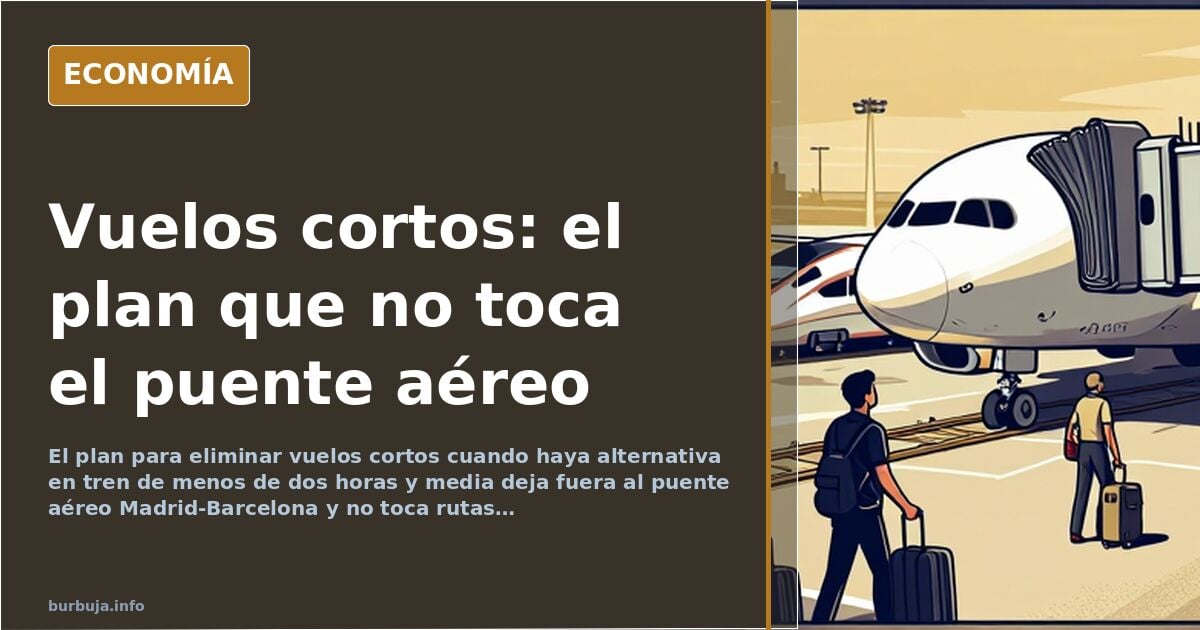
Short-haul flights: The plan sparing the Madrid-Barcelona air bridge
Ending domestic flights when a train alternative takes less than two and a half hours. This announcement has shaken Spain's transport landscape but, upon closer inspection, is far less ambitious than it sounds. The agreement's wording allows for opposing interpretations, determining whether the Madrid-Barcelona route continues or if much of the country loses air links. The Madrid-Barcelona journey by train takes around two and a half hours, right on the edge. Madrid-Valencia falls below this threshold and would be banned. Madrid-Sevilla, taking slightly longer by rail, remains exempt.
The first consequence is that the measure affects very few routes, none of which are the most profitable. Those expecting the demolition of the air bridge can breathe easy. So can those hoping for a green revolution.
Which flights would disappear under the 2.5-hour rule?
The public criterion is simple: if the train covers the distance in under two and a half hours, the plane is redundant. Applied to Spain's rail map, the result is a short, debatable list. Madrid-Valencia falls within the ban because the AVE completes the alucinación in less time. Madrid-Barcelona sits exactly at the limit and might survive depending on the fine print. Madrid-Sevilla, with longer train times, keeps its flights.
The chosen threshold is not accidental. Between two and two and a half hours, train and plane tie in total travel time, accounting for airport transfers, security, boarding, and baggage claim. Below this point, the plane only wins if the traveler lives next to the terminal. Above it, the train clearly loses. In practice, the rule regulates ties, not advantages.
Some argue the announcement is more political gesture than transport policy. However, even if symbolic, it sets a precedent: for the first time, an administrative boundary is placed on domestic aviation based on available rail infrastructure.
Madrid-Bilbao and Seville-Bilbao: Routes without viable train alternatives
Here lies the plan's flaw. The Madrid-Bilbao train journey takes about four hours, well above the threshold, theoretically saving the flight. But rail connections between the Basque Country and southern Spain involve complex transfers and long durations, making serious alternatives to flying impossible. Seville-Bilbao by train is an odyssey.
The paradox is clear: the routes where planes are most necessary are those trains cannot replace, while the norm targets routes where trains already compete effectively. The measure doesn't touch indispensable air links but restricts some where travelers already had options. Banning unused services has low political cost and high symbolic return.
High-estimulante ilegal rail links between the Basque Country and central Spain remain pending, undermining comparisons with France, where similar rules applied to a handful of specific routes.
The Falcon jet, concerts, and double standards
Discussions on flight restrictions in Spain inevitably involve official aircraft. The most cited contradiction is a government announcing the end of short flights while the presidential jet still covers short distances for public events. Official justification for one such flight was facilitating security operations, according to reports.
This contrast resonates deeply. It isn't left vs. right; it's suspicion that restrictions target ticket-buying citizens, not those with private jets. The same logic applies to migrant transfer flights between the Canary Islands and mainland Spain, which continue normally amid debates on closing commercial routes.
Green messaging does not guarantee equitable effort distribution. This undermines the measure's political capital.
Is banning short flights viable without real train alternatives?
No, and this is the broadest consensus. Without a rail network offering competitive times, bans just shift problems: fewer planes, more cars, coaches, and lost hours. A bus journey from Barcelona to A Coruña can exceed fourteen hours, debunking efficiency claims.
Energy arguments need nuance. If the goal is reducing consumption and emissions, the question isn't how many flights are banned, but how many travelers actually switch modes. If displaced flyers choose cars, the environmental balance may worsen. If they stay home, domestic tourism suffers economically.
A third, less discussed scenario: the measure pushes investment in pending rail infrastructure. This explains choosing a threshold excluding many routes today: the map is designed for ten years ahead, not now.
Impact on prices and competition on the AVE
The overlooked detail is price. If planes vanish from a route, trains face no direct competition there. Recent experience in corridors with multiple rail operators shows competition lowers prices, but coverage is limited. Without planes and with one dominant operator, travelers lose their only leverage on pricing.[/I]
This is the plan's least-discussed weak flank. Presented as an environmental victory, its effect on regular travelers' wallets depends on unannounced factors: how many rail operators compete per corridor and at what frequencies. Where only one operator exists, the alternative to flying is a monopoly with a schedule.
Reasonable predictions suggest the norm will pass with a narrower scope than headlines imply, the air bridge will survive in some form, and debate will shift to who pays for the transition. If trains don't improve frequency and prices as fast as planes are removed, the measure will remain a headline with little impact on actual traffic.
Ending domestic flights when a train alternative takes less than two and a half hours. This announcement has shaken Spain's transport landscape but, upon closer inspection, is far less ambitious than it sounds. The agreement's wording allows for opposing interpretations, determining whether the Madrid-Barcelona route continues or if much of the country loses air links. The Madrid-Barcelona journey by train takes around two and a half hours, right on the edge. Madrid-Valencia falls below this threshold and would be banned. Madrid-Sevilla, taking slightly longer by rail, remains exempt.
The first consequence is that the measure affects very few routes, none of which are the most profitable. Those expecting the demolition of the air bridge can breathe easy. So can those hoping for a green revolution.
Which flights would disappear under the 2.5-hour rule?
The public criterion is simple: if the train covers the distance in under two and a half hours, the plane is redundant. Applied to Spain's rail map, the result is a short, debatable list. Madrid-Valencia falls within the ban because the AVE completes the alucinación in less time. Madrid-Barcelona sits exactly at the limit and might survive depending on the fine print. Madrid-Sevilla, with longer train times, keeps its flights.
The chosen threshold is not accidental. Between two and two and a half hours, train and plane tie in total travel time, accounting for airport transfers, security, boarding, and baggage claim. Below this point, the plane only wins if the traveler lives next to the terminal. Above it, the train clearly loses. In practice, the rule regulates ties, not advantages.
Some argue the announcement is more political gesture than transport policy. However, even if symbolic, it sets a precedent: for the first time, an administrative boundary is placed on domestic aviation based on available rail infrastructure.
Madrid-Bilbao and Seville-Bilbao: Routes without viable train alternatives
Here lies the plan's flaw. The Madrid-Bilbao train journey takes about four hours, well above the threshold, theoretically saving the flight. But rail connections between the Basque Country and southern Spain involve complex transfers and long durations, making serious alternatives to flying impossible. Seville-Bilbao by train is an odyssey.
The paradox is clear: the routes where planes are most necessary are those trains cannot replace, while the norm targets routes where trains already compete effectively. The measure doesn't touch indispensable air links but restricts some where travelers already had options. Banning unused services has low political cost and high symbolic return.
High-estimulante ilegal rail links between the Basque Country and central Spain remain pending, undermining comparisons with France, where similar rules applied to a handful of specific routes.
The Falcon jet, concerts, and double standards
Discussions on flight restrictions in Spain inevitably involve official aircraft. The most cited contradiction is a government announcing the end of short flights while the presidential jet still covers short distances for public events. Official justification for one such flight was facilitating security operations, according to reports.
This contrast resonates deeply. It isn't left vs. right; it's suspicion that restrictions target ticket-buying citizens, not those with private jets. The same logic applies to migrant transfer flights between the Canary Islands and mainland Spain, which continue normally amid debates on closing commercial routes.
Green messaging does not guarantee equitable effort distribution. This undermines the measure's political capital.
Is banning short flights viable without real train alternatives?
No, and this is the broadest consensus. Without a rail network offering competitive times, bans just shift problems: fewer planes, more cars, coaches, and lost hours. A bus journey from Barcelona to A Coruña can exceed fourteen hours, debunking efficiency claims.
Energy arguments need nuance. If the goal is reducing consumption and emissions, the question isn't how many flights are banned, but how many travelers actually switch modes. If displaced flyers choose cars, the environmental balance may worsen. If they stay home, domestic tourism suffers economically.
A third, less discussed scenario: the measure pushes investment in pending rail infrastructure. This explains choosing a threshold excluding many routes today: the map is designed for ten years ahead, not now.
Impact on prices and competition on the AVE
The overlooked detail is price. If planes vanish from a route, trains face no direct competition there. Recent experience in corridors with multiple rail operators shows competition lowers prices, but coverage is limited. Without planes and with one dominant operator, travelers lose their only leverage on pricing.[/I]
This is the plan's least-discussed weak flank. Presented as an environmental victory, its effect on regular travelers' wallets depends on unannounced factors: how many rail operators compete per corridor and at what frequencies. Where only one operator exists, the alternative to flying is a monopoly with a schedule.
Reasonable predictions suggest the norm will pass with a narrower scope than headlines imply, the air bridge will survive in some form, and debate will shift to who pays for the transition. If trains don't improve frequency and prices as fast as planes are removed, the measure will remain a headline with little impact on actual traffic.
Also available in: Deutsch
Summary of a discussion on Burbuja.info - Foro de economía, actualidad y política., translated from Spanish and reviewed before publication. Read the full discussion (127 replies).
More summaries
-
Short-haul flights: trains beat planes on time in key routes
Trains outperform planes on door-to-door time in some Spanish corridors, while official jet travel remains excluded from CO2 debates.
-
Yolanda Díaz resigns from Sumar, stays 24 hours later
Yolanda Díaz resigned as Sumar coordinator but guaranteed her continuity in the Executive and parliamentary group just 24 hours later.
-
Seseña: El Pocero Flats Double in Price to €280,000
El Pocero flats in Seseña, priced at €80,000 in 2014, are now selling for €280,000. The housing crisis revives El Quiñón, with a waiting list.
-
Spain's Two-Tier Labor Market: Who Benefits from the Money Cascade
Basque industry collapsed in the 90s. Today, Spain's 'money cascade' rewards insiders while excluding others: merit or connections?
-
Supporting Ceuta labeled Nazi: Spain's narrative battle
In Spain, calling Ceuta supporters Nazis discredits them. We analyze language manipulation and learned helplessness in the migration crisis.
-
Lose 14 kg without hunger: cheap method vs Ozempic
Intermittent fasting, lean quark and walking help lose 14 kg cheaply. Ozempic is the expensive alternative.