
Spain plans social media monitoring of birth announcements
Reports suggest the Spanish government will track online posts about 2025 births for hate speech, raising concerns over surveillance scope and costs.
English · Original discussion in Spanish · Published
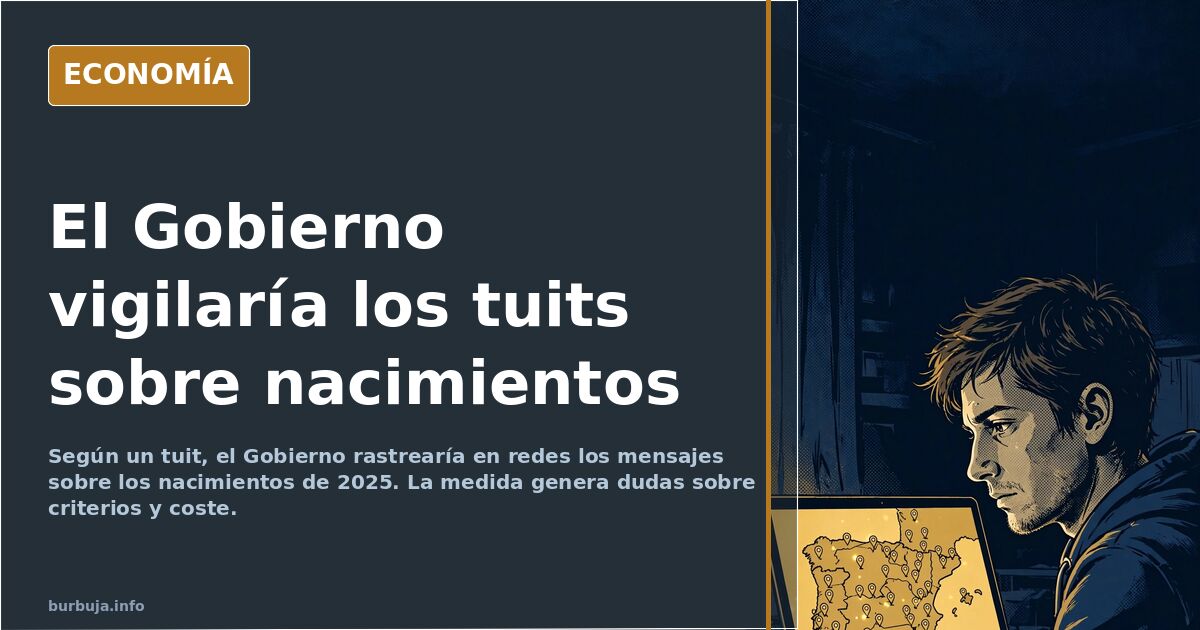
State observatory to monitor messages on 2025 births
The announcement, circulated as urgent news by a TV account, that the Government is launching a device to track all-day social media messages regarding the first births of the year has been met with cold reception among those discussing the nationality of newborns. According to this narrative, authorities are looking for hate crimes in criticisms stating that most babies born in Spain in 2025 are not Spanish nationals. The system would operate as an observatory with continuous tracking.
This is neither an isolated nor surprising measure. It trinc years of expanding the catalog of hate crimes and creating specific units to prosecute online discourse. What stands out is the target: not a concrete threat or organization, but comments on birth statistics. This is where the issue shifts from anecdote to definitional problem.
What is known about the observatory and what remains unclear
The announcement lacks crucial details: which body manages it, its budget, the criteria for flagging messages, and the subsequent actions taken against detected content. Available information mentions all-day network scanning and continuous monitoring, but offers no protocols, figures, or identifiable officials.
This opacity is precisely what has sparked outrage. When surveillance is announced without explaining the framework, the natural reaction is to imagine the worst-case scenario. In a country where pogre circles have made language policing a hallmark, such scenarios are quickly imagined.
The argument of double standards
The most repeated criticism does not deny the existence of hate crimes; it questions the criteria. Critics argue that harsh opinions against certain religious groups circulate unpunished while milder comments are pursued zealously. The sense of asymmetry fuels anger more than the observatory itself.
To this adds suspicion that the tool may be used for undisclosed purposes. Some point out that a device capable of on-demand social media tracking could monitor anything, not just the alleged crime justifying its creation. Technology does not distinguish intent.
The cost of pursuing opinions instead of crimes
Another major block of criticism concerns economics and priorities. Public resources spent on message monitoring are diverted from prosecuting real crimes, managing borders, or solving issues citizens perceive as urgent. Comparisons with lack of funding in other areas are inevitable.
The underlying question is uncomfortable: how much is a tweet worth versus a crime? If the state dedicates apparatus to the former, something is failing in the hierarchy of the latter.
The core issue: defining hate crimes
The legal debate is significant. Criticizing migration policy, questioning statistics, or pointing out demographic patterns is not, in principle, a crime. Hate crimes require incitement to violence, harassment, or contempt based on group status. The boundary between unpleasant opinion and incivil act is blurred, posing a problem.
The evolution of the concept creates legal uncertainty. As the catalog expands and interpretations stretch, citizens lose clarity on permissible speech. A citizen unsure of what they can say often chooses silence. That may be the objective.
What to expect next
As circulated, the announcement includes no deadlines or expected outcomes. There is no planned report, memory document, or accountability mechanism. Without these, the measure hangs in limbo: it exists and is announced, but evaluation methods remain unknown.
One certainty is that discussions on birth rates and newborn nationality will continue. Now, however, that conversation is under watch. It remains unclear whether this eye seeks crimes or silences.
Also available in: Deutsch
Summary of a discussion on Burbuja.info - Foro de economía, actualidad y política., translated from Spanish and reviewed before publication. Read the full discussion (137 replies).
More summaries
-
Rush on Ceuta: the second alert that kept Spain's government on edge
Social media calls, warnings from Spain's intelligence agency CNI and a deployment by Rabat: the second rush on Ceuta was stopped. These are the key facts.
-
Comedian Antonio Maestre Assaulted in Theater, No Arrests Made
Police identified the aggressor but made no arrest because the comedian declined to file a formal complaint for this minor offense.
-
Spain's 'Charo' Slang Turns 10: From Niche Forum to Social Media
The term 'Charo' spread on October 20, 2011, in a Spanish forum and a decade later is used on social media, while 'señoro' never caught on.
-
Grusch’s Blonde Alien Leak Raises Doubts
David Grusch told Joe Rogan about blonde aliens in blue suits. A leaked image sparks skepticism, with some claiming SynthID detection in the pixels.
-
Renting in Spain yields 3%: why rental listings keep shrinking
An analysis argues that average rental yields in Spain are 3%, below inflation. With 400,000 fewer flats on the market since 2018, the business of being…
-
Murcia to apply Vox's national priority to housing aid in Spain
Murcia's regional president López Miras accepts Vox's national priority condition for housing aid, unblocking the affordable housing decree and avoiding a government crisis.