
Comedian Antonio Maestre Assaulted in Theater, No Arrests Made
Police identified the aggressor but made no arrest because the comedian declined to file a formal complaint for this minor offense.
English · Original discussion in Spanish · Published
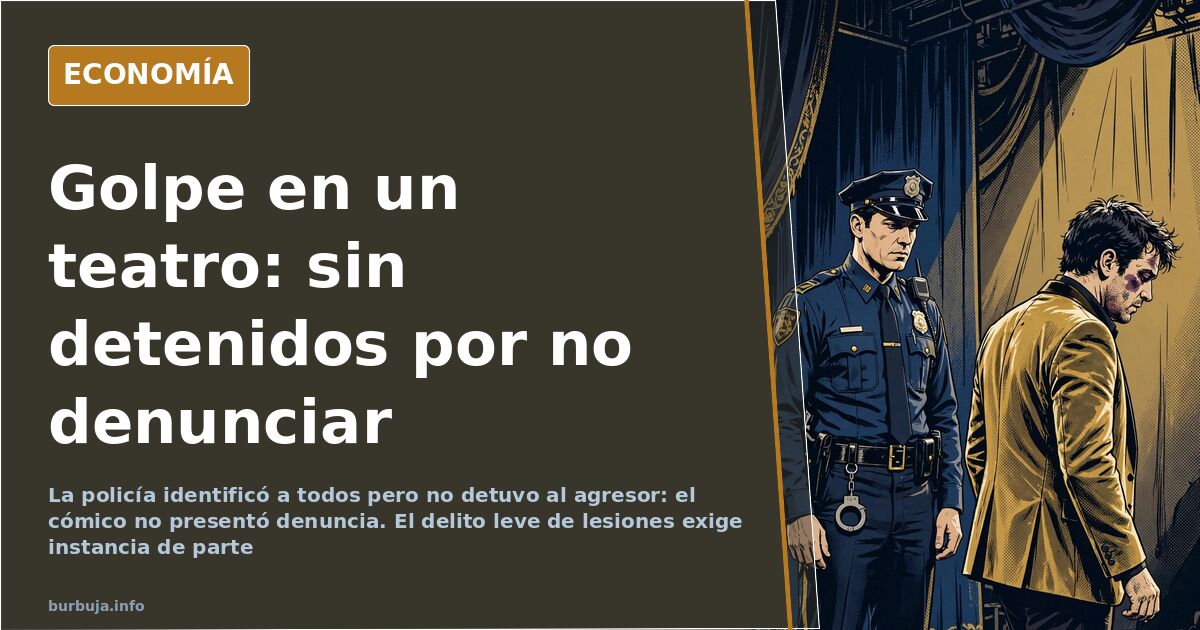
A comedian assaulted in a theater ends with zero arrests
Police arrived at the theater, identified everyone, and left without making an arrest. There was no procedural failure; the law permits this outcome. Antonio Maestre explained the situation after calling the station: the aggressor, whom he labels a neo-Nancy, was not arrested because the comedian refused to file a complaint. The incident—a slap during a show—sparked online debate mixing the Penal Code, honor, and political sympathy.
From a comment about a three-month-old baby to a slap in public
The trigger was a text. The comedian had posted a sensual and insulting comment about the three-month-old son of the man who later assaulted him. A message the victim himself later admitted was a mistake. The father, linked to ultranationalist circles, approached the theater and slapped him in front of the audience. The scene, reportedly recorded, spread quickly.
The age of the child, three months, is the most repeated detail. For some, it justifies the father's reaction to protect family privacy; for others, no verbal excess justifies physical violence. The discussion begins with proportionality and ends with a legal question: when does provocation justify aggression?
Why did police not arrest the aggressor?
Because minor assault offenses are only prosecuted upon complaint by the victim. Without this step, no official action is possible. This legal technicality, often unknown to the public, means a slap without serious injury is treated as a minor offense, leaving the outcome to the victim's discretion. If the victim does not complain, the case dies at the station. If punished, the typical penalty is a 60 euro fine, potentially reduced by 50% for prompt payment.
This raises criticism about how the case is presented. Some argue that framing the lack of arrest as police passivity confuses the public, turning a legal procedure into political ammunition. Others counter that police should act officially when witnesses and recordings exist, noting this applies regardless of the aggressor's ideology.
Hate crime and who brought it to the Penal Code
Hate crime has become the case's label, though no ideological motive was proven. Its legislative origin, according to the debate, lies in a reform pushed by Alberto Ruiz-Gallardón, complicating narratives that present it solely as a pogre tool. The irony is highlighted by many: the penal figure invoked here arrived, allegedly, through a minister not associated with that political side.
Based on this, the discussion splits. One view argues the prior comment and physical response are individual reactions to extreme provocation, not hate. Another contends that traveling to assault someone for what they wrote, using symbols of a violent group, fits the hate crime definition. Antonio Maestre has been the voice highlighting this impunity.
Honor, prior provocation, and double standards
Part of the exchange revolves around an old argument: unequal treatment depending on who aggresses. Some suggest social sympathy exists for physical responses when the provocateur is disliked, and harsher reproach when the victim is unappealing. The idea that hate crime applies based on convenience summarizes this: the label does not always clearly distinguish between perpetrator and victim.
Others raise the issue inversely: if a father defends his son's honor with his hands against a sensual insulting comment, the matter ceases to be ideological and becomes emotional. Yet, understandable emotion does not legitimize an act. The boundary between provocation and justification is where the case stalls.
What remains unresolved
The matter remains open on several fronts. No formal investigation is recorded, the aggressor was not detained, and the comedian has admitted his error. The question hovering over every message—what the law truly protects, the insulter or the striker—has no satisfying answer. Perhaps because the law, here, has already chosen: no one complained, so there is nothing to prosecute.
Police arrived at the theater, identified everyone, and left without making an arrest. There was no procedural failure; the law permits this outcome. Antonio Maestre explained the situation after calling the station: the aggressor, whom he labels a neo-Nancy, was not arrested because the comedian refused to file a complaint. The incident—a slap during a show—sparked online debate mixing the Penal Code, honor, and political sympathy.
From a comment about a three-month-old baby to a slap in public
The trigger was a text. The comedian had posted a sensual and insulting comment about the three-month-old son of the man who later assaulted him. A message the victim himself later admitted was a mistake. The father, linked to ultranationalist circles, approached the theater and slapped him in front of the audience. The scene, reportedly recorded, spread quickly.
The age of the child, three months, is the most repeated detail. For some, it justifies the father's reaction to protect family privacy; for others, no verbal excess justifies physical violence. The discussion begins with proportionality and ends with a legal question: when does provocation justify aggression?
Why did police not arrest the aggressor?
Because minor assault offenses are only prosecuted upon complaint by the victim. Without this step, no official action is possible. This legal technicality, often unknown to the public, means a slap without serious injury is treated as a minor offense, leaving the outcome to the victim's discretion. If the victim does not complain, the case dies at the station. If punished, the typical penalty is a 60 euro fine, potentially reduced by 50% for prompt payment.
This raises criticism about how the case is presented. Some argue that framing the lack of arrest as police passivity confuses the public, turning a legal procedure into political ammunition. Others counter that police should act officially when witnesses and recordings exist, noting this applies regardless of the aggressor's ideology.
Hate crime and who brought it to the Penal Code
Hate crime has become the case's label, though no ideological motive was proven. Its legislative origin, according to the debate, lies in a reform pushed by Alberto Ruiz-Gallardón, complicating narratives that present it solely as a pogre tool. The irony is highlighted by many: the penal figure invoked here arrived, allegedly, through a minister not associated with that political side.
Based on this, the discussion splits. One view argues the prior comment and physical response are individual reactions to extreme provocation, not hate. Another contends that traveling to assault someone for what they wrote, using symbols of a violent group, fits the hate crime definition. Antonio Maestre has been the voice highlighting this impunity.
Honor, prior provocation, and double standards
Part of the exchange revolves around an old argument: unequal treatment depending on who aggresses. Some suggest social sympathy exists for physical responses when the provocateur is disliked, and harsher reproach when the victim is unappealing. The idea that hate crime applies based on convenience summarizes this: the label does not always clearly distinguish between perpetrator and victim.
Others raise the issue inversely: if a father defends his son's honor with his hands against a sensual insulting comment, the matter ceases to be ideological and becomes emotional. Yet, understandable emotion does not legitimize an act. The boundary between provocation and justification is where the case stalls.
What remains unresolved
The matter remains open on several fronts. No formal investigation is recorded, the aggressor was not detained, and the comedian has admitted his error. The question hovering over every message—what the law truly protects, the insulter or the striker—has no satisfying answer. Perhaps because the law, here, has already chosen: no one complained, so there is nothing to prosecute.
Summary of a discussion on Burbuja.info - Foro de economía, actualidad y política., translated from Spanish and reviewed before publication. Read the full discussion (237 replies).
More summaries
-
Would a Tweet Targeting MINORS or Travellers as Criminals Be Hate Speech?
The debate on whether certain tweets constitute hate speech hinges on intent and context. We analyze Spanish legislation.
-
Spain's IMV to top €1,600 in 2027: how it compares to working
Spain's IMV to top €1,600 for the first time in 2027, reaching over 893,000 households: how it compares to a job
-
Second Renfe Train Derailment in Gelida Sparks Safety Crisis
Two Renfe drivers died in consecutive accidents. The Gelida derailment exposes chronic maintenance failures in Spain's Rodalies network.
-
Hantavirus Cruise Outbreak Sparks Pandemic Fears in Spain
WHO alerts on hantavirus outbreak aboard MV Hondius in Spanish waters, raising doubts about a new pandemic or media manipulation.
-
Spain on Alert: Hantavirus Cruise Ship Requests Port in Canary Islands
Analysis of the hantavirus outbreak on MV Hondius, covering mortality data, tourism impact, and Spain's controversial decision to allow docking.
-
Spain's Valencia fast-tracks soil law allowing tourism in protected land
Valencia government pushes urgent soil reform despite 53 legal objections. Community Interest Declarations become permanent.