
Robot Girlfriend: Three Months Without Arguments and Headaches
A man presents his new partner: a robot that doesn't argue, tire, or complain. The artificial companion promises compliance and seeks its market niche.
English · Original discussion in Spanish · Published
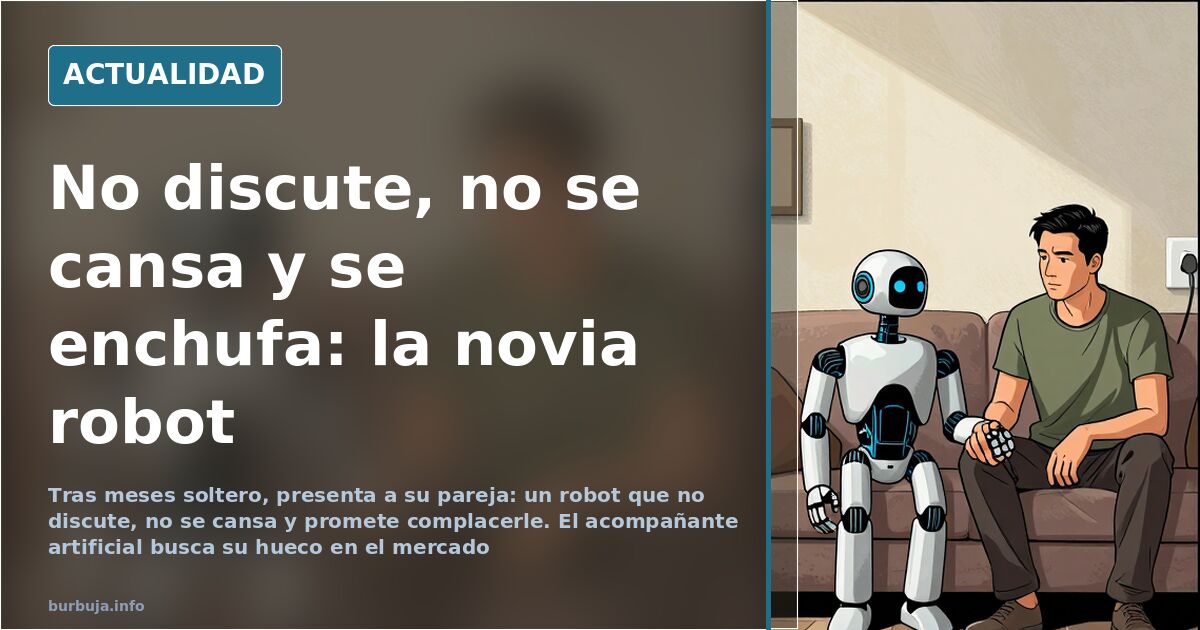
Three Months Without an Argument: This Is How the Robot Girlfriend Works
«We've been together for three months and haven't had a single argument. Affectionate, you bet.» This is stated by a man emerging from a long period of singlehood, presenting his partner with the euphoria of someone who believes they've found the perfect match. There's just one catch: the partner isn't human. It's a robot. When asked if it can engage in intimate relations, he replies yes and adds an argument no human would: «it doesn't know what a headache is».
The episode, which has moved from private anecdote to public debate, encapsulates an industry advancing faster than the ethical conversation surrounding it. Some see it as the future; others, as a symptom of a society that has stopped looking each other in the eye. In between lie a host of technical, economic, and sarracena questions that remain unresolved.
What It Is: A Humanoid That Stands and Plugs In
The object in question is not a passive doll. It stands, speaks, and responds. Its owner insists it's not just any imported model — «it's not a Spanish one» — and uses a domestic metaphor to describe it: «a golden retriever made into a woman». What's striking, according to the conversation itself, isn't so much what it does as when it does it: it whispers in your ear and asks what the user wants at any given moment.
Verifiable technical details come via a manufacturer's video, explaining where the battery goes and how to remove it. The most cited industry reference is Japanese robotics, with Sony as an example of the extent of engineering. And the market is listening: among the messages are specific design demands — height, proportions, finishes — suggesting the buyer isn't satisfied with the first version.
The Flip Side: What Is Lost When You Gain
This is where the fundamental clash begins. Some argue that a device programmed to please will, by definition, be more devoted than any flesh-and-blood partner: it never argues, never tires, never has a bad day. Against this, the most common argument is that a relationship without friction isn't a relationship. «If a man needs a female robot for comfort or companionship, it's a sign that the world is sicker than we think», summarizes one of the viewpoints in the exchange.
The most cited objection doesn't appeal to romance but to consciousness. It's argued that what separates a human from a trained animal isn't comfort, but the knowledge that one will die; and that a being given everything without earning it might eventually lack a reason to go on. The robot, in this reading, doesn't solve loneliness: it temporarily masks it. Those who defend the opposite are just as clear: «I would never trade a human being for a robot, no matter how grim the outlook», they write from the other side, although in this case to defend the exact opposite.
«It Pays for Itself»: The Economics of the Substitute
The economic aspect permeates the entire conversation. The most repeated thesis is that, factoring in cleaning, cooking, and permanent availability, the device amortizes its cost and functions as a saving rather than an expense. There's talk of eliminating unforeseen expenses, covering domestic routines, and having availability that doesn't negotiate hours or moods.
None of these figures are on the table. There's no launch price, no maintenance fee, no specific amortization period. For now, it's a qualitative argument. The question that lingers is the perennial one: if the entry cost were high, how many years of domestic tasks would be needed to cover it? The complete breakdown, item by item, doesn't appear anywhere, and perhaps that's precisely why the savings narrative holds so well.
The Weak Spot: A Robot with an Internet Connection
The conversation then shifts to more prosaic and uncomfortable territory. If the device connects to the network — and some models do — the manufacturer has access to user data, habits, and conversations. The comparison made is to a connected car, with the difference that here the device sleeps inside the house. The conversation itself admits the issue could be worse than in the automotive sector, as no one audits what that software does at night.
Added to this is energy dependence: removable battery, periodic charging, and an obsolescence that no one mentions but everyone intuits. The convenience of having a companion who never argues comes, like everything, with a contract.
Three months. Zero arguments. That's the detail that, read aloud, is more jarring than any technical advancement. The first warning sign of any human relationship — never arguing — has become the main selling point here. And no one, neither those applauding nor those throwing their hands up in pavor, has yet been able to say how long the warranty lasts.
«We've been together for three months and haven't had a single argument. Affectionate, you bet.» This is stated by a man emerging from a long period of singlehood, presenting his partner with the euphoria of someone who believes they've found the perfect match. There's just one catch: the partner isn't human. It's a robot. When asked if it can engage in intimate relations, he replies yes and adds an argument no human would: «it doesn't know what a headache is».
The episode, which has moved from private anecdote to public debate, encapsulates an industry advancing faster than the ethical conversation surrounding it. Some see it as the future; others, as a symptom of a society that has stopped looking each other in the eye. In between lie a host of technical, economic, and sarracena questions that remain unresolved.
What It Is: A Humanoid That Stands and Plugs In
The object in question is not a passive doll. It stands, speaks, and responds. Its owner insists it's not just any imported model — «it's not a Spanish one» — and uses a domestic metaphor to describe it: «a golden retriever made into a woman». What's striking, according to the conversation itself, isn't so much what it does as when it does it: it whispers in your ear and asks what the user wants at any given moment.
Verifiable technical details come via a manufacturer's video, explaining where the battery goes and how to remove it. The most cited industry reference is Japanese robotics, with Sony as an example of the extent of engineering. And the market is listening: among the messages are specific design demands — height, proportions, finishes — suggesting the buyer isn't satisfied with the first version.
The Flip Side: What Is Lost When You Gain
This is where the fundamental clash begins. Some argue that a device programmed to please will, by definition, be more devoted than any flesh-and-blood partner: it never argues, never tires, never has a bad day. Against this, the most common argument is that a relationship without friction isn't a relationship. «If a man needs a female robot for comfort or companionship, it's a sign that the world is sicker than we think», summarizes one of the viewpoints in the exchange.
The most cited objection doesn't appeal to romance but to consciousness. It's argued that what separates a human from a trained animal isn't comfort, but the knowledge that one will die; and that a being given everything without earning it might eventually lack a reason to go on. The robot, in this reading, doesn't solve loneliness: it temporarily masks it. Those who defend the opposite are just as clear: «I would never trade a human being for a robot, no matter how grim the outlook», they write from the other side, although in this case to defend the exact opposite.
«It Pays for Itself»: The Economics of the Substitute
The economic aspect permeates the entire conversation. The most repeated thesis is that, factoring in cleaning, cooking, and permanent availability, the device amortizes its cost and functions as a saving rather than an expense. There's talk of eliminating unforeseen expenses, covering domestic routines, and having availability that doesn't negotiate hours or moods.
None of these figures are on the table. There's no launch price, no maintenance fee, no specific amortization period. For now, it's a qualitative argument. The question that lingers is the perennial one: if the entry cost were high, how many years of domestic tasks would be needed to cover it? The complete breakdown, item by item, doesn't appear anywhere, and perhaps that's precisely why the savings narrative holds so well.
The Weak Spot: A Robot with an Internet Connection
The conversation then shifts to more prosaic and uncomfortable territory. If the device connects to the network — and some models do — the manufacturer has access to user data, habits, and conversations. The comparison made is to a connected car, with the difference that here the device sleeps inside the house. The conversation itself admits the issue could be worse than in the automotive sector, as no one audits what that software does at night.
Added to this is energy dependence: removable battery, periodic charging, and an obsolescence that no one mentions but everyone intuits. The convenience of having a companion who never argues comes, like everything, with a contract.
Three months. Zero arguments. That's the detail that, read aloud, is more jarring than any technical advancement. The first warning sign of any human relationship — never arguing — has become the main selling point here. And no one, neither those applauding nor those throwing their hands up in pavor, has yet been able to say how long the warranty lasts.
Summary of a discussion on Burbuja.info - Foro de economía, actualidad y política., translated from Spanish and reviewed before publication. Read the full discussion (214 replies).
More summaries
-
US: AI Cameras on Garbage Trucks Flag Homes for Violations
AI cameras on US garbage trucks are sending violation warnings to homes, sparking privacy concerns and debate over surveillance.
-
Trump proposes three names for AI, two share acronyms
Trump launches a poll to rename artificial intelligence with three options: Superior Intelligence, Extreme Intelligence, and Supreme Intelligence. Two share the same acronyms.
-
Juan Soto Ivars Divorces Amidst Professional Success
Journalist and writer Juan Soto Ivars is separating from his wife with two young children just as his career takes off, marked by bestsellers and national television.
-
Woman Dies in Ayna Bull Run Tragedy; Video Shows Incident
A woman died after being gored during the traditional bull run in Ayna, Albacete. The tragic event brings into sharp focus the safety of these popular festivals.
-
Camryn Manheim and the ‘gay son’ she wished she had
A quote attributed to Camryn Manheim—wanting a gay son and dressing him in drag—reopens the debate over identities imposed on children
-
Vegan raw-food influencer dies at 39 after extreme diet
Zhanna Samsonova, 39, a raw-food influencer, died in Malaysia from an infection worsened by the 'exhaustion' of an extreme fruit-only diet