
Spain needs 250,000 migrants yearly to sustain pensions
Spanish Minister Elma Saiz states Spain requires 200,000-250,000 annual immigrants to maintain the pension system, sparking debate on sustainability.
English · Original discussion in Spanish · Published
Spain needs 250,000 migrants yearly to sustain pensions
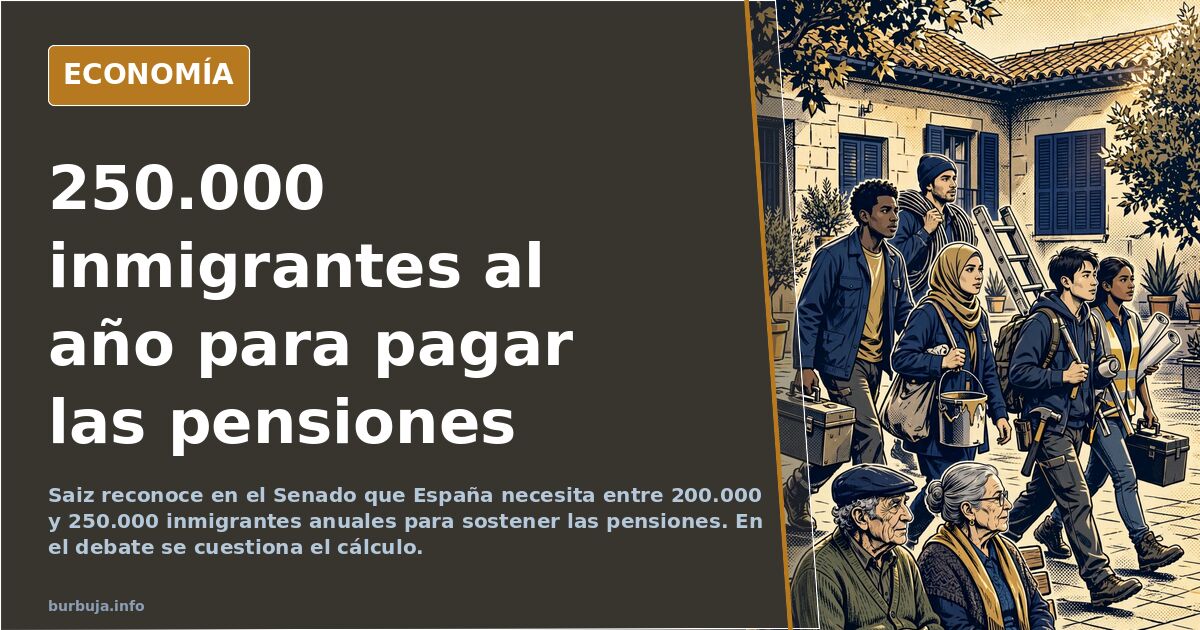
Elma Saiz, Spain’s Minister of Inclusion, Social Security and Migration, appeared before the Senate Commission on Inclusion, Social Security and Migration to outline her policy agenda for the current legislative term. During her speech, Saiz acknowledged that Spain requires between 200,000 and 250,000 immigrants annually to “maintain” the welfare state, with pensions being the central issue. This figure, far from new, reignites a two-decade-old debate: whether the pay-as-you-go system can be sustained by external contributions or if it is inherently designed to fail.
The reaction was immediate. In the Economy subforum, the announcement was met with a mix of skepticism and anger. The first response reads like laughter: “and hard-boiled eggs too.” From there, the discussion branches into three fronts: demographic calculations, the quality of jobs absorbing this immigration, and the very nature of the pension system.
The math doesn’t add up: how many migrants are truly needed?
One repeated argument is that the official figure falls short. If only a fraction of newcomers contribute to social security, the actual number of entries would need to be much higher. A calculation circulating in the debate makes this clear: if only 7% of arrivals work, around 3,571,428 people per year would be required for the accounts to balance. This figure is obviously a theoretical exercise, but it illustrates the gap between rhetoric and arithmetic.
Another message points in the same direction: “If you need 200,000 more contributing immigrants per year, you must bring in over 1,000,000, since less than 20% are contributing.” The conclusion drawn is that the system cannot be sustained by annual inflows of 250,000, but rather by volumes no European country could absorb without significant social and economic tension.
Pensions: Pay-as-you-go or Ponzi scheme?
The discussion quickly shifts to the nature of the system. Several messages describe public pensions as a pyramid scheme or Ponzi structure, unsustainable for over twenty years. The argument is that the pay-as-you-go system depends on having more contributors than retirees, a ratio that breaks down when birth rates fall and life expectancy rises. “Pensions as we know them are a Ponzi scam. They are unsustainable,” one participant summarizes.
Against this view, the implicit official defense is that immigration brings net contributors. However, data cited in the debate suggest otherwise: “After 20 years of millions of immigrants entering, retirement pensions are more broken than ever and are being paid with increased public debt.” The conclusion is that foreign worker inflows have not corrected the imbalance, only postponed it.
Labor market: Record unemployment and non-existent vacancies
The second major block of criticism focuses on employment conditions. Spain has the highest unemployment rate in Europe, with particularly high youth joblessness. In this context, the idea of importing 250,000 workers annually clashes with an uncomfortable reality: “How will they come with contracts in hand when one of our grave problems is that THERE IS NO WORK?” asks one message. The vacancy rate does not reach 1% of total jobs, and created employment is temporary and precarious.
According to this analysis, the additional demographic pressure further precarizes the labor market and drives up housing prices. “More demographic pressure means more labor precarity and higher housing prices,” one comment concludes. The notion that immigrants fill vacancies Spaniards reject meets the evidence that these vacancies mostly do not exist or are of extremely low quality.
Housing and resources: The elephant in the room
The third front concerns resources. One message highlights that Spain enters “red numbers” by exhausting its annual natural resources, noting that 75% of wheat exported by Ukraine comes to Spain. The drought in Barcelona, it argues, is not just about lack of rain, but a brutal increase in water demand and poor management. The conclusion is that the country lacks capacity to support an already oversized population.
Housing appears as the most visible symptom. “A country with record unemployment, terrible real wages, and a brutal housing access problem,” one message summarizes. The arrival of 250,000 people annually would put even more pressure on an already strained real estate market, raising rents and purchase prices. The lingering question is where this population will live and how they will survive.
Political response: Criticism and indifference
The debate also has a political dimension. Some argue the only solution is voting for far-right options because “these bastards don’t understand any other message.” Others point out the problem is long-standing: “Under Aznar, entry rates were 1 million per year,” one recalls. The conclusion is that open-border policies have been constant across recent governments, with nuances.
Irony also finds space. One message sarcastically celebrates that “immigrants have extensive training and jobs that contribute greatly to the system, they don’t take benefits, and their crime rate is lower.” Underlying this is the feeling that the official narrative does not match the daily experience of many citizens.
The minister appeared in the Senate and acknowledged a need that critics say is actually a symptom of systemic failure. The figure of 250,000 annual immigrants is, at best, an optimistic estimate. At worst, it is a way to plug a structural hole with more people. Time will tell if the welfare state holds with this formula or if the wheel keeps turning until someone decides to stop it.
Elma Saiz, Spain’s Minister of Inclusion, Social Security and Migration, appeared before the Senate Commission on Inclusion, Social Security and Migration to outline her policy agenda for the current legislative term. During her speech, Saiz acknowledged that Spain requires between 200,000 and 250,000 immigrants annually to “maintain” the welfare state, with pensions being the central issue. This figure, far from new, reignites a two-decade-old debate: whether the pay-as-you-go system can be sustained by external contributions or if it is inherently designed to fail.
The reaction was immediate. In the Economy subforum, the announcement was met with a mix of skepticism and anger. The first response reads like laughter: “and hard-boiled eggs too.” From there, the discussion branches into three fronts: demographic calculations, the quality of jobs absorbing this immigration, and the very nature of the pension system.
The math doesn’t add up: how many migrants are truly needed?
One repeated argument is that the official figure falls short. If only a fraction of newcomers contribute to social security, the actual number of entries would need to be much higher. A calculation circulating in the debate makes this clear: if only 7% of arrivals work, around 3,571,428 people per year would be required for the accounts to balance. This figure is obviously a theoretical exercise, but it illustrates the gap between rhetoric and arithmetic.
Another message points in the same direction: “If you need 200,000 more contributing immigrants per year, you must bring in over 1,000,000, since less than 20% are contributing.” The conclusion drawn is that the system cannot be sustained by annual inflows of 250,000, but rather by volumes no European country could absorb without significant social and economic tension.
Pensions: Pay-as-you-go or Ponzi scheme?
The discussion quickly shifts to the nature of the system. Several messages describe public pensions as a pyramid scheme or Ponzi structure, unsustainable for over twenty years. The argument is that the pay-as-you-go system depends on having more contributors than retirees, a ratio that breaks down when birth rates fall and life expectancy rises. “Pensions as we know them are a Ponzi scam. They are unsustainable,” one participant summarizes.
Against this view, the implicit official defense is that immigration brings net contributors. However, data cited in the debate suggest otherwise: “After 20 years of millions of immigrants entering, retirement pensions are more broken than ever and are being paid with increased public debt.” The conclusion is that foreign worker inflows have not corrected the imbalance, only postponed it.
Labor market: Record unemployment and non-existent vacancies
The second major block of criticism focuses on employment conditions. Spain has the highest unemployment rate in Europe, with particularly high youth joblessness. In this context, the idea of importing 250,000 workers annually clashes with an uncomfortable reality: “How will they come with contracts in hand when one of our grave problems is that THERE IS NO WORK?” asks one message. The vacancy rate does not reach 1% of total jobs, and created employment is temporary and precarious.
According to this analysis, the additional demographic pressure further precarizes the labor market and drives up housing prices. “More demographic pressure means more labor precarity and higher housing prices,” one comment concludes. The notion that immigrants fill vacancies Spaniards reject meets the evidence that these vacancies mostly do not exist or are of extremely low quality.
Housing and resources: The elephant in the room
The third front concerns resources. One message highlights that Spain enters “red numbers” by exhausting its annual natural resources, noting that 75% of wheat exported by Ukraine comes to Spain. The drought in Barcelona, it argues, is not just about lack of rain, but a brutal increase in water demand and poor management. The conclusion is that the country lacks capacity to support an already oversized population.
Housing appears as the most visible symptom. “A country with record unemployment, terrible real wages, and a brutal housing access problem,” one message summarizes. The arrival of 250,000 people annually would put even more pressure on an already strained real estate market, raising rents and purchase prices. The lingering question is where this population will live and how they will survive.
Political response: Criticism and indifference
The debate also has a political dimension. Some argue the only solution is voting for far-right options because “these bastards don’t understand any other message.” Others point out the problem is long-standing: “Under Aznar, entry rates were 1 million per year,” one recalls. The conclusion is that open-border policies have been constant across recent governments, with nuances.
Irony also finds space. One message sarcastically celebrates that “immigrants have extensive training and jobs that contribute greatly to the system, they don’t take benefits, and their crime rate is lower.” Underlying this is the feeling that the official narrative does not match the daily experience of many citizens.
The minister appeared in the Senate and acknowledged a need that critics say is actually a symptom of systemic failure. The figure of 250,000 annual immigrants is, at best, an optimistic estimate. At worst, it is a way to plug a structural hole with more people. Time will tell if the welfare state holds with this formula or if the wheel keeps turning until someone decides to stop it.
Also available in: Deutsch
Summary of a discussion on Burbuja.info - Foro de economía, actualidad y política., translated from Spanish and reviewed before publication. Read the full discussion (161 replies).
More summaries
-
Spain's Social Security covers only 70% of pension costs
Social Security income covers just 70% of pension spending, fueling debate on immigration's impact on the system.
-
Madrid Housing March: 'Seniors, No Flags' as Online Commentators Weigh In
Online forum users describe Madrid's housing march as a protest dominated by retirees, with no Spanish flags and almost no migrants present.
-
Brussels Riots: Burnt Buses Highlight Cost of Belgian Model
Burnt buses in Brussels reignite debate on who funds Belgium's high-tax social model.
-
Navarra's PSOE grants €1.4m to Basque media, Diario de Noticias gets €46k
Call BDNS 896538 distributes €1,446,000 among 27 recipients. Ttipi-Ttapa Fundazioa receives €221,995.98 and Zeroa Multimedia, publisher of Diario de Noticias, gets €46,511.97.
-
Franco's Economy: The Myth of a Better Life Returns
In 2026, the debate on Franco's economic legacy resurfaces, citing four million homes and repression amid AI fears.
-
Musk's Wealth Myth: Viral Video Exposes Liquidity Reality
Less than 0.1% of Elon Musk's fortune is cash. A fake video humiliating a host for demanding donations reveals the paradox of illiquid wealth.