
Spain migration warning: housing crisis and low wages
Warnings about Spain's lack of affordable housing and low salaries are spreading among prospective migrants, with some claiming the country only offers a struggle for survival.
English · Original discussion in Spanish · Published
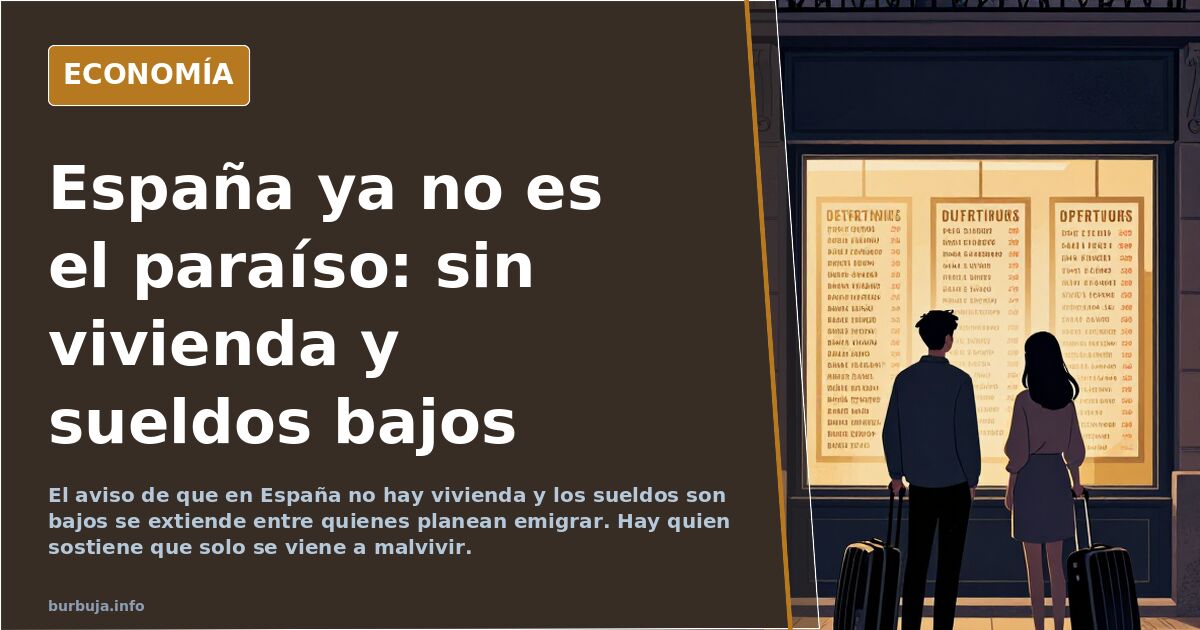
Spain is no longer a paradise: housing shortage and low pay
Is it worth crossing the Atlantic just to end up in a bunk bed paying €400 a month? The message circulating among those planning to migrate to Spain is becoming increasingly blunt: there is no housing and jobs are poorly paid. A supposed "imperial sister"—as the author of a viral video is referred to in the debate—warns her compatriots that the Spanish dream has turned into a trap of precariousness. The discussion, which has lasted months, has moved from personal anecdotes to structural analysis: the Spanish labor market no longer absorbs the migratory influx with dignified wages, and access to housing has become a maze of shared rooms and abusive rents.
The calculation that dismantles the mirage
The figures cited in the debate are stubborn. According to a circulating calculation, a waitress in a mid-sized city like Valladolid might earn €1,300 net, while a cook reaches €1,600. It seems like an acceptable salary until you subtract accommodation: a room costs around €300; an apartment, €600 plus €200 in utilities. The math is devastating: the waitress is left with €800 to live on, and with €400 she supports two children and her parents in Colombia or Venezuela. Other testimonies raise the rent for a room to €400 and the SMI (minimum wage) to €1,100, leaving an even more meager margin. The repeated conclusion is that people only come here to barely survive.
Why do they still come if the numbers don't add up?
The answer that prevails in the analysis is that Spain offers a unique combination: free public healthcare, education, social aid, ease of regularizing one's status, and nationality within a few years. "There is no other country in the world with such facilities," the argument goes. Added to this is the advantage of language, which removes the learning barrier. The result is that, despite the warnings, they continue arriving at Barajas airport daily. Some messages calculate that the flow will only stop when the minimum wage cannot even cover a room and unemployment rises, as peine after the 2008 crisis. The warning is that another deep recession would be needed to reverse the trend.
The labor market saturates and wages stagnate
The debate is not limited to housing. Some participants argue that the massive arrival of workers willing to accept conditions below collective agreements is precarizing employment for everyone. It is mentioned that many migrants accept salaries lower than stipulated and that, as this practice becomes normalized, local workers end up displaced. It is also pointed out that migrants themselves are beginning to notice the saturation: the labor market can take no more. Hospitality, one of the largest employers, often offers accommodation near the bar deducted from the paycheck, leaving the worker with €300 or €400 a month for food and little else.
Housing, the ultimate bottleneck
Access to housing is described as the factor that breaks any expectation. In Madrid and Barcelona, prices are through the roof and shared rooms have become the norm. There is talk of "hot beds in bunks" and apartments where rooms are divided to fit two beds and split the rent. The situation is not exclusive to major cities: Valencia and other northern areas are trinc the same path, and there is speculation that Zaragoza will be next to collapse. The diagnosis is that the scheme consists of wealthy people inflating prices and very poor people living in precarious conditions to serve them.
The future: robots, remittances, and the end of the model
The conversation shifts toward the role of automation and artificial intelligence. Some argue that robotics will eventually expel less qualified workers, including migrants, and that the current model has its days numbered. It is mentioned that 10,000 units of a robot (X1) have already been sold to replace factory workers, which in four years would leave 10,000 employees out of work. Others point out that remittances sent by migrants support their home countries, but if they stop arriving, pressure will increase. The debate remains open-ended: what will happen when jobs become scarce and housing remains inaccessible?
Is it worth crossing the Atlantic just to end up in a bunk bed paying €400 a month? The message circulating among those planning to migrate to Spain is becoming increasingly blunt: there is no housing and jobs are poorly paid. A supposed "imperial sister"—as the author of a viral video is referred to in the debate—warns her compatriots that the Spanish dream has turned into a trap of precariousness. The discussion, which has lasted months, has moved from personal anecdotes to structural analysis: the Spanish labor market no longer absorbs the migratory influx with dignified wages, and access to housing has become a maze of shared rooms and abusive rents.
The calculation that dismantles the mirage
The figures cited in the debate are stubborn. According to a circulating calculation, a waitress in a mid-sized city like Valladolid might earn €1,300 net, while a cook reaches €1,600. It seems like an acceptable salary until you subtract accommodation: a room costs around €300; an apartment, €600 plus €200 in utilities. The math is devastating: the waitress is left with €800 to live on, and with €400 she supports two children and her parents in Colombia or Venezuela. Other testimonies raise the rent for a room to €400 and the SMI (minimum wage) to €1,100, leaving an even more meager margin. The repeated conclusion is that people only come here to barely survive.
Why do they still come if the numbers don't add up?
The answer that prevails in the analysis is that Spain offers a unique combination: free public healthcare, education, social aid, ease of regularizing one's status, and nationality within a few years. "There is no other country in the world with such facilities," the argument goes. Added to this is the advantage of language, which removes the learning barrier. The result is that, despite the warnings, they continue arriving at Barajas airport daily. Some messages calculate that the flow will only stop when the minimum wage cannot even cover a room and unemployment rises, as peine after the 2008 crisis. The warning is that another deep recession would be needed to reverse the trend.
The labor market saturates and wages stagnate
The debate is not limited to housing. Some participants argue that the massive arrival of workers willing to accept conditions below collective agreements is precarizing employment for everyone. It is mentioned that many migrants accept salaries lower than stipulated and that, as this practice becomes normalized, local workers end up displaced. It is also pointed out that migrants themselves are beginning to notice the saturation: the labor market can take no more. Hospitality, one of the largest employers, often offers accommodation near the bar deducted from the paycheck, leaving the worker with €300 or €400 a month for food and little else.
Housing, the ultimate bottleneck
Access to housing is described as the factor that breaks any expectation. In Madrid and Barcelona, prices are through the roof and shared rooms have become the norm. There is talk of "hot beds in bunks" and apartments where rooms are divided to fit two beds and split the rent. The situation is not exclusive to major cities: Valencia and other northern areas are trinc the same path, and there is speculation that Zaragoza will be next to collapse. The diagnosis is that the scheme consists of wealthy people inflating prices and very poor people living in precarious conditions to serve them.
The future: robots, remittances, and the end of the model
The conversation shifts toward the role of automation and artificial intelligence. Some argue that robotics will eventually expel less qualified workers, including migrants, and that the current model has its days numbered. It is mentioned that 10,000 units of a robot (X1) have already been sold to replace factory workers, which in four years would leave 10,000 employees out of work. Others point out that remittances sent by migrants support their home countries, but if they stop arriving, pressure will increase. The debate remains open-ended: what will happen when jobs become scarce and housing remains inaccessible?
Also available in: Deutsch
Summary of a discussion on Burbuja.info - Foro de economía, actualidad y política., translated from Spanish and reviewed before publication. Read the full discussion (161 replies).
More summaries
-
Barajas Immigration and the Crisis of Precarious Labor
While Ceuta captures headlines, migration through Barajas involves millions of people and pressures wages—the debate VOX avoids.
-
Immigration and Labor Precarity in Spain: A Colombian Woman’s Struggle
A 58-year-old Colombian woman’s jobless plight in Spain highlights labor precarity and the debate over migration policies.
-
Rents surge 60%: exposing labor precarity
A 60% rent hike reveals the clash between audiovisual earnings and housing costs, highlighting the fragility of current residential contracts.
-
Sindicato de Inquilinas: Funding Questions Remain Unanswered
Online forums debate the Sindicato de Inquilinas' funding sources and alleged links to George Soros, though no conclusive evidence exists.
-
Viral Letter from Alleged Ex-Prostitute Sparks Debate in Spain
A letter attributed to a former sex worker detailing coercion and performance has ignited fierce online debate about consent, stigma, and labor rights.
-
Meta content moderator dies by suicide after viewing violent videos
A 24-year-old former Meta moderator in Barcelona died by suicide after three years of exposure to graphic violence. Her family is considering legal action against Meta and Telus.