
Spain mandates masks in healthcare and social care centers
Spain's Health Ministry imposes mandatory masks in healthcare facilities and convenes the Interterritorial Council to unify criteria.
English · Original discussion in Spanish · Published
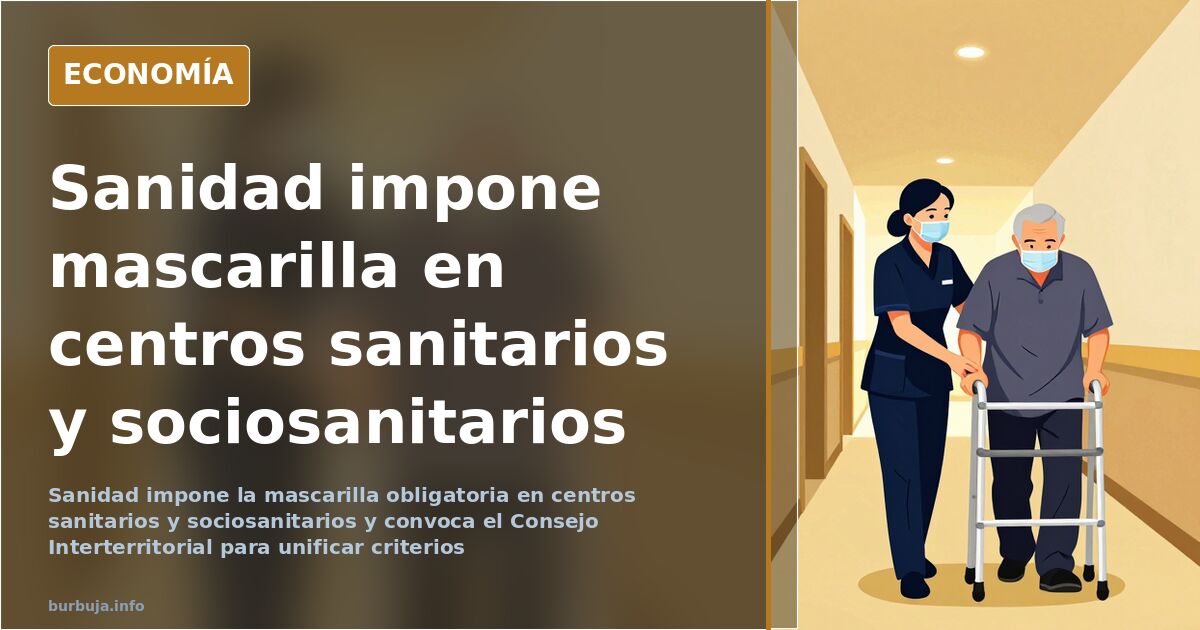
Mandatory masks in healthcare and social care centers
Next Monday, Spain's Ministry of Health will impose mandatory mask usage in healthcare and social care centers across autonomous communities. Minister Mónica García announced this on Lasensla, describing it as "initially temporary" due to the current peak in respiratory bicho, and called for an extraordinary plenary session of the National Health System's Interterritorial Council. She stated this is not about "invading competencies" but "coordinating" measures already applied by some regions. Public reaction has been swift, largely diverging from the minister's expectations.
Which regions have already implemented mandatory health masks?
The Valencian Community was the first to mandate masks in hospitals and health centers, where walk-in vaccinations begin Monday amid rising respiratory infections. In Catalonia, Health Minister Manel Balcells announced on X that they would apply the same measure. Galicia and the Basque Country had been recommending use for days. García's announcement aims to unify criteria among regional health departments, though several regions had already taken action before the meeting.
Conversely, the Community of Madrid rejected mandatory use in healthcare settings, preferring recommendations when symptoms appear, according to Europa Press tweets cited in discussions. Madrid's divergence highlights tensions between state coordination and regional autonomy. The minister previously denied any attempt to invade regional powers.
Does Order SND/776/2023 cited by media exist?
This doubt circulated widely online. A message using Liberum Informa letterhead claims that Order SND/776/2023, attributed to the Ministry by various reports, does not exist, suggesting the correct reference is SND/726/2023. This raises a critical question: if official narratives rely on regulations, they must be accurately cited.
Temporary, until when?
García's choice of words—presenting the measure as "initially temporary"—triggered skepticism. Antiestéticar that provisional measures become permanent drives much opposition; critics recall other restrictive measures labeled temporary that extended indefinitely.
Some express sarcasm, others genuine concern. The most common argument is timing: many claim seasonal colds or flu have already passed their local peaks, making indoor mandates feel like unnecessary inconvenience rather than effective containment. Supporters counter with specific scenarios: waiting rooms mixing healthy individuals, contagious respiratory patients, and immunocompromised persons. This overlap justifies the measure for proponents.
Another bottleneck: emergency services and walk-in vaccination
Beneath mask debates lies older infrastructure strain: emergency service saturation. Participants bluntly note no miracle cures exist—only paracetamol, acetylcysteine, and similar symptom relief—and argue patients should stay home instead of overwhelming services, risking transmission to critically ill patients and delaying care.
Two persistent complaints emerge. First, staffing: mandating masks doesn't hire doctors, and administrative zeal may mask resource shortages. Second, cost: some estimate 10 euros per mask, noting expired stock requires replacement, potentially benefiting manufacturers. International comparisons suggest Spain is Europe's only country considering mask reinstatement for flu season.
Overall sentiment reflects accumulated fatigue. Frustration with management mixes with distrust of new obligations, highlighting three years of conflict between medical orthodoxy and daily life without clear resolution.
Unresolved closure
One loose end remains unaddressed: while announced for healthcare and social care settings, speculation suggests expansion to all indoor spaces soon. No timeline or criteria for such decisions were provided. Nor is it clear what happens if a region simply refuses. Madrid has already said no.
Also available in: Deutsch
Summary of a discussion on Burbuja.info - Foro de economía, actualidad y política., translated from Spanish and reviewed before publication. Read the full discussion (153 replies).
More summaries
-
Spain's Health Minister booed in Ceuta over migrant healthcare
Health Minister Mónica García was unable to speak in Ceuta: healthcare workers greeted her with chants of "resign" over her handling of the mass arrival of migrants.
-
Protests in Ceuta against Spain's Health Minister as measles cases soar
Health Minister Mónica García was shouted down in Ceuta as measles cases jumped from 11 to 397. The controversy is at boiling point.
-
Mónica García urges housing for migrants in Spain's Ceuta
Spain's Health Minister Mónica García calls for shelter for migrants in Ceuta 16 days after the mass crossing. The housing crisis in Spain keeps worsening.
-
Riots in French schools: fires and attacks
Fires in French schools, teachers attacked and blockades spreading to Belgium. The unrest is attributed to the education strike and radical groups.
-
Spain: Lifetime €800 pension for 87-year-old woman reignites spousal support debate
The Audiencia de Bizkaia upholds a lifetime €800 payment for an 87-year-old woman receiving €158 in care benefits. He earns €1,630 net over 14 payments. Key points of the ruling
-
Death threats against Abascal and his family reignite Spain's political violence debate
An Instagram user threatened to shoot Santiago Abascal, his wife and children. Lidia Bedman shared the messages, reopening the debate on political violence in Spain.