
Spain: Man with ten vocational qualifications still unemployed at 48
Antonio Miguel Moreno Hidalgo holds ten Vocational Training certificates in Spain but remains without stable work, highlighting a labor market that values specialization over accumulation.
English · Original discussion in Spanish · Published
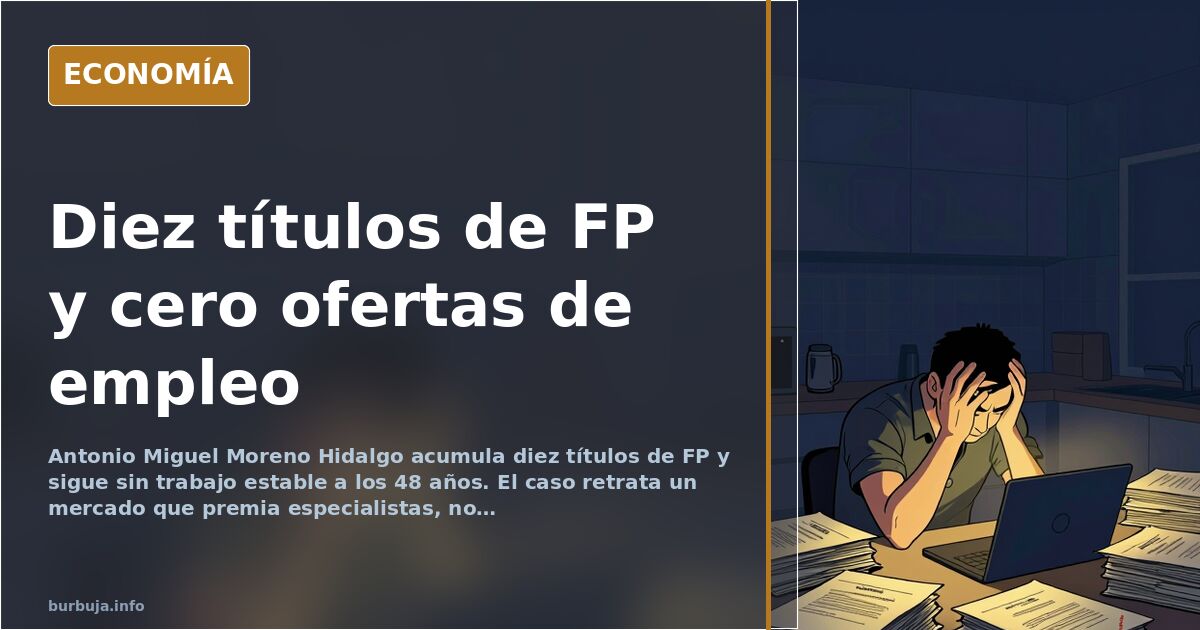
Ten qualifications, age 48, no offers: A case study of the Spanish labor market
A company restructuring (ERE) in 2009 left him out of the firm where he had worked for over a decade. Antonio Miguel Moreno Hidalgo, from Jerez and raised in the La Granja neighborhood, decided to turn unemployment and severance pay into training. Today, he holds ten Vocational Training (FP) certificates—ranging from electromedicine and robotics to social integration and employment teaching—and, according to his own account, still lacks stable work. "No one calls me," he summarizes. The paradox is stark: the man who could repair a CT scanner, code a website, or diagnose a factory robot cannot get a call back from any HR department.
What qualifications does he hold and what are they for?
The list looks impressive on paper. Electromedicine, his latest addition, qualifies him—according to circulating descriptions—to work on hospital equipment, from scanners to diagnostic imaging machinery. This is joined by robotics, social integration, employment training, and a variety of certificates that theoretically cover sectors as diverse as automotive, healthcare, and education. In practice, the market does not buy accumulation; it buys specialization.
The most repeated criticism points exactly there. An FP certificate does not make anyone an expert; it provides the basics for a company to finish training the candidate. Someone presenting ten different qualifications sends an ambiguous signal: they know a little about everything but master nothing. The employer looking for a lathe operator, a welder, or an electromechanic wants someone who has done that specific job a thousand times, not ten things once.
Some argue the problem is not excess training, but lack of experience. Others counter that, at 48 and without a professional network, even the brightest CV cannot compensate for age bias. Both can be true simultaneously.
The experience trap: Internships without contracts
Moreno Hidalgo's case is not unique. Another profile appears in the material who trinc a different path: a warehouse worker who, after 25 years at the same company, was let go at 44. He completed an FP in milling and turning, entered an internship, strung together substitutions and summer jobs, then obtained a welding certificate, and this time successfully got hired. The difference was not the number of titles, but the sequence: one qualification, internship, experience, another qualification, internship, contract.
This contrast highlights the strategic error. Accumulating certificates without stepping into a workshop between courses turns training into an end in itself, not a means. And the market penalizes this drift.
Why doesn't he move to another city?
Moreno Hidalgo explained on television: he does not consider relocating because it would break his family circle and because rental and housing prices make it unviable. It is an answer shared by many that clashes with the official discourse promoting mobility as a solution. The lingering question is uncomfortable: What good is an FP system that trains thousands of people for jobs that do not exist in their province?
The argument for mobility has defenders and detractors. The former point out that the Spanish labor market is deeply asymmetric: candidates are abundant where there is no industrial fabric and scarce where there is. The latter respond that asking a 48-year-old unemployed person to move to another region to earn a salary that barely covers rent is not employment policy; it is a bad joke.
The labor market that does not reward degrees
The conversation shifts to a broader diagnosis: in Spain, a degree guarantees nothing. Some suggest that FP has become a certificate mill issuing credentials without real connection to company demand. Others recall that vocational training was always the ugly duckling of the educational system and has now expanded without solving the underlying problem: the lack of industrial fabric.
The disorienting fact is not that this man has ten degrees. It is that, with ten degrees, he is still waiting for a call that never comes.
A company restructuring (ERE) in 2009 left him out of the firm where he had worked for over a decade. Antonio Miguel Moreno Hidalgo, from Jerez and raised in the La Granja neighborhood, decided to turn unemployment and severance pay into training. Today, he holds ten Vocational Training (FP) certificates—ranging from electromedicine and robotics to social integration and employment teaching—and, according to his own account, still lacks stable work. "No one calls me," he summarizes. The paradox is stark: the man who could repair a CT scanner, code a website, or diagnose a factory robot cannot get a call back from any HR department.
What qualifications does he hold and what are they for?
The list looks impressive on paper. Electromedicine, his latest addition, qualifies him—according to circulating descriptions—to work on hospital equipment, from scanners to diagnostic imaging machinery. This is joined by robotics, social integration, employment training, and a variety of certificates that theoretically cover sectors as diverse as automotive, healthcare, and education. In practice, the market does not buy accumulation; it buys specialization.
The most repeated criticism points exactly there. An FP certificate does not make anyone an expert; it provides the basics for a company to finish training the candidate. Someone presenting ten different qualifications sends an ambiguous signal: they know a little about everything but master nothing. The employer looking for a lathe operator, a welder, or an electromechanic wants someone who has done that specific job a thousand times, not ten things once.
Some argue the problem is not excess training, but lack of experience. Others counter that, at 48 and without a professional network, even the brightest CV cannot compensate for age bias. Both can be true simultaneously.
The experience trap: Internships without contracts
Moreno Hidalgo's case is not unique. Another profile appears in the material who trinc a different path: a warehouse worker who, after 25 years at the same company, was let go at 44. He completed an FP in milling and turning, entered an internship, strung together substitutions and summer jobs, then obtained a welding certificate, and this time successfully got hired. The difference was not the number of titles, but the sequence: one qualification, internship, experience, another qualification, internship, contract.
This contrast highlights the strategic error. Accumulating certificates without stepping into a workshop between courses turns training into an end in itself, not a means. And the market penalizes this drift.
Why doesn't he move to another city?
Moreno Hidalgo explained on television: he does not consider relocating because it would break his family circle and because rental and housing prices make it unviable. It is an answer shared by many that clashes with the official discourse promoting mobility as a solution. The lingering question is uncomfortable: What good is an FP system that trains thousands of people for jobs that do not exist in their province?
The argument for mobility has defenders and detractors. The former point out that the Spanish labor market is deeply asymmetric: candidates are abundant where there is no industrial fabric and scarce where there is. The latter respond that asking a 48-year-old unemployed person to move to another region to earn a salary that barely covers rent is not employment policy; it is a bad joke.
The labor market that does not reward degrees
The conversation shifts to a broader diagnosis: in Spain, a degree guarantees nothing. Some suggest that FP has become a certificate mill issuing credentials without real connection to company demand. Others recall that vocational training was always the ugly duckling of the educational system and has now expanded without solving the underlying problem: the lack of industrial fabric.
The disorienting fact is not that this man has ten degrees. It is that, with ten degrees, he is still waiting for a call that never comes.
Also available in: Deutsch
Summary of a discussion on Burbuja.info - Foro de economía, actualidad y política., translated from Spanish and reviewed before publication. Read the full discussion (156 replies).
More summaries
-
14-Year-Old Student Stabs Three Teachers and Two Classmates at Jerez High School
A 14-year-old student injured three teachers and two peers in Jerez, shifting the case to the Juvenile Prosecutor's Office and reigniting the debate on school bullying.
-
Vocational Training Debate: Why the Faculty Issue Matters More Than the Bubble
A user claims IT vocational graduates earn over €30,000, sparking debate on whether vocational training is a bubble and who actually teaches.
-
Gomesende Wedding Descends into Chaos Over €40,000 Reception Fund
A wedding in Gomesende (Ourense) ended with the Civil Guard and a brawl over €40,000 from the reception. The groom denies claims of a marriage of convenience...
-
Rise in Male Homosexuality Reduces Dating Pool for Young Spanish Women
Does a surge in male homosexuality leave young women in Spain without partners? An analysis of a debate blending math, stereotypes, and social anxiety.
-
Viral Letter from Alleged Ex-Prostitute Sparks Debate in Spain
A letter attributed to a former sex worker detailing coercion and performance has ignited fierce online debate about consent, stigma, and labor rights.
-
Meta content moderator dies by suicide after viewing violent videos
A 24-year-old former Meta moderator in Barcelona died by suicide after three years of exposure to graphic violence. Her family is considering legal action against Meta and Telus.