
Spain: Man quits work at 49, claims benefits
A 49-year-old Spaniard with a paid-off home and severance pay stops working to claim all available state subsidies.
English · Original discussion in Spanish · Published
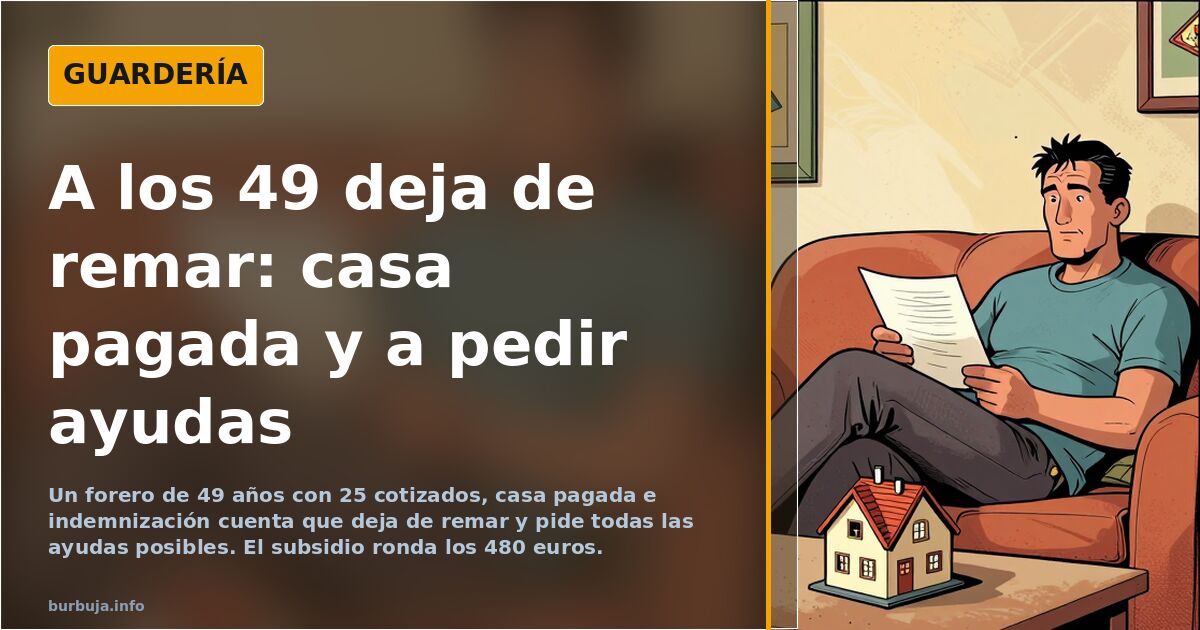
At 49, house paid off, ready to claim every possible benefit
A forum user with 25 years of continuous contributions, a fully paid-off home, and a severance package that reportedly exceeds his property's cost has decided to stop working. At age 49. His plan isn't just to live on the "paguita" (small handout), but he won't leave any money on the table. "I won't miss a single euro, whether I need it or not," he summarizes. The decision trinc a negotiated exit from his company partners, a conflict he describes as "brutal stress" from which he emerged victorious.
The case reveals a broader debate: what happens when a skilled worker with assets and ample contribution history decides to sign up for every available subsidy? The figure circulating in the conversation for those over 52 is around €480 per month, according to calculations shared in the thread. For those under that age, the subsidy is even smaller.
Requirements for the over-52 unemployment subsidy
The key lies in the specific coverage gap. To access the over-52 subsidy, one must have contributed for at least two years within the last fifteen before reaching that age, plus a total of fifteen years of contributions. The protagonist says he meets all requirements with margin: he started working the week after graduating and has been employed without interruption for 25 years. He continues contributing even while unemployed, so his record remains unbroken.
A nuance many overlook: SEPE (Spanish Public Employment Service) analyzes the applicant's assets. It doesn't count the primary residence, but does include income generated by other assets. If an apartment is empty or money sits idle in a checking account without generating returns, the administration calculates an imputed yield. In other words, holding static assets also counts against you.
How much the State pays those who stop working before retirement
The amounts discussed are modest. The over-52 subsidy hovers around €480 per month, a figure that doesn't change based on family responsibilities. For those under that age, the subsidy is lower. Comparisons with other benefits are inevitable: some argue certain social aids exceed €6,000 per month in specific cases, a claim made without breakdown that should be viewed with caution.
The Minimum Vital Income appears as another piece of the puzzle. Part of the conversation estimates that registering in a small municipality and waiting six months could open the door to about €730 per month. This figure isn't verified in the source material and depends on household composition, but circulates as a reference.
The fiscal argument: paying taxes to fund things you don't support
Fiscal disillusionment runs through the entire conversation. The protagonist states it bluntly: it burned him to see how they "skinned him alive" with taxes while seeing situations in his neighborhood he didn't share. It's not an isolated argument. Several participants agree that tax pressure on middle and high incomes has increased while public spending disperses into questionable items.
The most repeated response is planning. Those with a paid-off home, savings, and severance can afford to slow down. Those who can't keep rowing. The gap between these groups is the real subject of the debate.
Asset strategy: paid-off home, zero debt, and passive income
The specific case describes a roadmap others replicate with variations. Paid-off home, zero debt, invested savings, and a severance package that reportedly exceeds the original housing cost. The bank called the day after depositing the check to offer investment products. The anecdote illustrates the point: assets generate yields, and those yields condition access to certain aids.
Some add another leg: rentals. One participant declares two rental properties, a pension of slightly more than €900, and a family allowance of €1,500 his partner will start receiving. Four distinct income sources. "Don't put all your eggs in one basket," he calls it.
The emotional cost of stopping work: anxiety, health, and effort narratives
It's not all calculation. One participant shares lifelong anxiety and lost friends and social life due to it. Another reports health issues preventing emigration. The conversation mixes numbers with biographies, and the tone shifts there: less irony, more caution.
The protagonist insists his exit was voluntary and negotiated, not a traumatic dismissal. He acknowledges the stress but claims victory in the standoff. "I faced people initially more powerful than me," he says. The severance is the material proof of that victory.
One unsettling fact remains. With 25 years of contributions, a paid-off home, and a severance package reportedly exceeding his property's value, the system will continue paying him aid designed for those with nothing. And he intends to collect it. The question isn't if he's legally entitled. The question is how many others are making the same silent calculation.
A forum user with 25 years of continuous contributions, a fully paid-off home, and a severance package that reportedly exceeds his property's cost has decided to stop working. At age 49. His plan isn't just to live on the "paguita" (small handout), but he won't leave any money on the table. "I won't miss a single euro, whether I need it or not," he summarizes. The decision trinc a negotiated exit from his company partners, a conflict he describes as "brutal stress" from which he emerged victorious.
The case reveals a broader debate: what happens when a skilled worker with assets and ample contribution history decides to sign up for every available subsidy? The figure circulating in the conversation for those over 52 is around €480 per month, according to calculations shared in the thread. For those under that age, the subsidy is even smaller.
Requirements for the over-52 unemployment subsidy
The key lies in the specific coverage gap. To access the over-52 subsidy, one must have contributed for at least two years within the last fifteen before reaching that age, plus a total of fifteen years of contributions. The protagonist says he meets all requirements with margin: he started working the week after graduating and has been employed without interruption for 25 years. He continues contributing even while unemployed, so his record remains unbroken.
A nuance many overlook: SEPE (Spanish Public Employment Service) analyzes the applicant's assets. It doesn't count the primary residence, but does include income generated by other assets. If an apartment is empty or money sits idle in a checking account without generating returns, the administration calculates an imputed yield. In other words, holding static assets also counts against you.
How much the State pays those who stop working before retirement
The amounts discussed are modest. The over-52 subsidy hovers around €480 per month, a figure that doesn't change based on family responsibilities. For those under that age, the subsidy is lower. Comparisons with other benefits are inevitable: some argue certain social aids exceed €6,000 per month in specific cases, a claim made without breakdown that should be viewed with caution.
The Minimum Vital Income appears as another piece of the puzzle. Part of the conversation estimates that registering in a small municipality and waiting six months could open the door to about €730 per month. This figure isn't verified in the source material and depends on household composition, but circulates as a reference.
The fiscal argument: paying taxes to fund things you don't support
Fiscal disillusionment runs through the entire conversation. The protagonist states it bluntly: it burned him to see how they "skinned him alive" with taxes while seeing situations in his neighborhood he didn't share. It's not an isolated argument. Several participants agree that tax pressure on middle and high incomes has increased while public spending disperses into questionable items.
The most repeated response is planning. Those with a paid-off home, savings, and severance can afford to slow down. Those who can't keep rowing. The gap between these groups is the real subject of the debate.
Asset strategy: paid-off home, zero debt, and passive income
The specific case describes a roadmap others replicate with variations. Paid-off home, zero debt, invested savings, and a severance package that reportedly exceeds the original housing cost. The bank called the day after depositing the check to offer investment products. The anecdote illustrates the point: assets generate yields, and those yields condition access to certain aids.
Some add another leg: rentals. One participant declares two rental properties, a pension of slightly more than €900, and a family allowance of €1,500 his partner will start receiving. Four distinct income sources. "Don't put all your eggs in one basket," he calls it.
The emotional cost of stopping work: anxiety, health, and effort narratives
It's not all calculation. One participant shares lifelong anxiety and lost friends and social life due to it. Another reports health issues preventing emigration. The conversation mixes numbers with biographies, and the tone shifts there: less irony, more caution.
The protagonist insists his exit was voluntary and negotiated, not a traumatic dismissal. He acknowledges the stress but claims victory in the standoff. "I faced people initially more powerful than me," he says. The severance is the material proof of that victory.
One unsettling fact remains. With 25 years of contributions, a paid-off home, and a severance package reportedly exceeding his property's value, the system will continue paying him aid designed for those with nothing. And he intends to collect it. The question isn't if he's legally entitled. The question is how many others are making the same silent calculation.
Summary of a discussion on Burbuja.info - Foro de economía, actualidad y política., translated from Spanish and reviewed before publication. Read the full discussion (165 replies).
More summaries
-
Mental exhaustion and the pace of life in the digital age
Analysis of how breakneck speed and chronic fatigue define modern life, based on accounts of burnout.
-
Hiring an Escort: Minimum €100, Sexless Marriages Highlighted
Hiring an escort in Spain starts at €100, with ads often misleading and ongoing debate on real costs and risks.
-
Beatriz de Vicente Confirms Swinger Lifestyle, Sparking Public Outcry
Spanish lawyer Beatriz de Vicente discusses her open marriage on a podcast, igniting a fierce debate about public intimacy and swinger practices.
-
The Lion of Gripsholm: Stuffed by Someone Who Never Saw a Lion
The Lion of Gripsholm, mounted by artisans who never saw a live lion, opens a catalog of failed taxidermy up to the cat-drone.
-
Spanish AI Bot Mocks Users, Sparking Work Debate
An AI experiment on a Spanish forum reveals how automation can mock its creators, igniting debate on the future of work.
-
Overrated Films: From Star Wars to The Godfather
Star Wars, James Bond, The Godfather and Lord of the Rings top lists of films hailed as masterpieces by many but dismissed as boring by others.