
The Lion of Gripsholm: Stuffed by Someone Who Never Saw a Lion
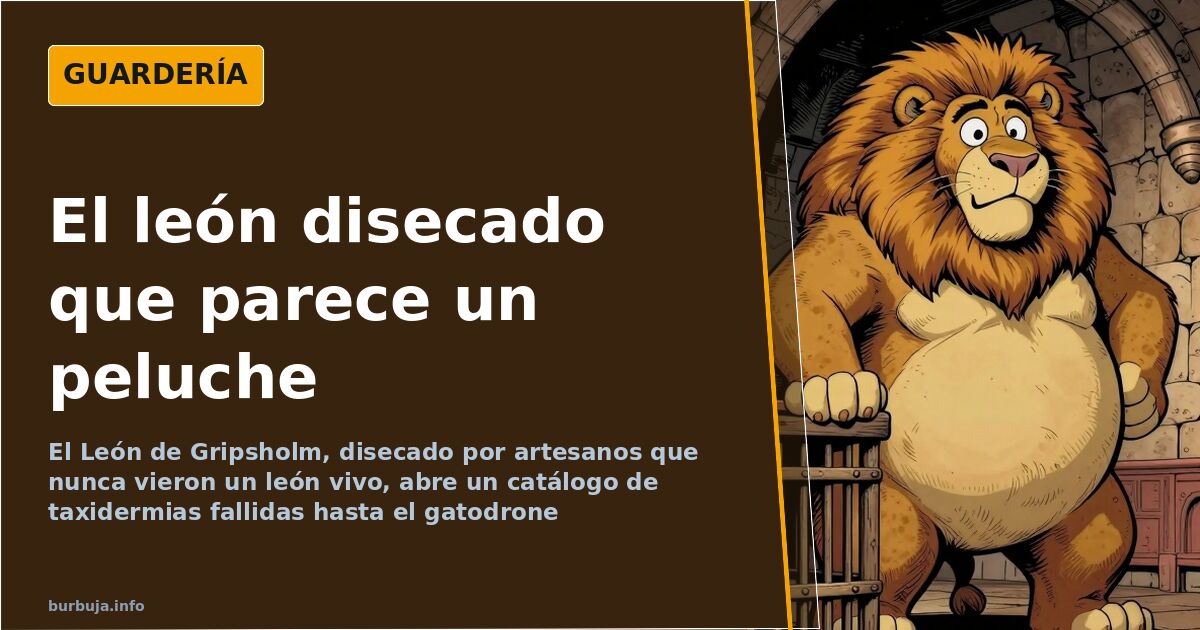
The Lion of Gripsholm, mounted by artisans who never saw a live lion, opens a catalog of failed taxidermy up to the cat-drone.
English · Original discussion in Spanish · Published
Failed Taxidermy: From the Lion of Gripsholm to the Cat-Drone
The most famous animal in the history of taxidermy is so due to an origin error: those who mounted it had never seen a live lion. In 1731, the Bey of Algiers gifted King Frederick I of Sweden with two Barbary lions, three hyenas, and a wild cat, all alive, plus a freed keeper tasked with caring for them. They were among the first lions to set foot in Scandinavia. One of them ended up, still alive, in the hands of George II, then Elector of Saxony, who kept it in a cage near Junibacken. When the animal died, the skin and bones were handed over to a team that had never seen a live lion. The result is preserved today as one of the most cited pieces of the craft and its most endearing icon.
The paradox is exact: the animal was stuffed without a model, without anatomical reference, and without anyone able to warn that it did not resemble a live lion.
Why Does the Lion of Gripsholm Look Like a Plush Toy?
The mounting sought the gallant and heraldic pose appropriate for a palace piece. The problem is that the lion lacks lion anatomy: whoever filled it had no other reference than their own imagination. The skin was stretched to absurdity and the expression remained between surprise and fright. It is not a minor detail: it is the predictable result of asking an artisan to reconstruct something they have never seen.
When there are no references, the workshop fills the gaps with what is at hand, and thus a gallant and, above all, unintentionally comical animal was born.
Portugal, Germany, and Other Failed Mounts
The defect was not exclusive to Sweden. The thread mentions pieces sent to Portugal that, according to participants, suffer from the same vice: stretched animals, impossible gestures, and a rigidity that betrays the improviser. Some argue that the Portuguese no longer had the excuse of not knowing what a lion was, and that either they did it badly on purpose or sent the apprentice of the day.
In the same vein, a participant alludes to the "German tradition" and the Museum für Naturkunde in Berlin, highlighting its own catalog of striking mounts.
Vegan Foxes, Party Mice, and Centipedes
If the 18th century produced monsters out of ignorance, the internet has produced them out of fun. The cat-drone, the vegan fox, the Lovecraftian mouse, the swaying female mouse, or the Dalinian donkey form a catalog that mixes technical error with whimsy. There are also eco-sustainable DIY tips and rodent-shaped coin purses. Side effect: it turns dead animals into memes.
Here opinions are divided. Some see involuntary humor while others see disrespect toward the animal. An 18th-century lion is not the same as a recently stuffed mouse, but both end up in the same folder. And one participant considers the very practice of taxidermy directly reprehensible.
When What Is Stuffed Is a Person
The issue escalates in gravity when the preserved piece is not an animal. The thread recalls the case of a person from an indigenous community, stuffed and exhibited in a museum in Banyoles, cited as one of the most uncomfortable episodes in European museology. There, the discussion is no longer about whether the mount was faithful, but whether it should have existed.
As noted in the debate, the preservation of human remains for exhibition purposes is now delegitimized, and their presence in collections is an outstanding issue regarding restitution and memory. This detail causes more discomfort than any surprised-looking lion.
Why Does Taxidermy Fail?
Because the technique depends on the available reference. Whoever cannot study the live animal fills the gaps, and the result stretches, deforms, and ends up looking like another species. There is no shortcut: the result depends on the reference, not on the goodwill of the workshop. And when the reference does not exist, the meme appears.
The one from Gripsholm remains in its showcase, with its surprised face. Is it preserved as a scientific piece, as an object of curiosity, or as a reminder that the greatest error in taxidermy was trying to invent an animal?
The most famous animal in the history of taxidermy is so due to an origin error: those who mounted it had never seen a live lion. In 1731, the Bey of Algiers gifted King Frederick I of Sweden with two Barbary lions, three hyenas, and a wild cat, all alive, plus a freed keeper tasked with caring for them. They were among the first lions to set foot in Scandinavia. One of them ended up, still alive, in the hands of George II, then Elector of Saxony, who kept it in a cage near Junibacken. When the animal died, the skin and bones were handed over to a team that had never seen a live lion. The result is preserved today as one of the most cited pieces of the craft and its most endearing icon.
The paradox is exact: the animal was stuffed without a model, without anatomical reference, and without anyone able to warn that it did not resemble a live lion.
Why Does the Lion of Gripsholm Look Like a Plush Toy?
The mounting sought the gallant and heraldic pose appropriate for a palace piece. The problem is that the lion lacks lion anatomy: whoever filled it had no other reference than their own imagination. The skin was stretched to absurdity and the expression remained between surprise and fright. It is not a minor detail: it is the predictable result of asking an artisan to reconstruct something they have never seen.
When there are no references, the workshop fills the gaps with what is at hand, and thus a gallant and, above all, unintentionally comical animal was born.
Portugal, Germany, and Other Failed Mounts
The defect was not exclusive to Sweden. The thread mentions pieces sent to Portugal that, according to participants, suffer from the same vice: stretched animals, impossible gestures, and a rigidity that betrays the improviser. Some argue that the Portuguese no longer had the excuse of not knowing what a lion was, and that either they did it badly on purpose or sent the apprentice of the day.
In the same vein, a participant alludes to the "German tradition" and the Museum für Naturkunde in Berlin, highlighting its own catalog of striking mounts.
Vegan Foxes, Party Mice, and Centipedes
If the 18th century produced monsters out of ignorance, the internet has produced them out of fun. The cat-drone, the vegan fox, the Lovecraftian mouse, the swaying female mouse, or the Dalinian donkey form a catalog that mixes technical error with whimsy. There are also eco-sustainable DIY tips and rodent-shaped coin purses. Side effect: it turns dead animals into memes.
Here opinions are divided. Some see involuntary humor while others see disrespect toward the animal. An 18th-century lion is not the same as a recently stuffed mouse, but both end up in the same folder. And one participant considers the very practice of taxidermy directly reprehensible.
When What Is Stuffed Is a Person
The issue escalates in gravity when the preserved piece is not an animal. The thread recalls the case of a person from an indigenous community, stuffed and exhibited in a museum in Banyoles, cited as one of the most uncomfortable episodes in European museology. There, the discussion is no longer about whether the mount was faithful, but whether it should have existed.
As noted in the debate, the preservation of human remains for exhibition purposes is now delegitimized, and their presence in collections is an outstanding issue regarding restitution and memory. This detail causes more discomfort than any surprised-looking lion.
Why Does Taxidermy Fail?
Because the technique depends on the available reference. Whoever cannot study the live animal fills the gaps, and the result stretches, deforms, and ends up looking like another species. There is no shortcut: the result depends on the reference, not on the goodwill of the workshop. And when the reference does not exist, the meme appears.
The one from Gripsholm remains in its showcase, with its surprised face. Is it preserved as a scientific piece, as an object of curiosity, or as a reminder that the greatest error in taxidermy was trying to invent an animal?
Summary of a discussion on Burbuja.info - Foro de economía, actualidad y política., translated from Spanish and reviewed before publication. Read the full discussion (163 replies).
More summaries
-
Why Is destacamentos.com Blocked by ISPs?
Find out why users face access blocks on destacamentos.com and how VPNs bypass telecom restrictions.
-
Online cry for help turns into pubic hair fetish underworld
A plea for help in an internet forum devolves into a pubic hair obsession; the community dives deeper instead of rescuing.
-
Forum Debate on Spanish Porn Star's Body and Odor
A Spanish forum has debated for 740 days over a porn actress's changing physique and alleged body odor, splitting users between admiration and disgust.
-
Spanish AI Bot Mocks Users, Sparking Work Debate
An AI experiment on a Spanish forum reveals how automation can mock its creators, igniting debate on the future of work.
-
Overrated Films: From Star Wars to The Godfather
Star Wars, James Bond, The Godfather and Lord of the Rings top lists of films hailed as masterpieces by many but dismissed as boring by others.
-
Spain: Cuckold Pact Broken by Partner in Office Tryst
A Spanish couple agreed on strict cuckold rules with a coworker. She broke three limits the same night, leaving him unsure how to proceed.