
Spain hits lowest birth rate since 1941
Spain recorded 322,075 births in 2023, the lowest since 1941. Housing costs, low wages, and VAT on baby products drive the demographic crisis.
English · Original discussion in Spanish · Published
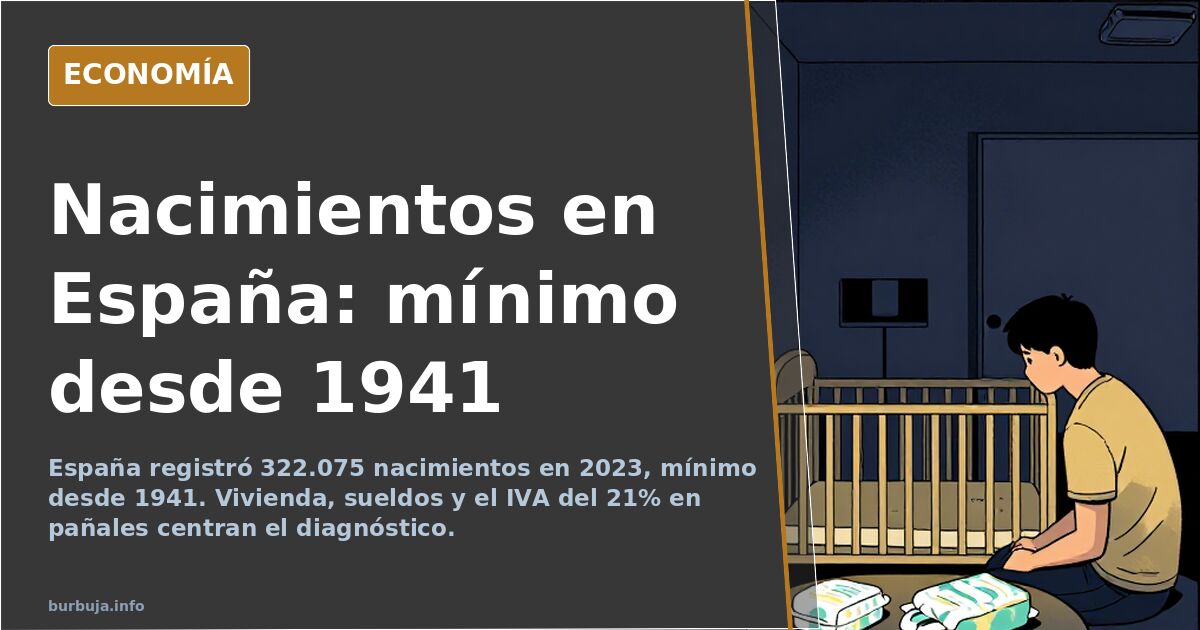
Spain sees fewest births since 1941: 322,075 children born
Spain has not seen such low birth rates since official records began. In 2023, there were 322,075 births, the lowest figure in a statistical series starting in 1941. The paradox is uncomfortable: the country with the highest aggregate wealth in its history, with more technology and comforts than ever, is also bringing fewer children into the world. No one disputes the collapse. What is debated, often with frustration, is who to blame.
What does it cost to have a child in Spain?
The calculation can be made with numbers, which is exactly what is being done. Rent in high-demand areas is cited at €1,400 for what many describe as a cramped space. A twelve-hour workday yields an annual salary of around €12,000. And a crucial detail: diapers, baby food, shoes, and clothing are subject to 21% VAT, the general rate, with no automatic reduction in the shopping basket when a child arrives.
Added to this is the feeling that real aid doesn't reach those with Spanish paychecks, and salaries described in slang as barely covering the month and little more. Hence the phrase repeated in all versions of the diagnosis: young people don't lack the desire to have children; they cannot afford them.
The child planned before birth
There is a nuance that explains the era's change better than any statistic. Previously, children arrived and space was made for them; today, a child comes with their entire life projected before birth: specific nursery, specific school, activities, university. Each step has a price, and each price adds up before the baby exists. When the sum is complete, the biological window has often closed.
That is the invisible cost: not just raising a child, but doing so as society expects. Parenting has ceased to be improvised adaptation and become a project with a budget. Projects without funding are postponed until there is no time left.
Those who believe money isn't the problem
Here the rift opens. It is argued that if the obstacle were purely economic, poorer countries would not have higher birth rates than rich ones, yet evidence points to the opposite: where income is lower, births are higher. From this comes an uncomfortable conclusion: the issue lies in priorities, comfort, and a society that has traded responsibility for leisure, solitude, and pets.
The counterargument has deep roots. Before contraceptives, people had the children they got, not those they desired; abortion and infanticide existed on a large scale, and infant mortality took away much of the offspring. Children were also old-age insurance: those without help in their sixties suffered greatly. It wasn't virtue; it was lack of alternatives.
Demography as political weapon
The conversation twists when immigration enters. One analysis holds that foreign-born populations sustain the birth rate and fill jobs natives do not cover, replicating what Spaniards did in Germany or France decades ago. Another stream turns the data into an identity-based complaint, shifting the issue from economic to something else.
It is wise to separate planes. The demographic plane is verifiable: without migration, the population would fall absolutely. The identity plane is debatable, aggressive in many parts, and ultimately useless for deciding whether someone will have a child next year.
The bill no one wants to look at
The final diagnosis appears when discussion shifts to public spending: the country pays pensions and salaries before children. The figures are stark—debt over €1.5 trillion and administration salaries far above the private sector—and always lead to the same reading: if every available euro sustains the elderly, nothing remains for those not yet born.
The argument has flaws, because today's children are tomorrow's contributors. But it describes a hard-to-refute sensation: birth rates appear nowhere as a budget priority, only as headlines. Some even claim, without flinching, that the current system can hold for another twenty or thirty years.
No one has answered the question
With 322,075 annual births and historical trends falling, the issue is no longer how many children people want, but how many they can afford without ruin. If the math doesn't add up despite greater wealth than in 1941, perhaps the problem isn't the calculation. Is it about who decides how each euro is used?
Spain has not seen such low birth rates since official records began. In 2023, there were 322,075 births, the lowest figure in a statistical series starting in 1941. The paradox is uncomfortable: the country with the highest aggregate wealth in its history, with more technology and comforts than ever, is also bringing fewer children into the world. No one disputes the collapse. What is debated, often with frustration, is who to blame.
What does it cost to have a child in Spain?
The calculation can be made with numbers, which is exactly what is being done. Rent in high-demand areas is cited at €1,400 for what many describe as a cramped space. A twelve-hour workday yields an annual salary of around €12,000. And a crucial detail: diapers, baby food, shoes, and clothing are subject to 21% VAT, the general rate, with no automatic reduction in the shopping basket when a child arrives.
Added to this is the feeling that real aid doesn't reach those with Spanish paychecks, and salaries described in slang as barely covering the month and little more. Hence the phrase repeated in all versions of the diagnosis: young people don't lack the desire to have children; they cannot afford them.
The child planned before birth
There is a nuance that explains the era's change better than any statistic. Previously, children arrived and space was made for them; today, a child comes with their entire life projected before birth: specific nursery, specific school, activities, university. Each step has a price, and each price adds up before the baby exists. When the sum is complete, the biological window has often closed.
That is the invisible cost: not just raising a child, but doing so as society expects. Parenting has ceased to be improvised adaptation and become a project with a budget. Projects without funding are postponed until there is no time left.
Those who believe money isn't the problem
Here the rift opens. It is argued that if the obstacle were purely economic, poorer countries would not have higher birth rates than rich ones, yet evidence points to the opposite: where income is lower, births are higher. From this comes an uncomfortable conclusion: the issue lies in priorities, comfort, and a society that has traded responsibility for leisure, solitude, and pets.
The counterargument has deep roots. Before contraceptives, people had the children they got, not those they desired; abortion and infanticide existed on a large scale, and infant mortality took away much of the offspring. Children were also old-age insurance: those without help in their sixties suffered greatly. It wasn't virtue; it was lack of alternatives.
Demography as political weapon
The conversation twists when immigration enters. One analysis holds that foreign-born populations sustain the birth rate and fill jobs natives do not cover, replicating what Spaniards did in Germany or France decades ago. Another stream turns the data into an identity-based complaint, shifting the issue from economic to something else.
It is wise to separate planes. The demographic plane is verifiable: without migration, the population would fall absolutely. The identity plane is debatable, aggressive in many parts, and ultimately useless for deciding whether someone will have a child next year.
The bill no one wants to look at
The final diagnosis appears when discussion shifts to public spending: the country pays pensions and salaries before children. The figures are stark—debt over €1.5 trillion and administration salaries far above the private sector—and always lead to the same reading: if every available euro sustains the elderly, nothing remains for those not yet born.
The argument has flaws, because today's children are tomorrow's contributors. But it describes a hard-to-refute sensation: birth rates appear nowhere as a budget priority, only as headlines. Some even claim, without flinching, that the current system can hold for another twenty or thirty years.
No one has answered the question
With 322,075 annual births and historical trends falling, the issue is no longer how many children people want, but how many they can afford without ruin. If the math doesn't add up despite greater wealth than in 1941, perhaps the problem isn't the calculation. Is it about who decides how each euro is used?
Summary of a discussion on Burbuja.info - Foro de economía, actualidad y política., translated from Spanish and reviewed before publication. Read the full discussion (200 replies).
More summaries
-
Euro banknote redesign sparks cultural debate at ECB
The ECB launches a public consultation on new euro notes, triggering identity politics debates over proposed designs featuring diverse faces and birds.
-
Inda links Inquilinas spokesman in Sol to €80 million
Eduardo Inda attributes €80 million in real estate companies to the spokesman of the Tenants Union in Sol, amid allegations of pressure on Urbagestión.
-
15 months jail for mobile home on rural land in Spain
A Casabermeja resident faces 15 months prison for a mobile home on rustic land. Defense claims it was used as a tool shed.
-
Spain's Government pays Christmas bonus before elections
Spain disburses the Christmas bonus for civil servants and pensioners just hours before voting, according to forum calculations.
-
Study claims Black arrests mislabeled as White in North Carolina
Analysis of 7,000 NC arrest records suggests Black detainees are classified as White, potentially skewing US crime statistics.
-
Spain PM Sánchez considers adding Begoña Gómez to election list
Spanish PM Pedro Sánchez is weighing including his wife, Begoña Gómez, in the PSOE's Nov. 29 election lists to secure her legal immunity.