
Spain has gone three years without a budget: the anomaly nobody fixes
Spain has now spent three years without passing a national budget. The government is running on rolled-over accounts from a previous term while tax revenues hit record highs.
English · Original discussion in Spanish · Published
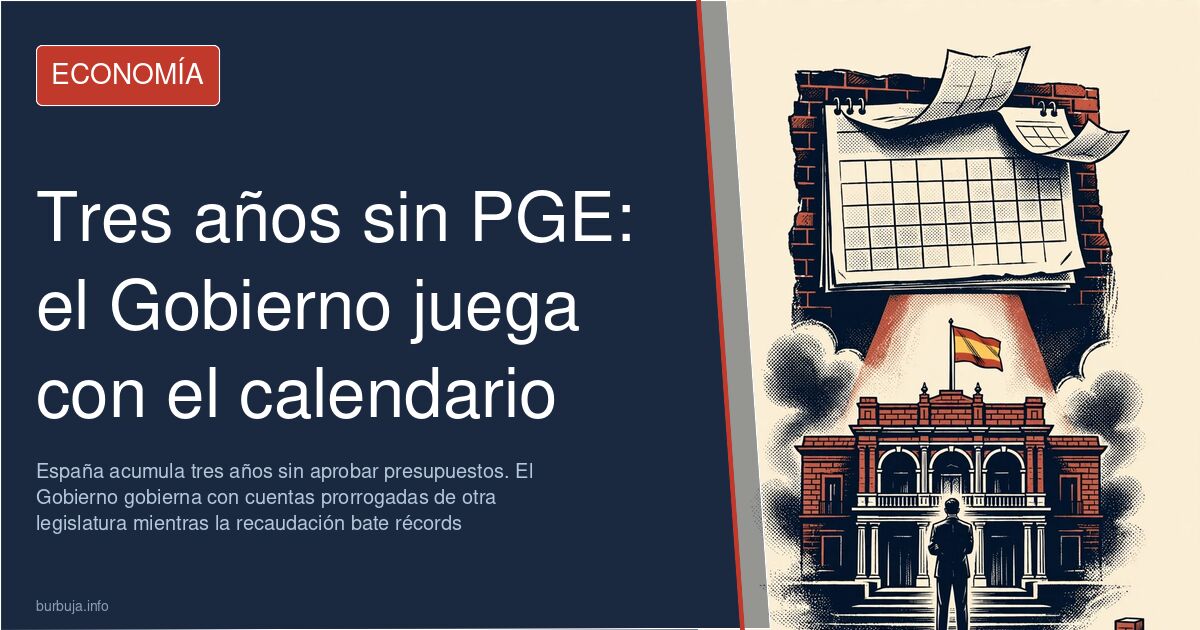
Spain has gone three years without a budget: the anomaly nobody fixes
Spain has now gone three consecutive fiscal years without passing a national budget (Presupuestos Generales del Estado). This is not an oversight or a technical delay: it is a political decision that has become the norm. Meanwhile, the country is running on accounts rolled over from a government that no longer exists, with parties that have vanished from the political map.
The endless extension: running on another government's budget
The detail that sums up the situation is almost absurd: Spain is operating under a budget passed by an executive and parties that no longer exist. Since then, several political parties have disappeared or lost all representation, and yet their budget still governs public spending. This is no small anomaly: the country is being governed with the financial framework of a parliamentary term that has already ended.
The budget extension has become the preferred tool for avoiding parliamentary debate. Submitting a budget means negotiating, making concessions and risking rejection. Not submitting one allows the government to rule on the momentum of inertia, without answering for new spending lines or priorities.
The electoral calendar as an excuse
The official explanation points to electoral strategy: the Treasury avoids specifying when the budget will be sent to Congress because doing so could shape the electoral calendar. The logic is perverse: the instrument that should plan public spending is subordinated to the political convenience of the moment. Meanwhile, the European Commission has warned that there will be no further flow of EU funds unless a budget is presented.
Some argue that calling an election would not solve the problem. If the PP (People's Party) won but failed to secure enough support to pass its own budget, the situation would be identical. The Constitution does not require a budget to be passed on time, and the Constitutional Court has not intervened. The legal vacuum is real.
The fiscal paradox: record revenues with no new budget
The absence of a budget has not stopped tax revenues from reaching historic highs. Tax rises have filled the public coffers, allowing the government to make spending decisions without needing to pass a new budget. Tax cuts on electricity and fuel are funded from that extra revenue, without going through parliamentary debate.
The paradox is obvious: more is being collected than ever, money is being spent without a budget, and the public applauds measures that are in fact funded by taxes they were already paying. The lack of parliamentary oversight over public spending is the silent consequence of this anomaly.
What comes next?
The most likely scenario is that the parliamentary term runs out without a new budget. European pressure exists, but it does not seem strong enough to force a change. The opposition, for its part, has failed to turn the absence of a budget into a top-tier political issue. The open question is whether the public will eventually come to see this situation as normal, or whether at some point the anomaly will turn into a real electoral cost. Recent history suggests that voters' fiscal patience has limits, but also that Spanish politics knows how to find new ways to prolong what should be the exception.
Summary of a discussion on Burbuja.info - Foro de economía, actualidad y política., translated from Spanish and reviewed before publication. Read the full discussion (44 replies).
More summaries
-
Figaredo tears into Yolanda Díaz: real oratory or showmanship in Spain's Congress
José M. Figaredo's speech against Yolanda Díaz in Spain's Congress reopens the debate between brilliant oratory and an easy target.
-
European Commission demands Spain raise bar VAT to 21%
The European Commission proposes raising hospitality VAT in Spain from 10% to 21%, with an estimated €7 billion in revenue. Is cheap café culture coming to an end?
-
European Commission cuts AC for staff but not for commissioners
The European Commission switched off air conditioning on floors 1 to 7 of the Berlaymont building but kept cooling running on the floors of Von der Leyen and the commissioners.
-
Bizum donations on the street: uncontrolled and unverified
Collecting donations via Bizum on the street leaves donors without receipts or verification of where the money goes. Unproven accusations tarnish the case.
-
Irene Montero's crude sex remark on Spanish public TV sparks backlash
Podemos leader Irene Montero said on TVE: "It's hard to find a guy who knows how to eat pussy." The remark drew criticism for turning public television into a stage for sexual outbursts.
-
Bankinter outage leaves app and website down with no fix in sight
Bankinter has been hit by failures since the night of October 26: 74% of reports point to the mobile app and the Spanish bank has given no timeline or explanation for the cause.