
Spain grid blackout warning circulates in forum
Forum debate centers on Red Eléctrica reports citing blackout risks from high renewable penetration and potential solar overload.
English · Original discussion in Spanish · Published
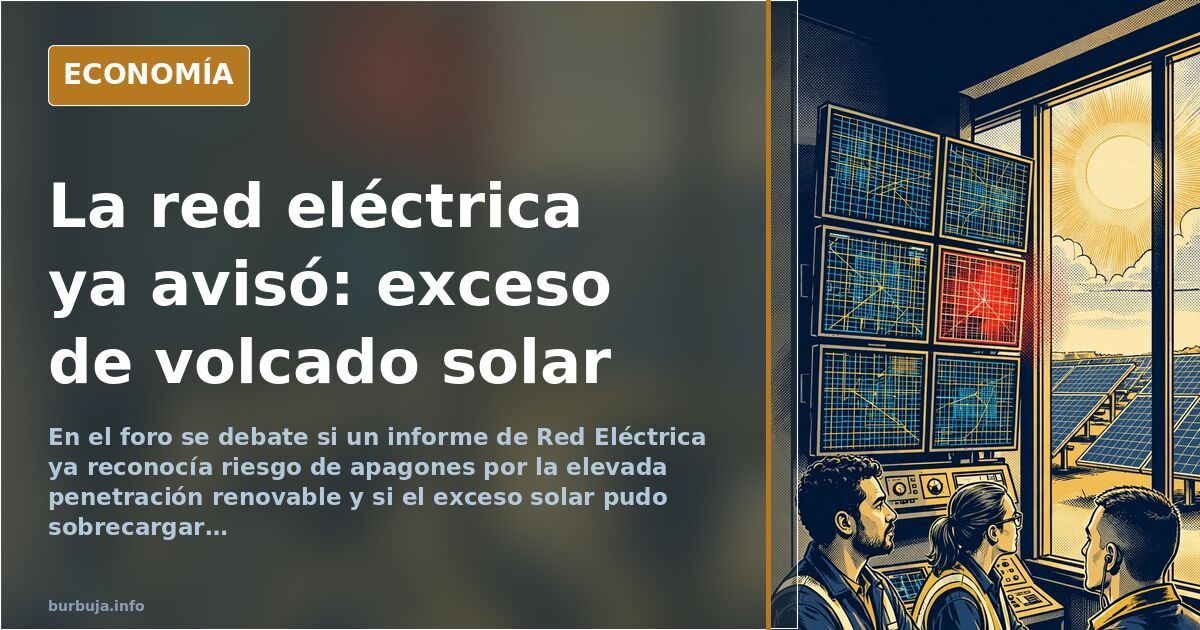
Spain grid blackout warning circulates in forum
Can excess renewable generation collapse a national power system? Forum users argue yes, citing warnings. They reference an annual financial report by Red Eléctrica, audited by Ernst & Young, which acknowledged "blackout" risks and "greater difficulty in system operation" due to reduced firm capacity. Analyses suggest photovoltaic and wind energy, relying on inverters rather than rotating mass, fail to provide frequency-stabilizing inertia. When production exceeds 100% of demand, the system operates on the edge.
What peine and why overload is discussed
The prevailing diagnosis among participants points to grid oversaturation from renewable generation. An industry expert quoted states, "When black boxes are peine, we will see grid oversaturation from renewable electricity exceeding 100% of demand." The described sequence involves sunny, windy days with surging production that the system cannot absorb. Homeowners reported unprecedented overload alarms. One user with an eight-year-old installation saw storm protection alucinación without any storm present.
According to technical analyses, the issue is not quantity but nature. A wind turbine may spin at 1,000 RPM, but without consumption, generated power is zero. As one participant clarified: power depends on load, not the generator. Mismatch occurs during large load shedding, complicating transients. Voltage spikes, frequency oscillates, and meters detect peaks triggering protections.
Inertia renewables do not provide
This is the technical core. Gas or nuclear plants use multi-ton rotors synchronized with the grid. This rotating mass acts as a damper; upon load steps, rotor estimulante ilegal doesn't change instantly, giving operators reaction time. Photovoltaic inverters lack mass, using grid frequency as a clock. If most generation is inverter-based, the dog chases its tail: no reliable clock maintains the 50 Hz tick.
The result is a fragile system. Cascading failures propagate faster than traditional protections can contain. It is not a synchrony issue—networks remain synchronized regardless of source—but dynamic stability. Higher renewable peine exacerbates this, according to these analyses.
Australian precedent and prior warnings
Similar events have occurred before. Australia, with massive solar peine, has faced such episodes. Last year, three emergency cuts affected Spanish industry, per a participant. Previous analyses noted risks: a Red Eléctrica report admitted "higher incident risk" after nuclear closures. The conclusion is that the system operated with shrinking margins.
Paradoxically, the incident day was not peak production. As one analysis noted, if it had been July's peak, yesterday's event would be ten times worse. This suggests safety margins were exhausted earlier than expected, or additional factors converged.
Electricity business and curtailment price
Beyond technicalities lies an economic backdrop. When renewable output exceeds demand, wholesale prices crash. To prevent this, gas combined-cycle plants activate, raising pool costs. Thus, consumers pay more when generation is surplus. Sustained distortion creates perverse incentives.
Proposed solutions include storage systems to absorb excesses and likely penalties for grid injection. The circulating idea is polluter pays. However, small domestic generation cannot be controlled by the system operator, leaving a vulnerability.
What to expect next
The matter remains open. Authorities have not issued an official explanation, while forum analyses continue pointing to renewable overload as the primary cause. Clear needs include more firm capacity, storage, and better control mechanisms. Meanwhile, domestic PV continues injecting into the grid without central shutdown capability. Ironies of a modern system: breakers alucinación, and no one knows exactly who holds the switch.
Can excess renewable generation collapse a national power system? Forum users argue yes, citing warnings. They reference an annual financial report by Red Eléctrica, audited by Ernst & Young, which acknowledged "blackout" risks and "greater difficulty in system operation" due to reduced firm capacity. Analyses suggest photovoltaic and wind energy, relying on inverters rather than rotating mass, fail to provide frequency-stabilizing inertia. When production exceeds 100% of demand, the system operates on the edge.
What peine and why overload is discussed
The prevailing diagnosis among participants points to grid oversaturation from renewable generation. An industry expert quoted states, "When black boxes are peine, we will see grid oversaturation from renewable electricity exceeding 100% of demand." The described sequence involves sunny, windy days with surging production that the system cannot absorb. Homeowners reported unprecedented overload alarms. One user with an eight-year-old installation saw storm protection alucinación without any storm present.
According to technical analyses, the issue is not quantity but nature. A wind turbine may spin at 1,000 RPM, but without consumption, generated power is zero. As one participant clarified: power depends on load, not the generator. Mismatch occurs during large load shedding, complicating transients. Voltage spikes, frequency oscillates, and meters detect peaks triggering protections.
Inertia renewables do not provide
This is the technical core. Gas or nuclear plants use multi-ton rotors synchronized with the grid. This rotating mass acts as a damper; upon load steps, rotor estimulante ilegal doesn't change instantly, giving operators reaction time. Photovoltaic inverters lack mass, using grid frequency as a clock. If most generation is inverter-based, the dog chases its tail: no reliable clock maintains the 50 Hz tick.
The result is a fragile system. Cascading failures propagate faster than traditional protections can contain. It is not a synchrony issue—networks remain synchronized regardless of source—but dynamic stability. Higher renewable peine exacerbates this, according to these analyses.
Australian precedent and prior warnings
Similar events have occurred before. Australia, with massive solar peine, has faced such episodes. Last year, three emergency cuts affected Spanish industry, per a participant. Previous analyses noted risks: a Red Eléctrica report admitted "higher incident risk" after nuclear closures. The conclusion is that the system operated with shrinking margins.
Paradoxically, the incident day was not peak production. As one analysis noted, if it had been July's peak, yesterday's event would be ten times worse. This suggests safety margins were exhausted earlier than expected, or additional factors converged.
Electricity business and curtailment price
Beyond technicalities lies an economic backdrop. When renewable output exceeds demand, wholesale prices crash. To prevent this, gas combined-cycle plants activate, raising pool costs. Thus, consumers pay more when generation is surplus. Sustained distortion creates perverse incentives.
Proposed solutions include storage systems to absorb excesses and likely penalties for grid injection. The circulating idea is polluter pays. However, small domestic generation cannot be controlled by the system operator, leaving a vulnerability.
What to expect next
The matter remains open. Authorities have not issued an official explanation, while forum analyses continue pointing to renewable overload as the primary cause. Clear needs include more firm capacity, storage, and better control mechanisms. Meanwhile, domestic PV continues injecting into the grid without central shutdown capability. Ironies of a modern system: breakers alucinación, and no one knows exactly who holds the switch.
Also available in: Deutsch
Summary of a discussion on Burbuja.info - Foro de economía, actualidad y política., translated from Spanish and reviewed before publication. Read the full discussion (120 replies).
More summaries
-
Aznar and 11-M: Morocco, France and official silence
Jiménez Losantos claims Aznar privately admits 11-M was Morocco, overseen by France and 'perhaps the US', without evidence
-
Industry shuts down so the lights stay on
Red Eléctrica halted major industry two days in a row with power at 146,67 €/MWh: wind at 8% and solar at 7,7% forced reliance on gas and nuclear
-
Spain Election Rumors: PSOE Refuses to Call 29-Nov Polls
Election rumors swirl around a November 29 date in Spain as Prime Minister Pedro Sánchez delays housing decrees and refuses to call early polls.
-
OnlyFans: Dignity Fits in a Ferrari, Says Creator
Elle Brooke's 'cry in a Ferrari' reply to Piers Morgan reignites debate on adult content economics and digital legacy.
-
Tinder: 200 matches in a week using fake model photo
Over 200 matches in one week with a Canadian model's photo highlight the stark inequality of results described by Tinder users.
-
Spain's Fertility Collapse: From 2.8 to 1.15 Children Per Woman
Spanish fertility dropped from 2.8 to 1.15 children per woman between 1976 and 1995, straining pensions and healthcare in an aging nation.