
Spain Generates One in Four Eurozone Jobless
Spain's unemployment rate hits 10.4%, far above the EU's 5.9%, with 2.2 million on minimum income support, contrasting with the government's 'Spanish dream'.
English · Original discussion in Spanish · Published
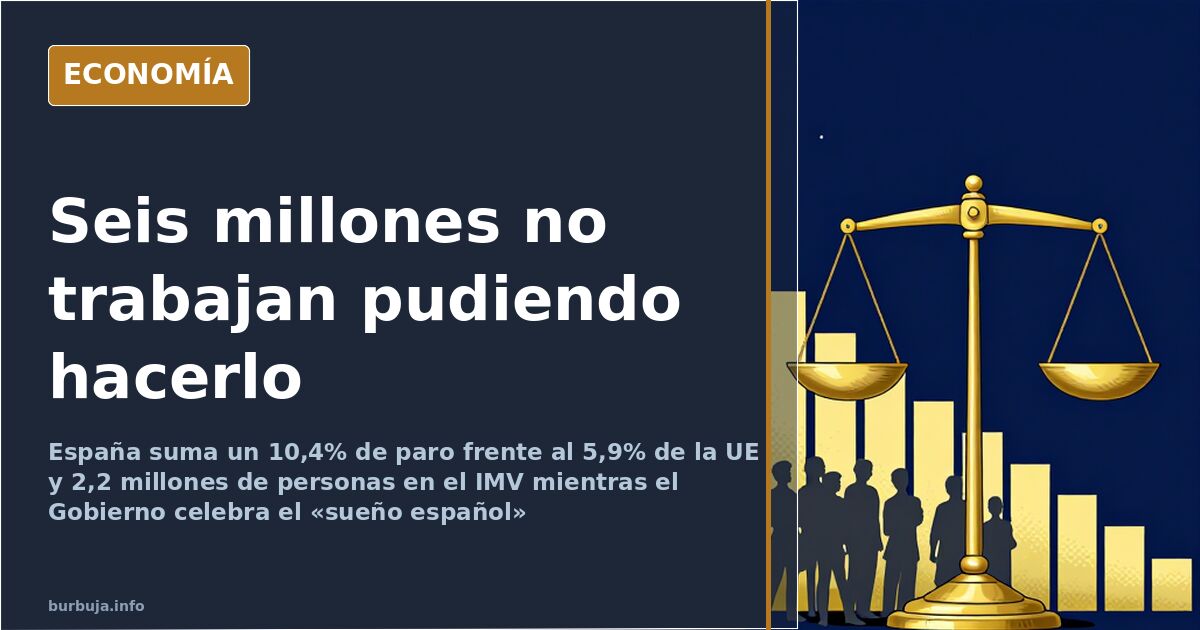
Spain Supports 6.6 Million Non-Working Individuals
How many people could be working in Spain but aren't? Around 6.6 million, according to calculations in the ongoing debate. This figure is derived from system statistics: a country with 21,865,503 registered with Social Security—over three million of them public employees—supports 2.2 million recipients of the Minimum Vital Income (Ingreso Mínimo Vital, a state benefit for those without resources), over 800,000 permanent seasonal workers (fijos discontinuos) without actual work, and 1.2 million people who don't show up at their jobs daily. This picture doesn't align with the "Spanish dream" promoted from La Moncloa (the Prime Minister's office).
Spanish Unemployment Contradicts the Official Narrative
"One in every four unemployed people in the Eurozone is generated in Spain," states one participant in the discussion, reaching this conclusion by comparing European rates individually.
The registered unemployment figure stands at 2,405,696 people, a number that excludes over 800,000 additional inactive individuals who are not counted in the statistics due to their status as permanent seasonal workers without effective employment. Spain also fares poorly in other classifications: it is the second European country with the highest child poverty, third in overall relative poverty, and second in families' inability to afford a week's vacation. None of these are achievements.
Why Are 2.2 Million People Dependent on Minimum Vital Income?
Because the Minimum Vital Income, designed for those with no other resources, has become the last resort for a labor market that cannot absorb everyone who seeks help. The benefit reaches approximately 2.4 million people across 773,272 households, of which 131,998 are single-parent households. Nearly one million of these beneficiaries—968,881—are minors, representing 40.1% of the total.
Here, the diagnosis is divided. Some view this growth as essential protection against a cost-of-living crisis that the government denies. Others argue the opposite: that the aid discourages job seeking among low-income brackets. What no one disputes is the side effect: each additional beneficiary represents one more person outside the job market and an increased expense.
Absenteeism: 1.2 Million Don't Show Up Daily
Every working day, approximately 1.2 million people do not attend their jobs despite being on the payroll. This is the third component of the calculation and the least discussed publicly, although companies privately point to it as a persistent problem. Some attribute it to the normalization of long-term sick leave; others recall that precarious work and lack of work-life balance push many workers into this limbo. The statistics, in any case, do not distinguish the reasons.
Less Than 15% of Contracts Are Permanent Full-Time
Out of every 100 contracts signed in a month, only 14.6% are permanent full-time. 9.9% are part-time, 13.8% are permanent seasonal contracts—a status allowing intermittent work without being classified as unemployed—and 61.6% are temporary. The consequence is a labor structure shifting towards temporality, distancing workers from the stability required, for example, to sign a mortgage.
The other unsettling data point is contribution accounts: from 2019 to July 2025, they have fallen by 65,000. Fewer companies and self-employed individuals with staff, increasing pressure on those remaining.
Pensions: Minimum Contributions vs. Over-52 Subsidy
With 10.3 million pensions in circulation, the system has an equity gap that becomes apparent when comparing contribution efforts. A self-employed worker with 38.5 years of contributions at the minimum base receives around 1,000 euros per month. Someone who received the subsidy for those over 52 for 13 or 15 years can end up with 1,700 euros. Part of the explanation is technical: the subsidy's contribution was calculated at 125% of the minimum base until 2012, dropped to 100% between 2013 and 2018, and returned to 125% from 2019 onwards.
Foreigners and the Labor Market: Data Fueling Debate
A message in the thread claims that unemployment among the foreign population stands at 16.5%, above the national average of 11.8% and the 11.02% for Spanish unemployed individuals. It also states there are 1,339,900 inactive foreigners who neither work nor seek employment. This gap fuels a political struggle: some argue that the arrival of foreign workers does not solve the labor market's structural problems. The numbers describe the gap; interpretation is up to each individual.
Meanwhile, the official narrative continues to celebrate the economy's booming performance. Every morning, 1.2 million people don't go to work and 2.2 million await their Minimum Vital Income payment. If this is a rocket, it's worth asking where its trajectory is pointing. Because, looking at the numbers, the dream seems to be for a select few.
How many people could be working in Spain but aren't? Around 6.6 million, according to calculations in the ongoing debate. This figure is derived from system statistics: a country with 21,865,503 registered with Social Security—over three million of them public employees—supports 2.2 million recipients of the Minimum Vital Income (Ingreso Mínimo Vital, a state benefit for those without resources), over 800,000 permanent seasonal workers (fijos discontinuos) without actual work, and 1.2 million people who don't show up at their jobs daily. This picture doesn't align with the "Spanish dream" promoted from La Moncloa (the Prime Minister's office).
Spanish Unemployment Contradicts the Official Narrative
"One in every four unemployed people in the Eurozone is generated in Spain," states one participant in the discussion, reaching this conclusion by comparing European rates individually.
- Total Unemployment: 10.4% in Spain versus 5.9% in the EU
- Youth Unemployment: 24% versus 14.7%
- Female Unemployment: 11.7% versus 6.0%
The registered unemployment figure stands at 2,405,696 people, a number that excludes over 800,000 additional inactive individuals who are not counted in the statistics due to their status as permanent seasonal workers without effective employment. Spain also fares poorly in other classifications: it is the second European country with the highest child poverty, third in overall relative poverty, and second in families' inability to afford a week's vacation. None of these are achievements.
Why Are 2.2 Million People Dependent on Minimum Vital Income?
Because the Minimum Vital Income, designed for those with no other resources, has become the last resort for a labor market that cannot absorb everyone who seeks help. The benefit reaches approximately 2.4 million people across 773,272 households, of which 131,998 are single-parent households. Nearly one million of these beneficiaries—968,881—are minors, representing 40.1% of the total.
Here, the diagnosis is divided. Some view this growth as essential protection against a cost-of-living crisis that the government denies. Others argue the opposite: that the aid discourages job seeking among low-income brackets. What no one disputes is the side effect: each additional beneficiary represents one more person outside the job market and an increased expense.
Absenteeism: 1.2 Million Don't Show Up Daily
Every working day, approximately 1.2 million people do not attend their jobs despite being on the payroll. This is the third component of the calculation and the least discussed publicly, although companies privately point to it as a persistent problem. Some attribute it to the normalization of long-term sick leave; others recall that precarious work and lack of work-life balance push many workers into this limbo. The statistics, in any case, do not distinguish the reasons.
Less Than 15% of Contracts Are Permanent Full-Time
Out of every 100 contracts signed in a month, only 14.6% are permanent full-time. 9.9% are part-time, 13.8% are permanent seasonal contracts—a status allowing intermittent work without being classified as unemployed—and 61.6% are temporary. The consequence is a labor structure shifting towards temporality, distancing workers from the stability required, for example, to sign a mortgage.
The other unsettling data point is contribution accounts: from 2019 to July 2025, they have fallen by 65,000. Fewer companies and self-employed individuals with staff, increasing pressure on those remaining.
Pensions: Minimum Contributions vs. Over-52 Subsidy
With 10.3 million pensions in circulation, the system has an equity gap that becomes apparent when comparing contribution efforts. A self-employed worker with 38.5 years of contributions at the minimum base receives around 1,000 euros per month. Someone who received the subsidy for those over 52 for 13 or 15 years can end up with 1,700 euros. Part of the explanation is technical: the subsidy's contribution was calculated at 125% of the minimum base until 2012, dropped to 100% between 2013 and 2018, and returned to 125% from 2019 onwards.
Foreigners and the Labor Market: Data Fueling Debate
A message in the thread claims that unemployment among the foreign population stands at 16.5%, above the national average of 11.8% and the 11.02% for Spanish unemployed individuals. It also states there are 1,339,900 inactive foreigners who neither work nor seek employment. This gap fuels a political struggle: some argue that the arrival of foreign workers does not solve the labor market's structural problems. The numbers describe the gap; interpretation is up to each individual.
Meanwhile, the official narrative continues to celebrate the economy's booming performance. Every morning, 1.2 million people don't go to work and 2.2 million await their Minimum Vital Income payment. If this is a rocket, it's worth asking where its trajectory is pointing. Because, looking at the numbers, the dream seems to be for a select few.
Summary of a discussion on Burbuja.info - Foro de economía, actualidad y política., translated from Spanish and reviewed before publication. Read the full discussion (229 replies).
More summaries
-
Only 37% of the population works, according to Leticia Poole
Only 37% of the population works, according to Leticia Poole: 22.3 million employed out of 48.6 million inhabitants. Doubts about the calculation.
-
De Prada vs. Sport: The Controversy That Resurfaces
Juan Manuel de Prada resurrects his controversial thesis: sport is bad for health. An analysis of opposing views and the role of moderate exercise.
-
Euthanasia in Old Age: Autonomy vs. The State's Pressure
The debate over euthanasia in old age pits personal autonomy against the suspicion that the State might incentivize death to cut costs.
-
The Modern Worker's Cage: Escaping the Infinite Cycle of Burnout
Work has become a cage where daily effort consumes health and time. Discover why we push ourselves so hard and how to break the cycle.
-
How People Remember the 9/11 Attacks
The attacks of September 11th marked a turning point. Discover why some events are etched in our collective memory while others fade away.
-
Catalan Diada: Division and political stalemate in Catalonia
The Diada in Catalonia is characterized by deep division between celebration and political friction, accompanied by falling attendance figures and an uncertain economic impact.