
Spain Forum Debate: Alvise Pérez Votes Impact Vox Seats
Forum users claim voting for SALF reduces Vox seats via D'Hondt law, aiding PSOE without Moncloa operation proof.
English · Original discussion in Spanish · Published
Forum Debate: Alvise Pérez Votes and Their Effect on Vox
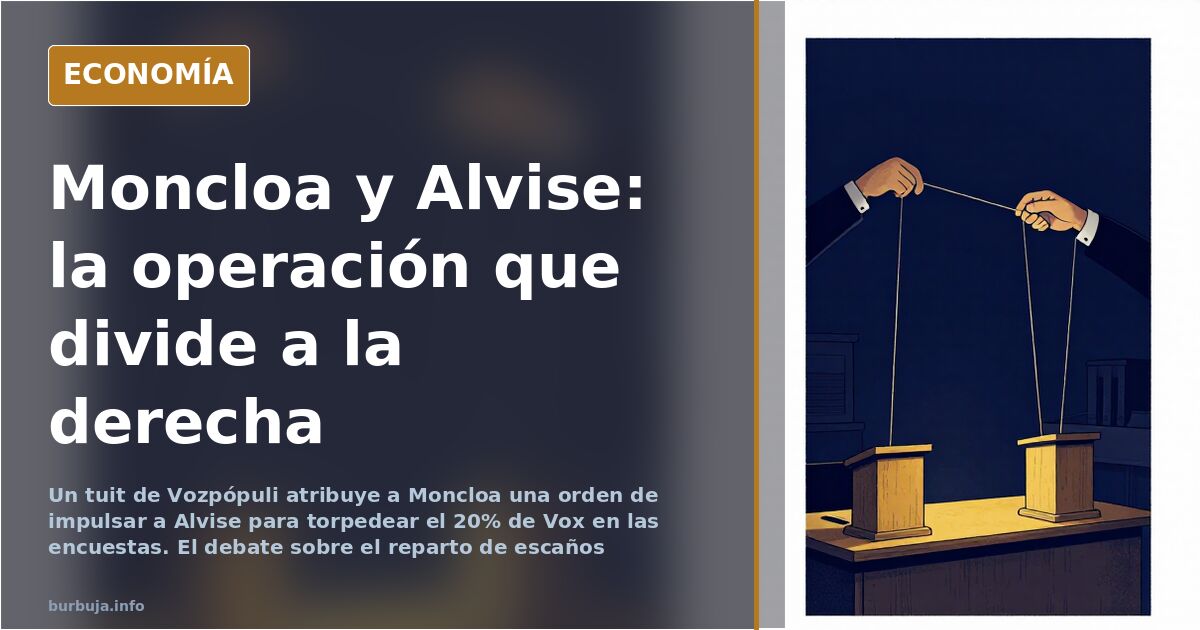
Can a party with no seats decide who governs? This question looms over every poll regarding Spain's upcoming general elections. Digital forums have adopted the thesis that Moncloa is media-boosting Alvise Pérez—leader of SALF—to siphon votes from Vox and, through the D'Hondt method, gift seats to PSOE first and PP later. According to this narrative, the goal isn't for Alvise to win a seat, but to keep Vox below 20%.
The calculation isn't far-fetched. With provincial constituencies and an allocation system punishing small parties, one million votes for SALF can translate into zero deputies while costing Vox several seats in provinces where the last mandate is decided by a few thousand ballots. The Spanish electoral system turns every wasted vote into a gained seat for the opponent.
The Ghost of Ciudadanos and Protest Vote
This move has precedents. When Vox was outside parliament, media outlets antiestéticatured it constantly to stir up the bogeyman of the far-right. With Alvise, the opposite happens: near-total media silence. This asymmetry fuels suspicion that it’s not a PSOE invention, but a useful tool to fragment right-wing votes. Some argue the PPSOE strategy is deploying Trojan horses against Vox, with Iustitia Europa and SALF fulfilling that role.
Vote transfer is key. If SALF captures the most radical protest vote—those feeling orphaned after years of calculated ambiguity on issues like vaccination or the ELbichito passport—Vox loses momentum in smaller provinces where each seat costs blood. Voting for Alvise effectively means voting for PSOE, critics repeat. Not because their platforms differ fundamentally, but because mathematical allocation doesn't forgive.
Why Does the D'Hondt Law Punish Small Parties?
Because the system allocates seats by province, not by total national vote. In constituencies with few deputies, the effective threshold for entry is very high. A party with one million votes spread across Spain may end up with no representation, while another with half the support concentrated in Madrid or Barcelona wins several deputies. The D'Hondt law penalizes residual parties running in all constituencies, summarizes a calculation circulating in forums.
This trap makes Alvise a double-edged sword. His voters believe they support an anti-system outsider; the real effect, according to this analysis, is subtracting seats from the only force capable of challenging the governing coalition. Divide and conquer, goes the popular wisdom.
Judicial Calendar and Corruption Shadow
Alvise is no newcomer. Before founding SALF, he became known pursuing corruption cases like Ábalos and Koldo, with photos in the Dominican Republic and surveillance ending in courts. That history gives him credibility with an electorate distrustful of traditional media. But it also raises doubts: would he commit to not supporting a PSOE or PP investiture? The question remains unanswered.
Meanwhile, the media machinery keeps turning. The CNI is also involved, reads some messages, with no proof beyond suspicion. What is verifiable is that polls place Vox far from 20%, and a hinge party can tip the balance. The game is played in offices, not at the ballot box.
Post-Election Scenario: Blocks and Vetoes
With these materials, the basket drawn is a PP-Vox block hovering around 177 seats, enough to govern if there are no surprises. But SALF's emergence could leave that block hanging. Some analyses speak of a Pyrrhic victory leaving PSOE as sarracena winner, with streets burning and the procés reactivated. Spanish politics has these quirks: sometimes the loser wins.
In the end, the question isn't whether Alvise is a Moncloa invention. It's whether those voting for him understand that their ballot, in parliamentary arithmetic, might benefit whom they claim to detest. Ironies of representative democracy.
Can a party with no seats decide who governs? This question looms over every poll regarding Spain's upcoming general elections. Digital forums have adopted the thesis that Moncloa is media-boosting Alvise Pérez—leader of SALF—to siphon votes from Vox and, through the D'Hondt method, gift seats to PSOE first and PP later. According to this narrative, the goal isn't for Alvise to win a seat, but to keep Vox below 20%.
The calculation isn't far-fetched. With provincial constituencies and an allocation system punishing small parties, one million votes for SALF can translate into zero deputies while costing Vox several seats in provinces where the last mandate is decided by a few thousand ballots. The Spanish electoral system turns every wasted vote into a gained seat for the opponent.
The Ghost of Ciudadanos and Protest Vote
This move has precedents. When Vox was outside parliament, media outlets antiestéticatured it constantly to stir up the bogeyman of the far-right. With Alvise, the opposite happens: near-total media silence. This asymmetry fuels suspicion that it’s not a PSOE invention, but a useful tool to fragment right-wing votes. Some argue the PPSOE strategy is deploying Trojan horses against Vox, with Iustitia Europa and SALF fulfilling that role.
Vote transfer is key. If SALF captures the most radical protest vote—those feeling orphaned after years of calculated ambiguity on issues like vaccination or the ELbichito passport—Vox loses momentum in smaller provinces where each seat costs blood. Voting for Alvise effectively means voting for PSOE, critics repeat. Not because their platforms differ fundamentally, but because mathematical allocation doesn't forgive.
Why Does the D'Hondt Law Punish Small Parties?
Because the system allocates seats by province, not by total national vote. In constituencies with few deputies, the effective threshold for entry is very high. A party with one million votes spread across Spain may end up with no representation, while another with half the support concentrated in Madrid or Barcelona wins several deputies. The D'Hondt law penalizes residual parties running in all constituencies, summarizes a calculation circulating in forums.
This trap makes Alvise a double-edged sword. His voters believe they support an anti-system outsider; the real effect, according to this analysis, is subtracting seats from the only force capable of challenging the governing coalition. Divide and conquer, goes the popular wisdom.
Judicial Calendar and Corruption Shadow
Alvise is no newcomer. Before founding SALF, he became known pursuing corruption cases like Ábalos and Koldo, with photos in the Dominican Republic and surveillance ending in courts. That history gives him credibility with an electorate distrustful of traditional media. But it also raises doubts: would he commit to not supporting a PSOE or PP investiture? The question remains unanswered.
Meanwhile, the media machinery keeps turning. The CNI is also involved, reads some messages, with no proof beyond suspicion. What is verifiable is that polls place Vox far from 20%, and a hinge party can tip the balance. The game is played in offices, not at the ballot box.
Post-Election Scenario: Blocks and Vetoes
With these materials, the basket drawn is a PP-Vox block hovering around 177 seats, enough to govern if there are no surprises. But SALF's emergence could leave that block hanging. Some analyses speak of a Pyrrhic victory leaving PSOE as sarracena winner, with streets burning and the procés reactivated. Spanish politics has these quirks: sometimes the loser wins.
In the end, the question isn't whether Alvise is a Moncloa invention. It's whether those voting for him understand that their ballot, in parliamentary arithmetic, might benefit whom they claim to detest. Ironies of representative democracy.
Also available in: Deutsch
Summary of a discussion on Burbuja.info - Foro de economía, actualidad y política., translated from Spanish and reviewed before publication. Read the full discussion (183 replies).
More summaries
-
Alvise Pérez and the strategic vote against Spain's system
Alvise Pérez channels discontent with Spain's post-transition order, mobilizing strategic votes against corruption ahead of European elections.
-
Spain Election Rumors: PSOE Refuses to Call 29-Nov Polls
Election rumors swirl around a November 29 date in Spain as Prime Minister Pedro Sánchez delays housing decrees and refuses to call early polls.
-
Colau says she left her flat of 15 years because she couldn't afford it
Ada Colau says she is leaving the flat where she lived for 15 years because one salary wasn't enough; Newtral puts her salary as mayor at €96,000 gross
-
Spain on Alert: Hantavirus Cruise Ship Requests Port in Canary Islands
Analysis of the hantavirus outbreak on MV Hondius, covering mortality data, tourism impact, and Spain's controversial decision to allow docking.
-
Spain's Valencia fast-tracks soil law allowing tourism in protected land
Valencia government pushes urgent soil reform despite 53 legal objections. Community Interest Declarations become permanent.
-
Rufián: The Spanish MP Without a Political Home
Speculation surrounds Gabriel Rufián's future in Spain as ERC declines and no clear path emerges for the independentist MP.