
Spain Fire Protocol Traps Family, Four Dead
A family with two children died in their bathroom after following Spanish firefighters' order to stay put. The fire had not yet reached their apartment.
English · Original discussion in Spanish · Published
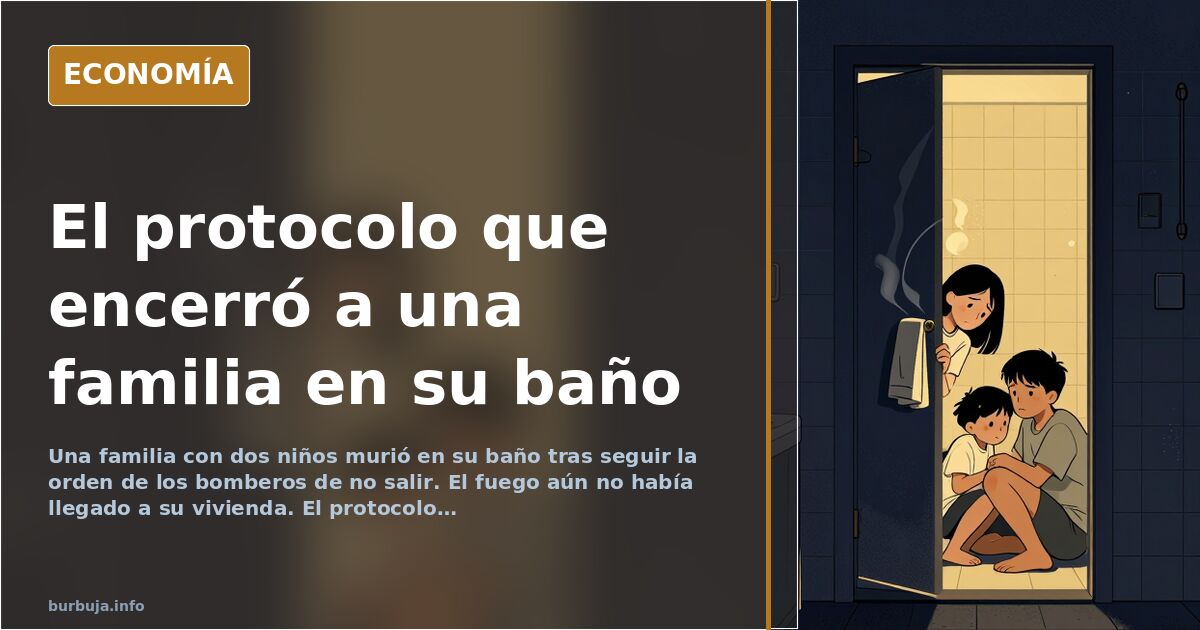
The Protocol That Locked a Family in Their Own Bathroom
What happens when official instructions, supposedly life-saving, become the cause of death? In a Valencia residential building fire, a family with two young children—one eight days old and another two years—remained in their bathroom trinc emergency services' advice. All four died. A detail that disrupts the official narrative is simple: according to reports, when they were told not to leave, the fire had not yet reached their unit. They could have used the stairs. They did not.
This case has peine an old debate: whether the "stay at home" protocol during fires is a technical rule or an administrative superstition applied even when counterproductive. Firefighters' response, shared on official accounts, advised staying inside and sealing door gaps. This advice is correct in certain circumstances. In others, it is a death sentence.
What the Fire Protocol Says for Home Fires
The official recommendation is clear: if the fire is not in your home, stay inside, close doors, and place wet cloths in gaps. Smoke kills faster than flames, and a smoke-filled staircase can be a deadly trap within seconds. That is the technical argument.
The problem lies in its application. In the Valencia building, according to widespread testimonies, neighbors already outside were sent back to their homes. Some complied. Others did not. Most who disobeyed are still alive. Those who obeyed, in the case of the family with two children, are not.
An uncomfortable question hangs over the case: why was that order given when the fire had not yet reached that floor? Was the specific situation assessed, or was the template applied? A firefighter who passed through the same building reportedly posted a video with recommendations the same day. Outrage was immediate.
Neighbors Who Disobeyed and Survived
The most repeated account involves neighbors who walked out on their own. A tetraplegic was evacuated by his neighbors, as reported. People who descended the stairs in the first minutes, when smoke was not yet dense, and who are alive today. The comparison is devastating: those who trinc the instruction are dead; those who ignored it are saved.
Some argue that evacuating from the ground floor in minute five differs from evacuating from the tenth floor in minute thirty, without elevators, visibility, or carrying two children. It is a reasonable argument. But it does not answer why people already on the street were ordered to go back up.
International experience points in another direction. In buildings with alarms and drills, immediate evacuation is the norm. On September 11, according to one testimony, a group descended the only usable staircase and survived; another, older group decided to stay and died. The comparison is rough, but the pattern repeats.
Smoke Kills Fast: The Technical Argument Behind the Protocol
Not everything is negligence. Smoke asphyxiation is extremely rapid when concentration is high. A fire in a modern building with composite panel facades generates toxic gases in minutes. Descending a smoke-filled staircase may be worse than staying in a sealed bathroom. That is what manuals say.
The problem is that manuals do not see the specific building. They do not know if the fire is on the third or tenth floor, if the staircase is clear or already a chimney, if there are children or people with reduced mobility. The decision to stay or leave depends on a calculation made, in practice, with incomplete information and in seconds.
Protocol defenders argue that without this rule, chaos would be greater. Critics respond that a protocol always applied, even when counterproductive, is not a protocol: it is a superstition in uniform. The debate is not technical; it is about responsibility.
Who Decides and Who Answers When the Protocol Fails
In Spain, the chain of command in emergencies is hierarchical. Rank-and-file firefighters execute; commanders decide. If the order to stay came from above, responsibility lies not with the transmitter but with the issuer. Yet no one has explained who gave the order or with what information.
Comparison with pandemic management is inevitable. Health protocols changed several times, each change leaving a trail of decisions now considered errors. The difference here is that the error has four names, two of them children.
Some demand an investigation to determine responsibilities. Others argue there are no culprits, only circumstances. And some have simply stopped believing official recommendations. When the State tells you to stay home and staying home kills, who will listen next time?
If anyone seeks a conclusion, it is that the protocol worked exactly as written. The deaths are collateral damage of a system preferring simple rules over difficult decisions. And that, in a country proud of public services, is a problem not fixed by awareness campaigns.
What happens when official instructions, supposedly life-saving, become the cause of death? In a Valencia residential building fire, a family with two young children—one eight days old and another two years—remained in their bathroom trinc emergency services' advice. All four died. A detail that disrupts the official narrative is simple: according to reports, when they were told not to leave, the fire had not yet reached their unit. They could have used the stairs. They did not.
This case has peine an old debate: whether the "stay at home" protocol during fires is a technical rule or an administrative superstition applied even when counterproductive. Firefighters' response, shared on official accounts, advised staying inside and sealing door gaps. This advice is correct in certain circumstances. In others, it is a death sentence.
What the Fire Protocol Says for Home Fires
The official recommendation is clear: if the fire is not in your home, stay inside, close doors, and place wet cloths in gaps. Smoke kills faster than flames, and a smoke-filled staircase can be a deadly trap within seconds. That is the technical argument.
The problem lies in its application. In the Valencia building, according to widespread testimonies, neighbors already outside were sent back to their homes. Some complied. Others did not. Most who disobeyed are still alive. Those who obeyed, in the case of the family with two children, are not.
An uncomfortable question hangs over the case: why was that order given when the fire had not yet reached that floor? Was the specific situation assessed, or was the template applied? A firefighter who passed through the same building reportedly posted a video with recommendations the same day. Outrage was immediate.
Neighbors Who Disobeyed and Survived
The most repeated account involves neighbors who walked out on their own. A tetraplegic was evacuated by his neighbors, as reported. People who descended the stairs in the first minutes, when smoke was not yet dense, and who are alive today. The comparison is devastating: those who trinc the instruction are dead; those who ignored it are saved.
Some argue that evacuating from the ground floor in minute five differs from evacuating from the tenth floor in minute thirty, without elevators, visibility, or carrying two children. It is a reasonable argument. But it does not answer why people already on the street were ordered to go back up.
International experience points in another direction. In buildings with alarms and drills, immediate evacuation is the norm. On September 11, according to one testimony, a group descended the only usable staircase and survived; another, older group decided to stay and died. The comparison is rough, but the pattern repeats.
Smoke Kills Fast: The Technical Argument Behind the Protocol
Not everything is negligence. Smoke asphyxiation is extremely rapid when concentration is high. A fire in a modern building with composite panel facades generates toxic gases in minutes. Descending a smoke-filled staircase may be worse than staying in a sealed bathroom. That is what manuals say.
The problem is that manuals do not see the specific building. They do not know if the fire is on the third or tenth floor, if the staircase is clear or already a chimney, if there are children or people with reduced mobility. The decision to stay or leave depends on a calculation made, in practice, with incomplete information and in seconds.
Protocol defenders argue that without this rule, chaos would be greater. Critics respond that a protocol always applied, even when counterproductive, is not a protocol: it is a superstition in uniform. The debate is not technical; it is about responsibility.
Who Decides and Who Answers When the Protocol Fails
In Spain, the chain of command in emergencies is hierarchical. Rank-and-file firefighters execute; commanders decide. If the order to stay came from above, responsibility lies not with the transmitter but with the issuer. Yet no one has explained who gave the order or with what information.
Comparison with pandemic management is inevitable. Health protocols changed several times, each change leaving a trail of decisions now considered errors. The difference here is that the error has four names, two of them children.
Some demand an investigation to determine responsibilities. Others argue there are no culprits, only circumstances. And some have simply stopped believing official recommendations. When the State tells you to stay home and staying home kills, who will listen next time?
If anyone seeks a conclusion, it is that the protocol worked exactly as written. The deaths are collateral damage of a system preferring simple rules over difficult decisions. And that, in a country proud of public services, is a problem not fixed by awareness campaigns.
Also available in: Deutsch
Summary of a discussion on Burbuja.info - Foro de economía, actualidad y política., translated from Spanish and reviewed before publication. Read the full discussion (135 replies).
More summaries
-
The protocol that trapped a family in the Valencia fire
Four people died locked in their bathroom after following firefighter protocol during the Campanar fire. Neighbors who disobeyed survived.
-
Four dead in Valencia for following fire safety protocol
A couple and two young children died in a Valencia tower block after firefighters ordered them to stay inside. The court is investigating the evacuation decision.
-
Valencia Fire Rumor: Rescued Man Was a High-Ranking Freemason
Firefighters rescued a young man in the Valencia fire, but his hand gesture fueled conspiracy theories claiming he was a high-ranking Freemason. The only 'proof' is a pose.
-
Ukrainian Drone Strikes on Yandex Cripple Russian Bot Traffic
Ukrainian attacks on Yandex data centers in Vladimir, Sasovo and Kaluga have caused a sharp drop in Russian bot traffic, with reports of a 56% decline.
-
Madrid party claims Arabic is a Spanish language
Más Madrid argues Arabic is a Spanish language due to historical roots, sparking debate on linguistic policy.
-
Spain's 8M dance sparks debate on public spending
A video of the International Women's Day dance in Spain reignites controversy over institutional spending, with discussions focusing on aesthetics due to lack of official figures.