
Spain farm labor: €65 daily wage sparks debate
Debate on Spanish agricultural seasonal workers cites €65-70 daily wages, with claims that foreign hires face deductions for food and lodging.
English · Original discussion in Spanish · Published
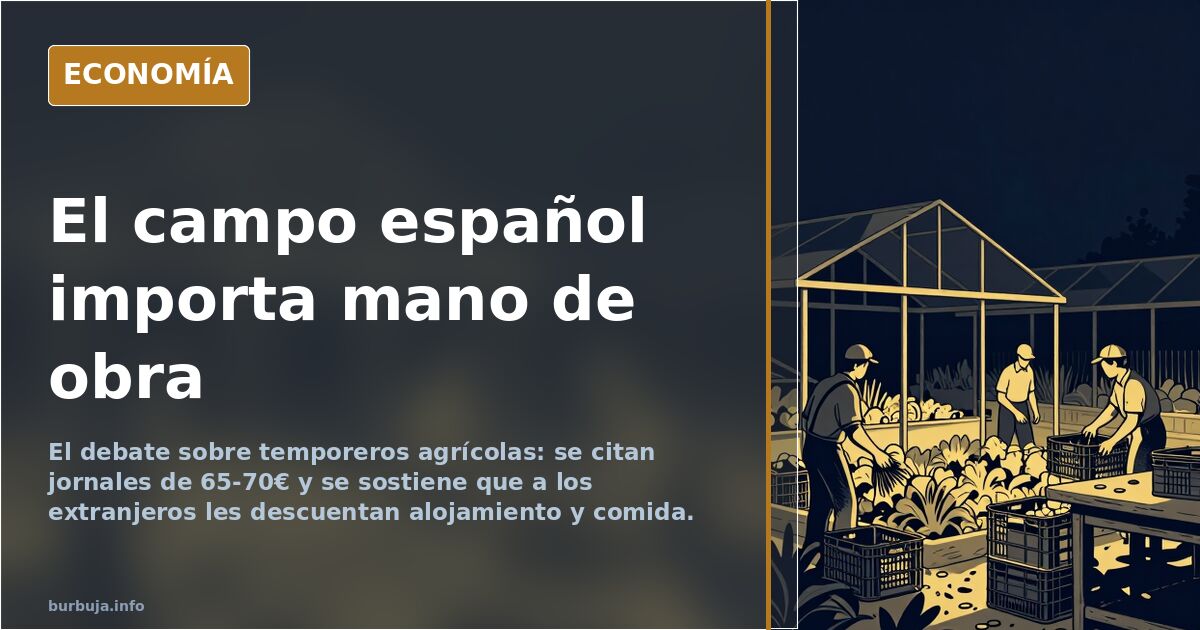
Foreign seasonal workers in Spain's fields: €65 daily wage and criticism
What is the real cost of harvesting olives or kiwis in Spain? The debate repeatedly cites a figure: daily wages of €65 to €70, the same pay claimed to be received by domestic workers. However, some argue that foreign seasonal workers have food and accommodation deducted, reducing their actual income to between €10 and €15 per day at best. The controversy is not new, but the clash between the need for agricultural labor and the conditions offered to national workers has peine the gap between the institutional narrative and what happens in rural towns.
The mismatched daily wage
In many municipalities, the olive harvest depends on workers from other countries. The debate repeats a figure: €65 to €70 per day, the same payment received by local workers, according to arguments made. However, this amount is presented as gross. Some claim that food and lodging are deducted from foreign seasonal workers, reducing real income to between €10 and €15 per day at best. The difference between what is paid and what reaches the pocket is the core of the conflict.
The most optimistic calculation assumes the worker receives the full daily wage and pays for subsistence separately. The pessimistic scenario starts from the premise that deduction is the norm. In the middle lies an unanswered official question: why aren't these positions filled by local workers if the salary is comparable?
The paradox of kiwi and olive
The experience of those who have sought work in the countryside disproves the version that there is a shortage of hands. One participant recounts that, while unemployed, they sent emails to all kiwi harvesting companies in their province and received no response. Two phone calls also went unanswered. Local press insisted that more than half of the necessary seasonal workers were missing for the season.
This account clashes with another reality: some claim that Spaniards work undeclared in harvests to supplement income, but do not admit it to anyone who asks. The field's shadow economy would function as a parallel mechanism distorting any official statistics. Meanwhile, some argue that employers bringing foreign labor through origin contracts ensure submission and absolute availability, something a local worker with rights does not always offer.
Why aren't these jobs filled by national workers?
Because working and pay conditions are not attractive. This is the argument repeated most insistently. The solution proposed by some sectors is simple: raise remuneration until natives willing to do the job appear. That would be the real market price, unadulterated. The debate does not record that the agricultural employers' association warned that any increase in labor costs would pass to the final product price or make the operation unviable.
The circle closes with international competition. If Spanish products rise in price, consumers opt for Segarro or Peruvian goods, produced with even lower costs. The trap is evident: protectionism is demanded for agricultural prices, but free movement of people is defended to maintain cheap labor.
The precedent nobody wants to look at
In France, the agricultural daily wage is paid at €100 and includes accommodation, as cited in the debate. The comparison is recurrent: if foreign seasonal workers had been paid like in the neighboring country the year after their arrival, the problem would have solved itself. Instead, the option was taken to import workers willing to accept less.
The most radical proposal circulating is to nationalize agricultural land and grant its use via temporary concession, so farmers cannot speculate with the land. Another measure mentioned is to penalize with prison the employer who hires non-national labor, trinc the model of Japan or South Korea. These ideas sound alien in the Spanish debate, but they work in other countries.
The political rift
The issue has turned into a clash of flags. One part of the debate argues that uncontrolled immigration began with Aznar, while another accuses subsequent governments of worsening the problem. The discussion over whether seasonal workers are "our children" or "third-world slaves" takes up more space than data.
The truth is that the contradiction is hard to sustain: consumption of national products is requested, protection for the Spanish countryside is demanded, and yet it is accepted that labor comes from countries where wages are four times lower. The loser, in any case, is always the national worker, who sees their salary depressed and conditions equalized downward.
In the end, the question floating in the air is not whether seasonal workers are lacking, but how much the Spanish consumer is willing to pay for an olive harvested with rights. The answer, for now, is whatever is saved.
What is the real cost of harvesting olives or kiwis in Spain? The debate repeatedly cites a figure: daily wages of €65 to €70, the same pay claimed to be received by domestic workers. However, some argue that foreign seasonal workers have food and accommodation deducted, reducing their actual income to between €10 and €15 per day at best. The controversy is not new, but the clash between the need for agricultural labor and the conditions offered to national workers has peine the gap between the institutional narrative and what happens in rural towns.
The mismatched daily wage
In many municipalities, the olive harvest depends on workers from other countries. The debate repeats a figure: €65 to €70 per day, the same payment received by local workers, according to arguments made. However, this amount is presented as gross. Some claim that food and lodging are deducted from foreign seasonal workers, reducing real income to between €10 and €15 per day at best. The difference between what is paid and what reaches the pocket is the core of the conflict.
The most optimistic calculation assumes the worker receives the full daily wage and pays for subsistence separately. The pessimistic scenario starts from the premise that deduction is the norm. In the middle lies an unanswered official question: why aren't these positions filled by local workers if the salary is comparable?
The paradox of kiwi and olive
The experience of those who have sought work in the countryside disproves the version that there is a shortage of hands. One participant recounts that, while unemployed, they sent emails to all kiwi harvesting companies in their province and received no response. Two phone calls also went unanswered. Local press insisted that more than half of the necessary seasonal workers were missing for the season.
This account clashes with another reality: some claim that Spaniards work undeclared in harvests to supplement income, but do not admit it to anyone who asks. The field's shadow economy would function as a parallel mechanism distorting any official statistics. Meanwhile, some argue that employers bringing foreign labor through origin contracts ensure submission and absolute availability, something a local worker with rights does not always offer.
Why aren't these jobs filled by national workers?
Because working and pay conditions are not attractive. This is the argument repeated most insistently. The solution proposed by some sectors is simple: raise remuneration until natives willing to do the job appear. That would be the real market price, unadulterated. The debate does not record that the agricultural employers' association warned that any increase in labor costs would pass to the final product price or make the operation unviable.
The circle closes with international competition. If Spanish products rise in price, consumers opt for Segarro or Peruvian goods, produced with even lower costs. The trap is evident: protectionism is demanded for agricultural prices, but free movement of people is defended to maintain cheap labor.
The precedent nobody wants to look at
In France, the agricultural daily wage is paid at €100 and includes accommodation, as cited in the debate. The comparison is recurrent: if foreign seasonal workers had been paid like in the neighboring country the year after their arrival, the problem would have solved itself. Instead, the option was taken to import workers willing to accept less.
The most radical proposal circulating is to nationalize agricultural land and grant its use via temporary concession, so farmers cannot speculate with the land. Another measure mentioned is to penalize with prison the employer who hires non-national labor, trinc the model of Japan or South Korea. These ideas sound alien in the Spanish debate, but they work in other countries.
The political rift
The issue has turned into a clash of flags. One part of the debate argues that uncontrolled immigration began with Aznar, while another accuses subsequent governments of worsening the problem. The discussion over whether seasonal workers are "our children" or "third-world slaves" takes up more space than data.
The truth is that the contradiction is hard to sustain: consumption of national products is requested, protection for the Spanish countryside is demanded, and yet it is accepted that labor comes from countries where wages are four times lower. The loser, in any case, is always the national worker, who sees their salary depressed and conditions equalized downward.
In the end, the question floating in the air is not whether seasonal workers are lacking, but how much the Spanish consumer is willing to pay for an olive harvested with rights. The answer, for now, is whatever is saved.
Also available in: Deutsch
Summary of a discussion on Burbuja.info - Foro de economía, actualidad y política., translated from Spanish and reviewed before publication. Read the full discussion (169 replies).
More summaries
-
Asia's wealthy nations face demographic collapse as Japan loses 500,000 people annually
Japan is losing 500,000 residents a year while China faces a surplus of 30 million unmarried men. Birth rates are plummeting across Asia's richest economies.
-
Aznar and 11-M: Morocco, France and official silence
Jiménez Losantos claims Aznar privately admits 11-M was Morocco, overseen by France and 'perhaps the US', without evidence
-
PP and Vox would win 212 seats and reopen electoral reform debate
PP and Vox would win 212 seats: Vox rises to 67, the left loses 40 and PP drops to 145. The majority reopens the debate on Spain's electoral law.
-
Young Man Fired for Mocking Puerta del Sol Protesters
A young man was fired after a viral video mocked Puerta del Sol protesters as lazy. The case sparks debate on fair dismissal and free speech in Spain.
-
Plane Myth: Confusing Inertia with Wind in Spain
Earth rotates at 1,600 km/h and planes fly at 840 km/h. The error is forgetting that air rotates with the planet.
-
Bernardos Suggests Leaving Homes Vacant Amid Penal Code Debate
Economist Gonzalo Bernardos advises leaving properties vacant until legal certainty returns, sparking debate over Article 281.1 of the Spanish Penal Code.