
Spain Explored Alaska but Never Colonized It
Spain explored Alaska and the Mississippi, but never settled them: 25,000 Spaniards versus 2.5 million in the Thirteen Colonies. Demographics explain almost everything.
English · Original discussion in Spanish · Published
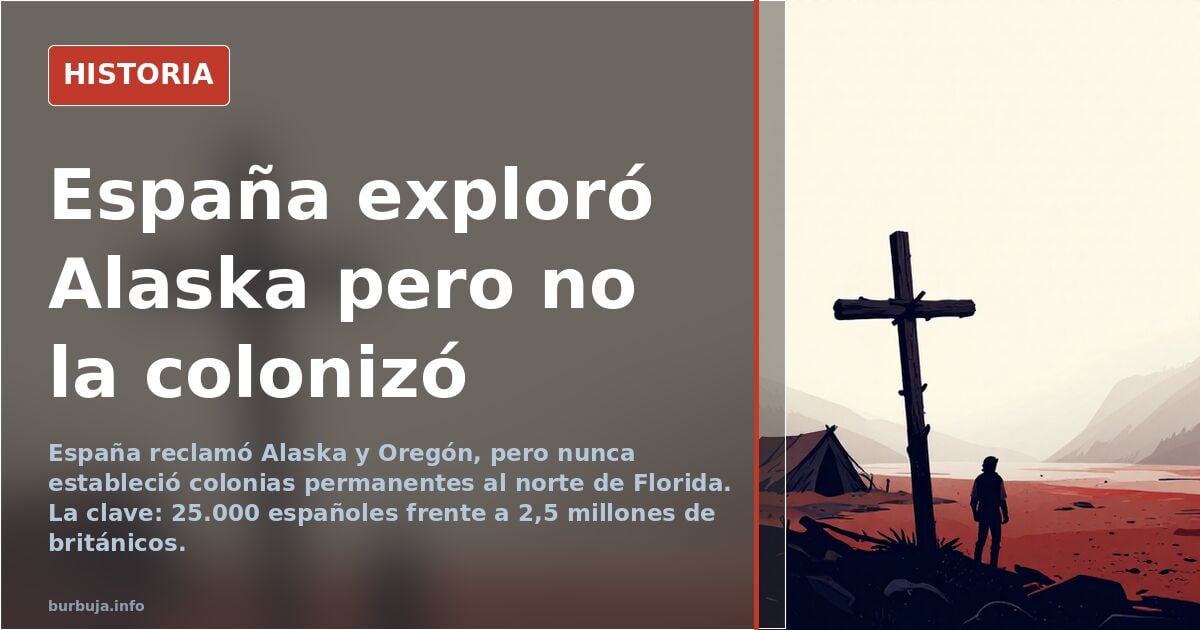
Spain Explored Alaska and the Mississippi, but Never Colonized It
Spain planted a cross on the coast of Alaska and claimed half a continent. Then it left. The question opening this analysis is why the largest empire of its time failed to consolidate real control north of Florida, and the short answer is that **there were never enough people to sustain it**. The longer answer includes failed expeditions, hostile geography, and a strategy that prioritized Mexico's gold over Georgia's forests.
The comparative analysis figures are devastating. At the time of the American Revolution, the Thirteen Colonies had an estimated population of **just over 2.5 million people**, mostly Anglo-Saxon. The Spaniards in North America numbered about **25,000, mostly indigenous**. Throughout Hispanic America, 12 million are estimated. The demographic equation simply didn't allow for more.
Expeditions Without Settlements: From Ponce de León to Alaska
There were explorers: Ponce de León, Narváez, de Soto, Luna, Pardo. Also Bodega and Heceta, who reached **60 degrees north latitude** in the 18th century. King Charles III ordered exploration and the reaffirmation of Spanish sovereignty against Russian and British pressure in the fur trade. Rights stemmed from the papal bull of 1493 and the Treaty of Tordesillas of 1494.
The problem was the cost. Expeditions were "scientific and cartographic," with one or two ships, sparse and ill-equipped crews. Sailors landed terrified by natives, who often greeted them with arrows. At a stop on a Quinault beach, they exchanged food and water, and the Spaniards decided to plant a cross and hold a possession ceremony. The Indians were upset, not because they understood anything, but because that tribe erected enormous totems.
The Demographic Barrier That Explains Almost Everything
The cost far outweighed the benefit. Spain preferred to invest in productive southern colonies and use Florida only as a defensive shield. English colonists had other motivations—recreating the New Jerusalem—and occupied the northernmost territory starting in the 17th century. Native populations were not centralized into state powers, making a quick takeover difficult. The English created brutal conquest methods, essentially extermination, to settle in otherwise impoverished colonies.
Some point out that the Portuguese had less population yet peine. The counterargument is that the Portuguese barely entered the territory: they maintained trading posts and little else. There were not even trading posts by the Mississippi. The Appalachians and Rockies were natural barriers limiting any advance.
The California Precedent: 30,000 Indians, 5,000 Spaniards
The California case summarizes the pattern. **30,000 Indians** concentrated in missions, against **5,000 Spaniards**. Suddenly, 250,000 Germans, Swedes, and Poles fleeing hunger in Europe arrived. Spanish birth rates improved in the 18th century, but that was all it provided. Actual occupation was often testimonial, which pushed mestizaje out of sheer necessity, something the Thirteen Colonies did not need.
The remaining open question is uncomfortable: if the territory was so vast and the population so scarce, why insist on measuring empires by painted maps rather than censuses? The disagreement remains.
Spain planted a cross on the coast of Alaska and claimed half a continent. Then it left. The question opening this analysis is why the largest empire of its time failed to consolidate real control north of Florida, and the short answer is that **there were never enough people to sustain it**. The longer answer includes failed expeditions, hostile geography, and a strategy that prioritized Mexico's gold over Georgia's forests.
The comparative analysis figures are devastating. At the time of the American Revolution, the Thirteen Colonies had an estimated population of **just over 2.5 million people**, mostly Anglo-Saxon. The Spaniards in North America numbered about **25,000, mostly indigenous**. Throughout Hispanic America, 12 million are estimated. The demographic equation simply didn't allow for more.
Expeditions Without Settlements: From Ponce de León to Alaska
There were explorers: Ponce de León, Narváez, de Soto, Luna, Pardo. Also Bodega and Heceta, who reached **60 degrees north latitude** in the 18th century. King Charles III ordered exploration and the reaffirmation of Spanish sovereignty against Russian and British pressure in the fur trade. Rights stemmed from the papal bull of 1493 and the Treaty of Tordesillas of 1494.
The problem was the cost. Expeditions were "scientific and cartographic," with one or two ships, sparse and ill-equipped crews. Sailors landed terrified by natives, who often greeted them with arrows. At a stop on a Quinault beach, they exchanged food and water, and the Spaniards decided to plant a cross and hold a possession ceremony. The Indians were upset, not because they understood anything, but because that tribe erected enormous totems.
The Demographic Barrier That Explains Almost Everything
The cost far outweighed the benefit. Spain preferred to invest in productive southern colonies and use Florida only as a defensive shield. English colonists had other motivations—recreating the New Jerusalem—and occupied the northernmost territory starting in the 17th century. Native populations were not centralized into state powers, making a quick takeover difficult. The English created brutal conquest methods, essentially extermination, to settle in otherwise impoverished colonies.
Some point out that the Portuguese had less population yet peine. The counterargument is that the Portuguese barely entered the territory: they maintained trading posts and little else. There were not even trading posts by the Mississippi. The Appalachians and Rockies were natural barriers limiting any advance.
The California Precedent: 30,000 Indians, 5,000 Spaniards
The California case summarizes the pattern. **30,000 Indians** concentrated in missions, against **5,000 Spaniards**. Suddenly, 250,000 Germans, Swedes, and Poles fleeing hunger in Europe arrived. Spanish birth rates improved in the 18th century, but that was all it provided. Actual occupation was often testimonial, which pushed mestizaje out of sheer necessity, something the Thirteen Colonies did not need.
The remaining open question is uncomfortable: if the territory was so vast and the population so scarce, why insist on measuring empires by painted maps rather than censuses? The disagreement remains.
Summary of a discussion on Burbuja.info - Foro de economía, actualidad y política., translated from Spanish and reviewed before publication. Read the full discussion (24 replies).
More summaries
-
Why Carlos III Settled Sierra Morena with Germans, Not Spaniards
Charles III brought German colonists to Sierra Morena because no Spaniards were willing to settle a depopulated, bandit-ridden region. Discover the historical truth.
-
Columbus: Genovese or Jewish origins debated after TV announcement
A TV program claims Columbus was a Sephardic Jew who spoke Catalan, while history books maintain he was Genoese. DNA evidence fails to close the case.
-
Criollos turned on each other after independence
A forum debate argues that Spanish colonies fractured into civil wars after expelling Spain, lacking a unified project rather than failing due to genetics.
-
Forum maps redesign Europe and the dispute over Lithuania
An enthusiast proposes forum maps featuring Greater Greece, a reunited Mesopotamia, and an unresolved dispute over Lithuania between Poland and Baltia.
-
Colonial Mixing Wasn't Just Spanish: Anglo, French, and Dutch Roots
90% of African Americans have European ancestry, and 101,657 Anglo-Indian families existed in 1911. Colonial mixing was not a Spanish monopoly.
-
The Reconquista: Ethnic cleansing or integration of 5 million?
Data shows 5-6 million lived in Al-Andalus; only 300,000 were expelled in 1609. The rest converted and integrated, debunking the ethnic cleansing theory.