
Spain electricity bills rise 10% despite wholesale price crash
Spanish household electricity bills rose 10.2% in April 2024 while wholesale prices fell 80%. VAT returned to 21%, and retailers did not pass on the savings.
English · Original discussion in Spanish · Published
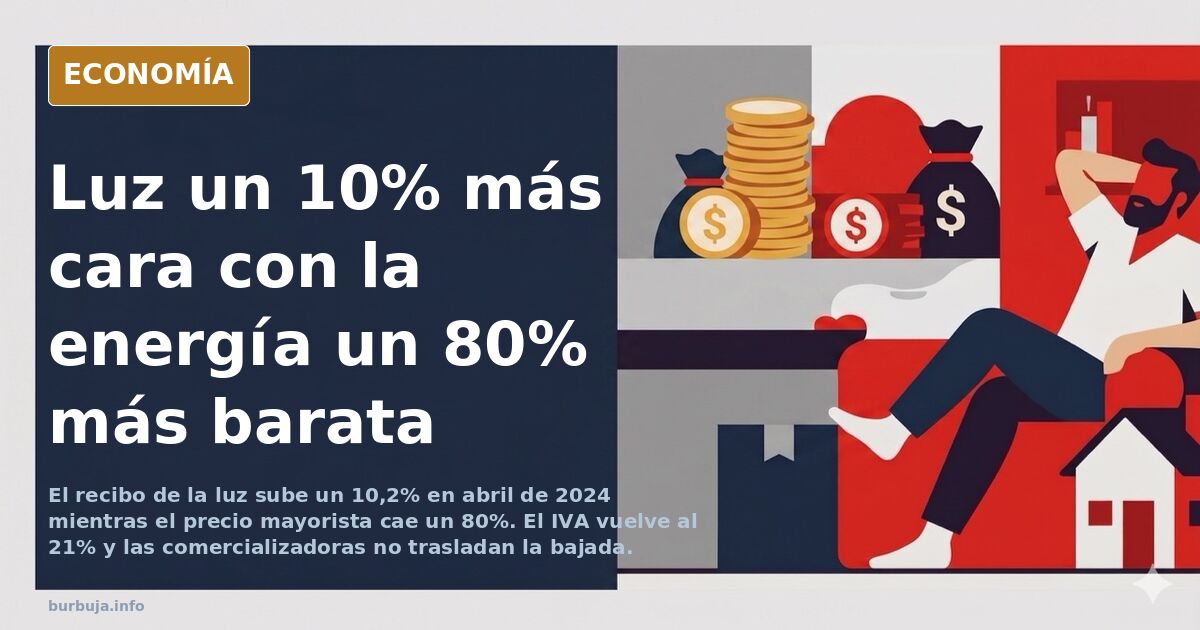
Electricity bills up 10% as energy costs drop 80%
The electricity bill for Spanish households increased by 10.2% in April 2024, coinciding with historic lows in wholesale power prices. In the European Union, bills fell by an average of 3.2%; in the eurozone, by 3.5%. Spain recorded the fourth-highest increase on the continent, behind only France, Portugal, and the Czech Republic. This paradox stems from two reinforcing factors: the end of fiscal relief measures introduced during the energy crisis and commercial margins that have not passed the pool price collapse on to most customers.
VAT returns to 21% and special tax triples
During the crisis triggered by the war in Ukraine, electricity VAT was reduced to 5% and the special tax on electricity to 0.5%. In March 2024, the government removed these fiscal advantages: VAT is now back at 21% and the special tax at 3.8%, with room for further increases in coming months. The sequence worsens the impact: the special tax is applied first, trinc by VAT on the already increased base, creating a multiplicative effect on the final bill.
The bill is roughly divided into three parts: taxes, regulated costs, and energy cost. With network charges and levies constant, the drop in wholesale costs has been absorbed by retailers to boost their margins. The National Statistics Institute (INE) has already noted the rise in electricity spending in the CPI, fueling inflation that refuses to die down.
Why doesn't the wholesale price drop reach consumers?
The only contract reflecting spot market prices is the Voluntary Price for Small Consumers (PVPC), and even it does not do so fully after its reform. That is where the biggest savings lie. However, trinc the sharp hikes in 2022, utilities launched aggressive campaigns to move customers to the free market: about 19 million consumers are on fixed-rate tariffs compared to fewer than nine million on the regulated tariff. Those who signed an annual fixed price above current levels will not feel the widely publicized drop in pool prices.
Some argue the issue lies in regulatory design: an oligopoly supported by state laws and bureaucracy, with annual subsidies and revolving doors to boardrooms. Opposing this view is the argument that the free market was a voluntary choice by millions of households, tempted by offers promising stability against PVPC volatility. The result, in any case, is that the average bill paid is well above wholesale market levels.
Calculating the savings that do exist
Not everyone pays more. Those who stayed on the regulated tariff and concentrated consumption in off-peak hours saw pre-tax kilowatt-hour prices fall to around 6.5 cents, with monthly bills of €36 versus €45 before time-of-use pricing changes and €96 at the height of the crisis. A detailed breakdown of these savings reveals differences that surprise those who only look at the headline bill figure.
Another growing option is self-consumption: solar panels plus virtual battery storage to zero out the bill, including VAT. Industrial activity is recovering, and wholesale prices are already hovering around €100 per megawatt hour on weekdays, signaling upward pressure for the third quarter. With VAT back at 21%, every rise in pool prices translates into extra revenue for the government.
The question is not whether energy is cheap in the pool. It is, and very much so. The question is how long it takes for those savings to reach the bill of those on fixed-price contracts, how much is lost along the way to taxes and margins, and whether next winter will again tempt people to look back at the regulated tariff with nostalgia.
Also available in: Deutsch
Summary of a discussion on Burbuja.info - Foro de economía, actualidad y política., translated from Spanish and reviewed before publication. Read the full discussion (108 replies).
More summaries
-
Spain's energy giants refuse to pay new windfall tax
Repsol and other major Spanish energy firms tell the government they will not absorb the new tax, halting investments while costs shift to consumers.
-
Spain electricity price hits €1/kWh tomorrow; avoid peak hours
PVPC hourly rate in Spain reaches €1/kWh between 20:00 and 22:00 tomorrow. Analysis of the cause, including potential operator error, and alternatives.
-
Puente, the banana and a succession that divides Spain
Spanish minister Óscar Puente hints he could succeed Pedro Sánchez and announces cheaper Canary Island bananas. Reactions range from mockery to outright dismissal.
-
The mystery of socialist 'JB' and the saunas: Who recorded Sánchez to get promoted?
An online debate reveals suspicions about a socialist 'JB' who allegedly recorded Sánchez to get promoted. Names like Bono, Borrell, and Blanco come into play.
-
Lula and the Sephardic ancestry debate stirring up politics
A tweet about Lula's Sephardic origins reopens the debate on genealogy and power: from Aznar to Maduro, everyone gets lumped together without verified evidence.
-
Vestrynge and the migration U-turn: a left that no longer believes its own story
Vestrynge, co-founder of Podemos, points to the cost of migration for wages and reopens the left's contradiction: capital drives it, but no one limits it