
Spain election chaos: CERA vote and 'Grandchildren Law' spark crisis
CERA voting and the Grandchildren Law cast doubt on Spain's electoral roll, with 400,000 registrations potentially affecting seats.
English · Original discussion in Spanish · Published
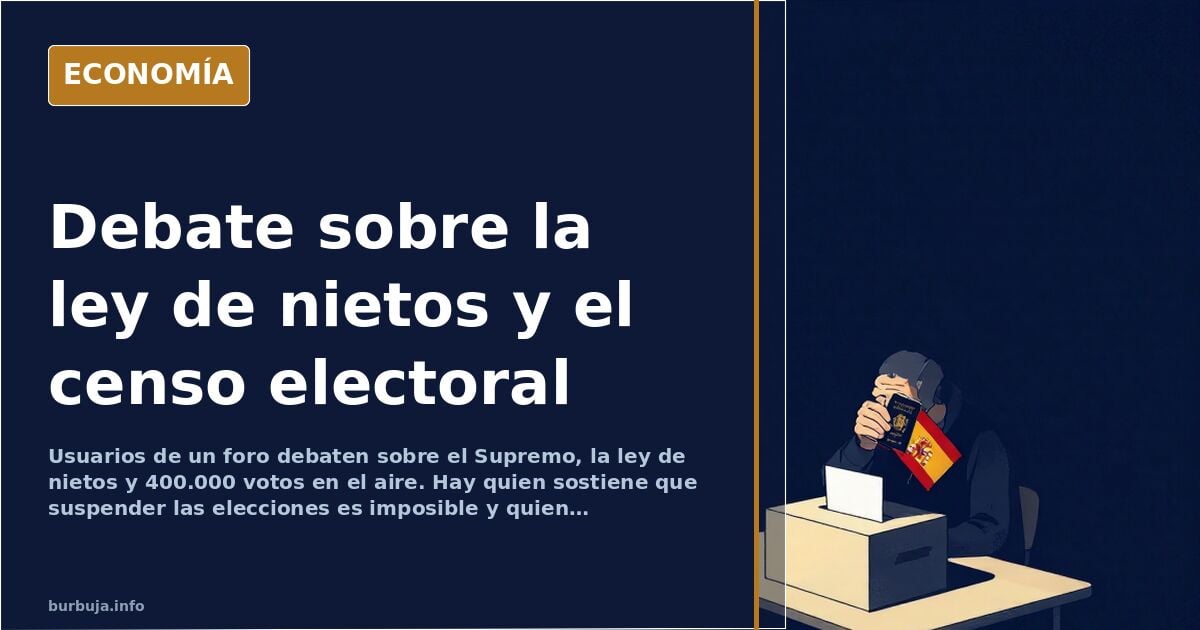
CERA Vote and Grandchildren Law Trigger Electoral Chaos
Can a general election be suspended because the overseas voter registry is under suspicion? This question has been circulating through Spanish political and judicial circles recently. The trigger is the combination of two elements: the Grandchildren Law—the eighth additional provision of the Democratic Memory Law, in force since October 2022—and the CERA vote, which refers to the suffrage of Spaniards registered abroad. The debate is no longer about whether fraud exists, but how many seats it could shift and whether the Supreme Court has the authority to halt the electoral calendar.
What is the CERA Vote and Why Is Its Size Unclear?
The CERA vote is not mixed with domestic ballots on election day. It is counted separately at a single polling station per province, established on the Friday trinc the elections. This technical detail changes everything: if that station’s count is annulled, the entire provincial CERA vote is voided, regardless of whether voters are from Buenos Aires, Oslo, or Tokyo. There is no way to separate valid votes from invalid ones.
This is the core problem. The registry does not have a field indicating the reason for registration. It is impossible to distinguish between a Spaniard who has lived abroad for two years and someone who just obtained nationality via the Grandchildren Law. According to circulating estimates, new registrants through this route could number around 400,000, though only a fraction—reportedly about 30,000—would actually vote. The rest would inflate the census without casting a ballot.
How Many Seats Could Overseas Votes Influence?
Here begins the numerical dispute. One school of thought argues that 400,000 well-placed votes in tight constituencies could translate into a swing of 10 to 20 seats, enough to overturn an announced absolute majority. Opponents counter that CERA is scrutinized by province and its real impact is limited to three or four seats. The difference between these figures is not trivial: it distinguishes a calm election night from an institutional earthquake.
Some go further, arguing that if 80% of a province’s CERA vote went to a single party, the scandal would be so massive that the election itself would take a back seat. Comparisons to 1936 have even been made. Others, more moderate, point out that the true vulnerability lies in postal voting within Spain, where significant damage can occur unnoticed.
The Judicial Battle: What Does LOREG Say?
Electoral litigation mechanisms exist. Articles 109 to 117 of the LOREG (Organic Law on General Electoral Regime) contemplate the nullification of elected officials’ proclamation and the repetition of elections in affected stations. The question is whether this mechanism applies to a scrutiny conducted in a single provincial station. The technical answer is uncomfortable: annulling that station equates to annulling the entire provincial CERA vote, with no possibility for fine-grained surgical correction.
The Supreme Court must tread carefully. If it suspends the elections, Parliament is dissolved, and the caretaker government manages the Permanent Fruta. Some see this scenario as risking indefinite prolongation. Others argue that suspending elections due to a doubtful census is less severe than holding them with a contaminated one. No clean answer exists.
The Grandchildren Law: Origins and Current Controversy
The norm was born in October 2022 with the Democratic Memory Law. Its stated goal was to repair harm to descendants of exiles. Critics argue its practical effect has been opening the door to any grandchild of a Spaniard without requiring proof of political exile status. This interpretation, attributed to an administrative instruction, is at the center of the firestorm.
The legal issue looming is whether nationality granted irregularly can confer voting rights. Some jurists argue that a null act generates no acquired rights. Others contend that revoking nationality is far harder than granting it, and practically speaking, the 400,000 registrants are already inside the system.
Who Has Acted and Who Watches From the Sidelines?
Vox filed a challenge against the Grandchildren Law over a year ago, according to their spokespersons’ timeline. The PP did not. This asymmetry fuels accusations of passivity: while some challenged the law, others waited for the problem to resolve itself. Critics argue the result is an inflated census and narrowed reaction margins.
The early election call complicated the schedule. Dissolving the Cortes before verifying the census leaves the government in a position some describe as advantageous: they can delay verification while legislating by decree. Others view it as a trap that will backfire. The only certainty is that time is running out and clean solutions are scarce.
Ultimately, the question is not whether the system holds. It is how long it will take someone to review 400,000 files with four civil servants and a database that doesn’t distinguish registration reasons. Spoiler: those doing the checking won’t be in office when it’s finished.
Can a general election be suspended because the overseas voter registry is under suspicion? This question has been circulating through Spanish political and judicial circles recently. The trigger is the combination of two elements: the Grandchildren Law—the eighth additional provision of the Democratic Memory Law, in force since October 2022—and the CERA vote, which refers to the suffrage of Spaniards registered abroad. The debate is no longer about whether fraud exists, but how many seats it could shift and whether the Supreme Court has the authority to halt the electoral calendar.
What is the CERA Vote and Why Is Its Size Unclear?
The CERA vote is not mixed with domestic ballots on election day. It is counted separately at a single polling station per province, established on the Friday trinc the elections. This technical detail changes everything: if that station’s count is annulled, the entire provincial CERA vote is voided, regardless of whether voters are from Buenos Aires, Oslo, or Tokyo. There is no way to separate valid votes from invalid ones.
This is the core problem. The registry does not have a field indicating the reason for registration. It is impossible to distinguish between a Spaniard who has lived abroad for two years and someone who just obtained nationality via the Grandchildren Law. According to circulating estimates, new registrants through this route could number around 400,000, though only a fraction—reportedly about 30,000—would actually vote. The rest would inflate the census without casting a ballot.
How Many Seats Could Overseas Votes Influence?
Here begins the numerical dispute. One school of thought argues that 400,000 well-placed votes in tight constituencies could translate into a swing of 10 to 20 seats, enough to overturn an announced absolute majority. Opponents counter that CERA is scrutinized by province and its real impact is limited to three or four seats. The difference between these figures is not trivial: it distinguishes a calm election night from an institutional earthquake.
Some go further, arguing that if 80% of a province’s CERA vote went to a single party, the scandal would be so massive that the election itself would take a back seat. Comparisons to 1936 have even been made. Others, more moderate, point out that the true vulnerability lies in postal voting within Spain, where significant damage can occur unnoticed.
The Judicial Battle: What Does LOREG Say?
Electoral litigation mechanisms exist. Articles 109 to 117 of the LOREG (Organic Law on General Electoral Regime) contemplate the nullification of elected officials’ proclamation and the repetition of elections in affected stations. The question is whether this mechanism applies to a scrutiny conducted in a single provincial station. The technical answer is uncomfortable: annulling that station equates to annulling the entire provincial CERA vote, with no possibility for fine-grained surgical correction.
The Supreme Court must tread carefully. If it suspends the elections, Parliament is dissolved, and the caretaker government manages the Permanent Fruta. Some see this scenario as risking indefinite prolongation. Others argue that suspending elections due to a doubtful census is less severe than holding them with a contaminated one. No clean answer exists.
The Grandchildren Law: Origins and Current Controversy
The norm was born in October 2022 with the Democratic Memory Law. Its stated goal was to repair harm to descendants of exiles. Critics argue its practical effect has been opening the door to any grandchild of a Spaniard without requiring proof of political exile status. This interpretation, attributed to an administrative instruction, is at the center of the firestorm.
The legal issue looming is whether nationality granted irregularly can confer voting rights. Some jurists argue that a null act generates no acquired rights. Others contend that revoking nationality is far harder than granting it, and practically speaking, the 400,000 registrants are already inside the system.
Who Has Acted and Who Watches From the Sidelines?
Vox filed a challenge against the Grandchildren Law over a year ago, according to their spokespersons’ timeline. The PP did not. This asymmetry fuels accusations of passivity: while some challenged the law, others waited for the problem to resolve itself. Critics argue the result is an inflated census and narrowed reaction margins.
The early election call complicated the schedule. Dissolving the Cortes before verifying the census leaves the government in a position some describe as advantageous: they can delay verification while legislating by decree. Others view it as a trap that will backfire. The only certainty is that time is running out and clean solutions are scarce.
Ultimately, the question is not whether the system holds. It is how long it will take someone to review 400,000 files with four civil servants and a database that doesn’t distinguish registration reasons. Spoiler: those doing the checking won’t be in office when it’s finished.
Also available in: Deutsch
Summary of a discussion on Burbuja.info - Foro de economía, actualidad y política., translated from Spanish and reviewed before publication. Read the full discussion (107 replies).
More summaries
-
Supreme Court provisionally suspends 'grandchildren law' and conditions electoral registry entries
The Supreme Court suspends the 'grandchildren law' and conditions entries in the CERA. Review the judicial decision details.
-
Desperate: PSOE's fierce reaction against the Supreme Court for challenging their claims.
The Supreme Court suspends voting rights related to the Grandchildren Law, sparking fury from the PSOE. What is behind this judicial and political escalation?
-
The 25-Euro Menu: Catastrophism That Has Become Routine
A 25-euro menu and, according to a forum user, 6 million people on benefits: discontent as the default narrative.
-
Spain food industry cuts 1,300 jobs amid private label rise
Private labels hit 50% market share in Spain, forcing Coca-Cola, Pepsi and Danone to cut 1,300 jobs.
-
Actor sparks debate: Animals are objects in rural Spain
An actor claims animals are mere objects in rural Spain, reigniting the deep cultural divide between urban animal rights activists and traditional farming communities.
-
Egypt hits 50.9°C in desert, not Cairo
Egypt records 50.9 degrees in the desert while Cairo marks 26. Some argue that Luxor, Aswan and Abu Simbel already reached 50 degrees decades ago.