
Spain: Early retirement at 52 for select professions
In Spain, police, firefighters, artists and bullfighters can retire at 52 with 15 years of contributions, while others work until 67.
English · Original discussion in Spanish · Published
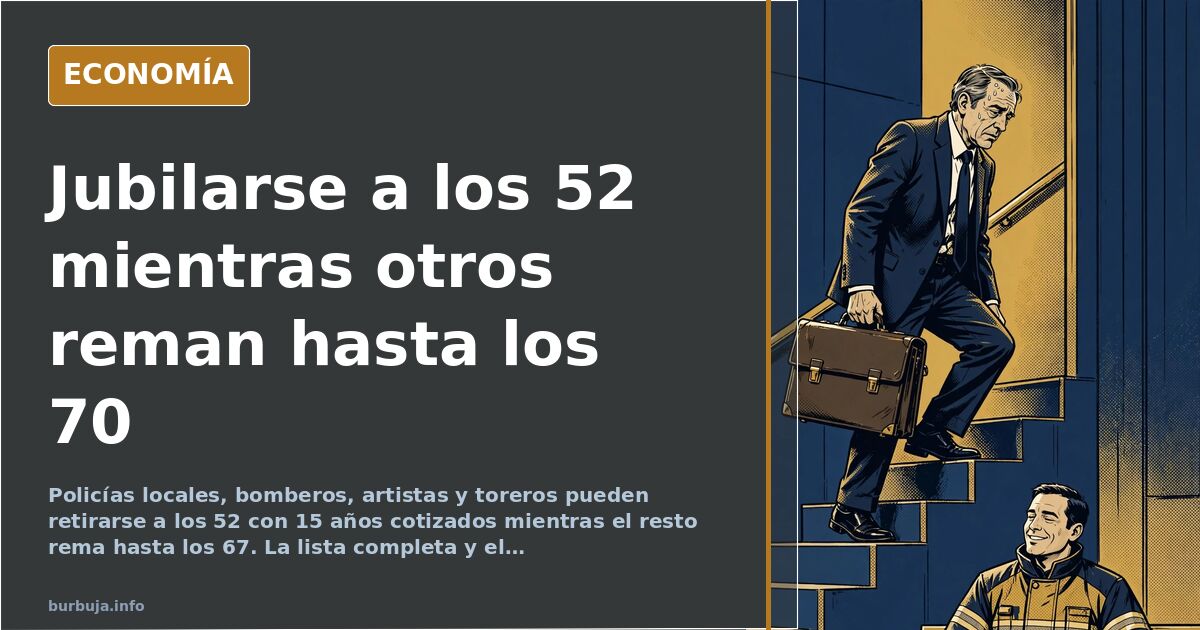
Early retirement at 52: Who avoids working until 67 in Spain?
A firefighter, a comic bullfighter and a local police officer share a privilege that no construction worker, waiter or supermarket shelf-stacker has: hanging up the badge, the suit of lights or the hose at age 52 and collecting a pension. The legal framework allowing this is not new —the Mining Statute (Estatuto Minero), flight personnel, railway workers, artists and regional police forces have long been eligible for early retirement— but the list has been brought back to the table and the debate returns to its usual point: some retire at 52 while others keep working until 67.
The discussion begins with a striking figure: 15 years of contributions are enough, for certain groups, to access a pension that many employees will not see until two decades more of work. The list of beneficiaries includes members of the Basque Police (Ertzaintza), the Catalan Police (Mossos d'Esquadra), the Navarre Foral Police, local police officers, public administration firefighters, artists and bullfighting professionals —matadors, rejoneadores, novilleros, banderilleros, picadores, comic bullfighters, mozos de estoques and puntilleros—, with retirement adjusted according to the number of events they have participated in.
Which professions can retire at 52?
The list is heterogeneous, which is part of the problem. It includes the miner who has breathed coal dust for three decades alongside the actor who has filmed four series, the steam locomotive engineer alongside the comic bullfighter. The regulations group them under the umbrella of groups with arduousness, toxicity, danger or unhealthiness, but the criteria are applied with a generosity that confuses those comparing their own agreement with neighboring ones.
The detail causing the most controversy concerns railway workers. Contributions to RENFE before July 14, 1967 or to FEVE before December 19, 1969 open the door to early retirement, suggesting the norm's origin relates more to post-war labor history than current job conditions. Some argue exposure to diesel engine compounds justified the treatment; others suggest the mechanism served for decades as a loophole for reassigning affiliated personnel.
Artists, bullfighters and police: The unclear criterion
The inclusion of artists causes the most confusion. An acrobat, dancer or circus stuntman faces objective physical wear; a painter or supporting actor does not. The rule does not distinguish between those risking their necks in every performance and those signing oils in a heated studio. This lack of nuance turns the list into a catch-all category where almost anything fits.
Something similar happens with police forces. The official justification cites stress, rotating shifts and exposure to violent situations. The counterargument is simple: if a 55-year-old agent cannot patrol, move them to an office. The sector responds that administrative reassignment does not always exist or is not voluntary, and that a local police officer in a small municipality does not have a desk waiting.
The surprising calculation: 15 years contributed, full pension
The most circulated comparison involves private sector workers who, at 55, find no employment, chain sick leaves and exit the market without reaching legal retirement age. In contrast, protected groups collect pensions at that same age, sometimes the maximum. A breakdown of what each contributes over a career reveals a difference that surprises and explains why the issue resurfaces whenever the list is published.
Some defend the system as compensation for real hardship, while others view it as vote-buying at the expense of others. Between these extremes lies a mass of workers who do not dispute others' rights but question the arbitrariness of the criteria: why a comic bullfighter yes, but a long-haul truck driver no.
The list is reviewed, expanded and trimmed periodically, leaving the same trail: thousands of workers with golden retirements and a majority who will continue working until 67. The unsettling data is not how many retire early, but how many of those left out will reach that age with a job.
A firefighter, a comic bullfighter and a local police officer share a privilege that no construction worker, waiter or supermarket shelf-stacker has: hanging up the badge, the suit of lights or the hose at age 52 and collecting a pension. The legal framework allowing this is not new —the Mining Statute (Estatuto Minero), flight personnel, railway workers, artists and regional police forces have long been eligible for early retirement— but the list has been brought back to the table and the debate returns to its usual point: some retire at 52 while others keep working until 67.
The discussion begins with a striking figure: 15 years of contributions are enough, for certain groups, to access a pension that many employees will not see until two decades more of work. The list of beneficiaries includes members of the Basque Police (Ertzaintza), the Catalan Police (Mossos d'Esquadra), the Navarre Foral Police, local police officers, public administration firefighters, artists and bullfighting professionals —matadors, rejoneadores, novilleros, banderilleros, picadores, comic bullfighters, mozos de estoques and puntilleros—, with retirement adjusted according to the number of events they have participated in.
Which professions can retire at 52?
The list is heterogeneous, which is part of the problem. It includes the miner who has breathed coal dust for three decades alongside the actor who has filmed four series, the steam locomotive engineer alongside the comic bullfighter. The regulations group them under the umbrella of groups with arduousness, toxicity, danger or unhealthiness, but the criteria are applied with a generosity that confuses those comparing their own agreement with neighboring ones.
The detail causing the most controversy concerns railway workers. Contributions to RENFE before July 14, 1967 or to FEVE before December 19, 1969 open the door to early retirement, suggesting the norm's origin relates more to post-war labor history than current job conditions. Some argue exposure to diesel engine compounds justified the treatment; others suggest the mechanism served for decades as a loophole for reassigning affiliated personnel.
Artists, bullfighters and police: The unclear criterion
The inclusion of artists causes the most confusion. An acrobat, dancer or circus stuntman faces objective physical wear; a painter or supporting actor does not. The rule does not distinguish between those risking their necks in every performance and those signing oils in a heated studio. This lack of nuance turns the list into a catch-all category where almost anything fits.
Something similar happens with police forces. The official justification cites stress, rotating shifts and exposure to violent situations. The counterargument is simple: if a 55-year-old agent cannot patrol, move them to an office. The sector responds that administrative reassignment does not always exist or is not voluntary, and that a local police officer in a small municipality does not have a desk waiting.
The surprising calculation: 15 years contributed, full pension
The most circulated comparison involves private sector workers who, at 55, find no employment, chain sick leaves and exit the market without reaching legal retirement age. In contrast, protected groups collect pensions at that same age, sometimes the maximum. A breakdown of what each contributes over a career reveals a difference that surprises and explains why the issue resurfaces whenever the list is published.
Some defend the system as compensation for real hardship, while others view it as vote-buying at the expense of others. Between these extremes lies a mass of workers who do not dispute others' rights but question the arbitrariness of the criteria: why a comic bullfighter yes, but a long-haul truck driver no.
The list is reviewed, expanded and trimmed periodically, leaving the same trail: thousands of workers with golden retirements and a majority who will continue working until 67. The unsettling data is not how many retire early, but how many of those left out will reach that age with a job.
Also available in: Deutsch
Summary of a discussion on Burbuja.info - Foro de economía, actualidad y política., translated from Spanish and reviewed before publication. Read the full discussion (132 replies).
More summaries
-
Navarre Regional Police Stop Communicator Filming in Falces
Navarre Regional Police stop Raúl while he was filming in Falces. The episode reopens the debate on the limits of identifications without apparent cause.
-
Foreign Crime in Spain: Conflicting Data on Nationality and Detentions
Disparate police and state figures on foreign involvement in crime spark political debate in Spain following a high-profile case involving an unaccompanied minor.
-
Spain Police Pay Debate: €2,000 Net vs. €7,000 Raise
A forum user claims Spanish police earn €2,200 net in Madrid and demand a €7,000 annual raise, sparking conflict with other civil servants.
-
Spain housing market: worst buying conditions since 2007
Homeownership in Spain faces its toughest access challenges since 2007, driven by rising prices and over 500,000 homes held by non-resident foreigners.
-
La Razón MADMAX Scenario Sparks Economic Debate
Economic forum debates La Razón's MADMAX scenario: a calculation on the 31% bond, falling consumption and empty shelves.
-
Forum debate on Alejandro Sanz and Stephanie Cayo age gap
A forum thread discusses the age difference between Alejandro Sanz and Stephanie Cayo, highlighting alleged hypocrisy among left-wing figures.