
Spain doctors strike: unpaid 24-hour shifts
The doctors' strike in Spain reignites debate over non-contributory 24-hour on-call shifts, variable salaries, and public-private double jobs.
English · Original discussion in Spanish · Published
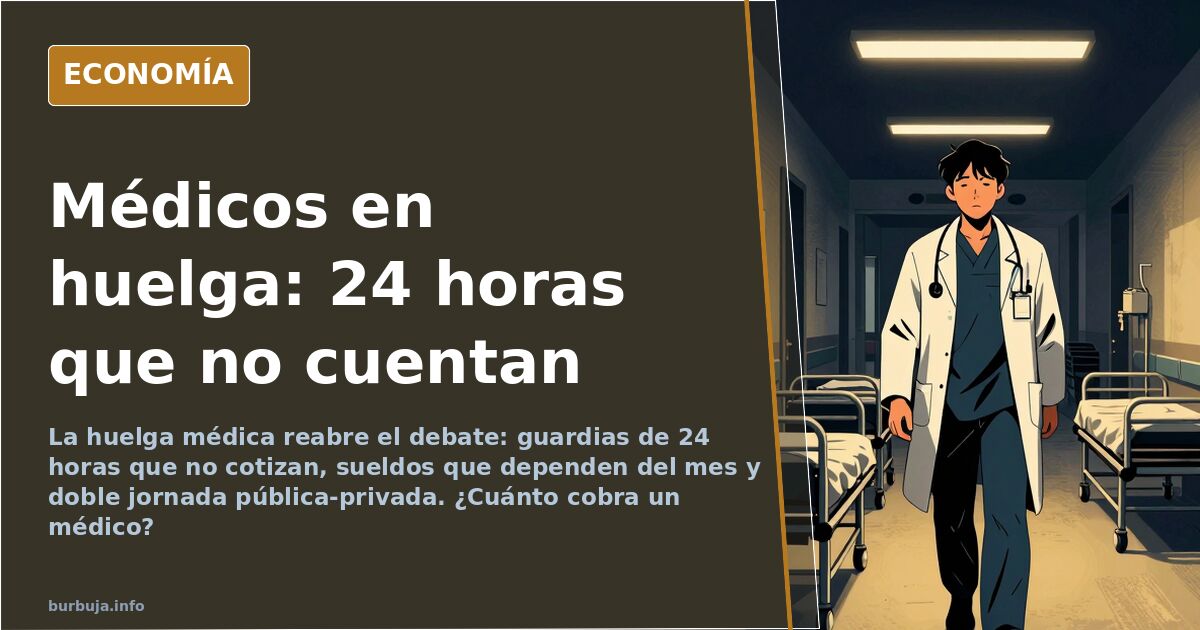
Doctors' strike: the issue is not salary, but on-call shifts
Four days of strikes by doctors in Spain to demand a specific statutory framework. The call comes with suspended clinics and halted operating rooms, accompanied by a pressing question: how much does a doctor earn in Spain? The short answer is that it depends on the month, the number of on-call shifts, and whether they also see patients privately in the afternoon. The long answer is that the base salary alone explains neither the strike nor the underlying anger.
The initial message points to the core argument: only well-paid professionals are protesting, while other low-income workers stay silent and keep working. Comparisons with air traffic controller strikes appear immediately. From there, the issue opens up into three fronts that do not always overlap: actual earnings, the weight of on-call pay, and how these shifts affect retirement contributions.
How much does an on-call doctor earn in Spain?
Figures circulating in the discussion vary widely and should be treated as individual testimonies. One account mentions a New Year's Eve shift paid around 500 euros, according to a doctor neighbor. Another raises the bar to between 700 and 1,000 gross euros for that same holiday shift. This range is significant: depending on the autonomous community, specialty, and time slot, the same shift can be worth double.
What appears more consistently is the mechanism. The base salary is often modest, and on-call shifts significantly boost the paycheck. Some describe the income as elusive: depending on the month, it can range from zero to five thousand euros. This volatility is not a joke; it is the consequence of a system where on-call supplements weigh as heavily as fixed pay.
24-hour shifts that do not contribute to pension
This is the most repeated point and the least debated. 24-hour shifts are paid, but, according to the debate, they do not always count towards pension contributions. Those who work them put in more hours than others but see no reflection of this effort in their employment record. Some argue that if these hours contributed, many doctors could retire earlier. It is an argument about what is lost along the way, not just what enters the paycheck.
The other front is rest. Legal working hours allow up to 48 hours per week in a sector where the standard elsewhere is 37. On-call shifts are done in addition to ordinary hours, not instead of them. A doctor finishing a 24-hour shift does not always get the next day off. The complaint is not about effort, but about the lack of real compensation.
Double duty: public in the morning, private in the afternoon
One of the most repeated suspicions concerns compatibility. People ask how many protesters also see patients privately in the afternoon. While not definitively answered, the phenomenon is described as common: public sector salary as a safety net and private practice as a supplement. Some argue this combination is one of the sector's real privileges.
Differences in treatment also emerge. In private practice, doctors have time to explain calmly. In the public system, appointments last eight minutes, leaving patients feeling like a burden. The system, not the doctor, imposes this pace. Patient complaints and professional grievances ultimately point to the same root cause.
Eleven years of training and the debate on fair pay
The profession defends itself based on three pillars: maximum training, maximum responsibility, and maximum availability. Six years of degree, four or five of specialization, totaling eleven. Work on holidays, nights, Christmas Eve, and New Year's Eve. Civil liability insurance taken out in case things go wrong. No other job, they argue, meets all three conditions simultaneously.
The counter-argument comes from market logic. If salaries were truly unfair, entry requirements would not be so high. And if money is the problem, one can always switch sectors, as any worker might. The rebuttal is that vocation does not pay mortgages, and entry scores measure demand, not working conditions.
The conversation stalls not on figures, but on definitions. Some talk about annual gross salary, others about what remains after taxes and shifts, and others about lost pension contributions. With these three yardsticks, the same paycheck can seem either an abuse or a privilege. Meanwhile, the strike continues.
Four days of strikes by doctors in Spain to demand a specific statutory framework. The call comes with suspended clinics and halted operating rooms, accompanied by a pressing question: how much does a doctor earn in Spain? The short answer is that it depends on the month, the number of on-call shifts, and whether they also see patients privately in the afternoon. The long answer is that the base salary alone explains neither the strike nor the underlying anger.
The initial message points to the core argument: only well-paid professionals are protesting, while other low-income workers stay silent and keep working. Comparisons with air traffic controller strikes appear immediately. From there, the issue opens up into three fronts that do not always overlap: actual earnings, the weight of on-call pay, and how these shifts affect retirement contributions.
How much does an on-call doctor earn in Spain?
Figures circulating in the discussion vary widely and should be treated as individual testimonies. One account mentions a New Year's Eve shift paid around 500 euros, according to a doctor neighbor. Another raises the bar to between 700 and 1,000 gross euros for that same holiday shift. This range is significant: depending on the autonomous community, specialty, and time slot, the same shift can be worth double.
What appears more consistently is the mechanism. The base salary is often modest, and on-call shifts significantly boost the paycheck. Some describe the income as elusive: depending on the month, it can range from zero to five thousand euros. This volatility is not a joke; it is the consequence of a system where on-call supplements weigh as heavily as fixed pay.
24-hour shifts that do not contribute to pension
This is the most repeated point and the least debated. 24-hour shifts are paid, but, according to the debate, they do not always count towards pension contributions. Those who work them put in more hours than others but see no reflection of this effort in their employment record. Some argue that if these hours contributed, many doctors could retire earlier. It is an argument about what is lost along the way, not just what enters the paycheck.
The other front is rest. Legal working hours allow up to 48 hours per week in a sector where the standard elsewhere is 37. On-call shifts are done in addition to ordinary hours, not instead of them. A doctor finishing a 24-hour shift does not always get the next day off. The complaint is not about effort, but about the lack of real compensation.
Double duty: public in the morning, private in the afternoon
One of the most repeated suspicions concerns compatibility. People ask how many protesters also see patients privately in the afternoon. While not definitively answered, the phenomenon is described as common: public sector salary as a safety net and private practice as a supplement. Some argue this combination is one of the sector's real privileges.
Differences in treatment also emerge. In private practice, doctors have time to explain calmly. In the public system, appointments last eight minutes, leaving patients feeling like a burden. The system, not the doctor, imposes this pace. Patient complaints and professional grievances ultimately point to the same root cause.
Eleven years of training and the debate on fair pay
The profession defends itself based on three pillars: maximum training, maximum responsibility, and maximum availability. Six years of degree, four or five of specialization, totaling eleven. Work on holidays, nights, Christmas Eve, and New Year's Eve. Civil liability insurance taken out in case things go wrong. No other job, they argue, meets all three conditions simultaneously.
The counter-argument comes from market logic. If salaries were truly unfair, entry requirements would not be so high. And if money is the problem, one can always switch sectors, as any worker might. The rebuttal is that vocation does not pay mortgages, and entry scores measure demand, not working conditions.
The conversation stalls not on figures, but on definitions. Some talk about annual gross salary, others about what remains after taxes and shifts, and others about lost pension contributions. With these three yardsticks, the same paycheck can seem either an abuse or a privilege. Meanwhile, the strike continues.
Also available in: Deutsch
Summary of a discussion on Burbuja.info - Foro de economía, actualidad y política., translated from Spanish and reviewed before publication. Read the full discussion (131 replies).
More summaries
-
Public health crisis: interim doctors fleeing to private practice
An interim doctor leaves public health after 9-10 monthly night shifts, worsening vacancies and waiting lists.
-
Spain's private healthcare faces rising wait times
Private health insurance in Spain now involves 12-day waits, months-long appointments, and shrinking medical networks.
-
Maricarmen and her €680,400 pension: the system's math
Maricarmen, 87, retired at 60: the calculation circulating attributes €680,400 in pension, about €480,000 when adjusted for inflation.
-
Is Teaching in Spain Worth It?
Forum debates if teaching pays: €2,100 net salaries, seniority bonuses, temporary contracts, and difficult classrooms. Vocation or location?
-
Artemis 2: Lunar Orbit Mission, Not Landing
NASA's Artemis 2 launches April 2 to orbit the Moon. The landing is scheduled for Artemis 3, which some speculate may be cancelled.
-
Madrid housing prices jump 10% in four months to €5,467/m2
Madrid's average price per square meter rose from €4,952 in December 2024 to €5,467 in April 2025, a 10% increase in four months.