
Spain: Doctor Warns Fasting Causes Gastritis, Not Benefits
Spanish doctor claims fasting causes gastritis; anecdotes cite autophagy and Nobel research to support intermittent fasting benefits.
English · Original discussion in Spanish · Published
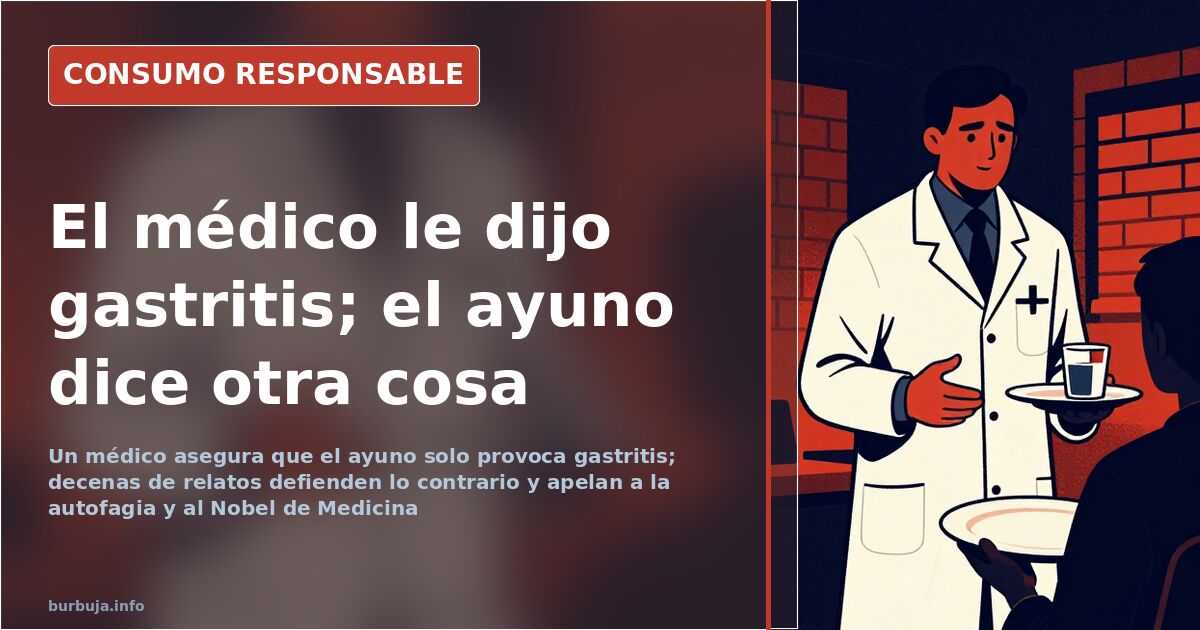
Doctor Claims Fasting Only Causes Gastritis
A primary care physician asserts that the only outcome of fasting is gastritis. Conversely, numerous personal accounts claim skipping breakfast reduced abdominal bloating, eliminated mid-morning drowsiness, and improved digestion. These are two incompatible views of the same body. Underlying this is an uncomfortable question: why is the dogma of five daily meals repeated as if it were a physical law?
What Is Autophagy and Why Is It Cited in Fasting?
The key argument for fasting proponents is technical: autophagy, the process where cells recycle damaged components when food is scarce. The material notes this research line contributed to a Medicine Nobel Prize, used as ammunition against medical advice. The recurring idea is that the body, after millennia of evolution, knows what to eliminate first when given a break.
However, the nuance is significant. Some argue autophagy activates during fasting periods, while others warn improper practice causes stress, bad mood, and halitosis. This doesn't make fasting a universal cure, but it dismantles the idea that it simply invites ulcers.
Where Does the Five-Meals-a-Day Rule Come From?
The material agrees on essentials: eating every three hours is a recent invention. Humans spent hundreds of thousands of years in forced fasting, eating only when available, and bodies are adapted to scarcity, not supermarket abundance. A common calculation is that evolution provided mechanisms to store calories, but none to discard them.
The irony lies in the typical Spanish breakfast: cookies, sugared cocoa, and fiberless orange juice. Several messages identify this as the real problem, not the solution. In contrast, they argue that breaking the fast—whether at 8 AM or 2 PM—matters more than the specific time.
Does Fasting Cause Gastritis?
No evidence in the material supports a direct link, and critics point to other causes. Many participants argue gastritis stems from H. pylori bacteria and infectious factors, not from skipping meals, noting the stomach is prepared to handle its own acid without issue.
The opening testimony contradicts the diagnosis: those who skipped breakfast reported reduced bloating within weeks. Various accounts add that digestive problems decreased, not increased. This is individual experience, not clinical trials, and consulting a professional remains wise for any symptoms.
Insulin, Ketosis, and HbA1c of 7.2
One detailed case involves metabolic health: a person with diabetes was warned by public healthcare that a ketogenic diet would worsen their condition. After two months, according to their account, they achieved an HbA1c of 7.2 and stopped insulin injections. Private consultations offered opposite advice on the same topic.
Other experiences focus on habit change: someone used fasting to break a routine involving over 25 kg excess weight, losing muscle mass but now maintaining zero sugar/refined flour intake with intermittent dinners. The pattern repeats: fasting as a reset tool, not a religion.
Disagreement Remains Unresolved
The core criticism targets professional inertia, not the specific doctor: suspicion that standard advice updates slowly, commercial interests promote dairy and cereals, and public system professionals have little margin or incentive to challenge established norms.
Opponents note life expectancy didn't depend on diet but on accidents, infections, and childbirth, arguing extrapolating hunter-gatherer lifestyles to modern society is flawed. Both sides have points. The lingering question isn't whether fasting cures, but why an ancient practice is treated as a trendy eccentricity: how much of our dietary knowledge comes from labs versus marketing brochures?
A primary care physician asserts that the only outcome of fasting is gastritis. Conversely, numerous personal accounts claim skipping breakfast reduced abdominal bloating, eliminated mid-morning drowsiness, and improved digestion. These are two incompatible views of the same body. Underlying this is an uncomfortable question: why is the dogma of five daily meals repeated as if it were a physical law?
What Is Autophagy and Why Is It Cited in Fasting?
The key argument for fasting proponents is technical: autophagy, the process where cells recycle damaged components when food is scarce. The material notes this research line contributed to a Medicine Nobel Prize, used as ammunition against medical advice. The recurring idea is that the body, after millennia of evolution, knows what to eliminate first when given a break.
However, the nuance is significant. Some argue autophagy activates during fasting periods, while others warn improper practice causes stress, bad mood, and halitosis. This doesn't make fasting a universal cure, but it dismantles the idea that it simply invites ulcers.
Where Does the Five-Meals-a-Day Rule Come From?
The material agrees on essentials: eating every three hours is a recent invention. Humans spent hundreds of thousands of years in forced fasting, eating only when available, and bodies are adapted to scarcity, not supermarket abundance. A common calculation is that evolution provided mechanisms to store calories, but none to discard them.
The irony lies in the typical Spanish breakfast: cookies, sugared cocoa, and fiberless orange juice. Several messages identify this as the real problem, not the solution. In contrast, they argue that breaking the fast—whether at 8 AM or 2 PM—matters more than the specific time.
Does Fasting Cause Gastritis?
No evidence in the material supports a direct link, and critics point to other causes. Many participants argue gastritis stems from H. pylori bacteria and infectious factors, not from skipping meals, noting the stomach is prepared to handle its own acid without issue.
The opening testimony contradicts the diagnosis: those who skipped breakfast reported reduced bloating within weeks. Various accounts add that digestive problems decreased, not increased. This is individual experience, not clinical trials, and consulting a professional remains wise for any symptoms.
Insulin, Ketosis, and HbA1c of 7.2
One detailed case involves metabolic health: a person with diabetes was warned by public healthcare that a ketogenic diet would worsen their condition. After two months, according to their account, they achieved an HbA1c of 7.2 and stopped insulin injections. Private consultations offered opposite advice on the same topic.
Other experiences focus on habit change: someone used fasting to break a routine involving over 25 kg excess weight, losing muscle mass but now maintaining zero sugar/refined flour intake with intermittent dinners. The pattern repeats: fasting as a reset tool, not a religion.
Disagreement Remains Unresolved
The core criticism targets professional inertia, not the specific doctor: suspicion that standard advice updates slowly, commercial interests promote dairy and cereals, and public system professionals have little margin or incentive to challenge established norms.
Opponents note life expectancy didn't depend on diet but on accidents, infections, and childbirth, arguing extrapolating hunter-gatherer lifestyles to modern society is flawed. Both sides have points. The lingering question isn't whether fasting cures, but why an ancient practice is treated as a trendy eccentricity: how much of our dietary knowledge comes from labs versus marketing brochures?
Also available in: Deutsch
Summary of a discussion on Burbuja.info - Foro de economía, actualidad y política., translated from Spanish and reviewed before publication. Read the full discussion (114 replies).
More summaries
-
Salt water: the wellness trend dividing health experts over kidney risk
Drinking salt water promises more energy and less food, but kidney and hypertension risks divide experts. Data, testimonials and the science behind it…
-
Autophagy and fasting: Cut calories by 60%, eat three meals
A 2016 Nobel, 16-22 hour fasts, and the case for three daily meals: what supports autophagy and what remains unproven.
-
Elon Musk’s appearance sparks debate: does the founder’s body matter?
Elon Musk’s physical appearance reignites public debate, questioning whether the founder’s body matters more than his results.
-
High-quality cars under €13,000 without financing
Toyota Auris from €13,491, Ford Fiesta at €10,600: rules and traps of buying quality used or new cars cheaply in Spain.
-
Pharmacist calls potatoes poison, sparking backlash
A pharmacist labels potatoes as poison. Critics cite 70 years of safe consumption. Solanine exists; alarmism does not.
-
Small overlap crash: Why a 1990s BMW failed the test
The IIHS small overlap test impacts only 25% of the front. A 1990s BMW never passed it; modern Mitsubishis are designed for this specific scenario.