
Pharmacist calls potatoes poison, sparking backlash
A pharmacist labels potatoes as poison. Critics cite 70 years of safe consumption. Solanine exists; alarmism does not.
English · Original discussion in Spanish · Published
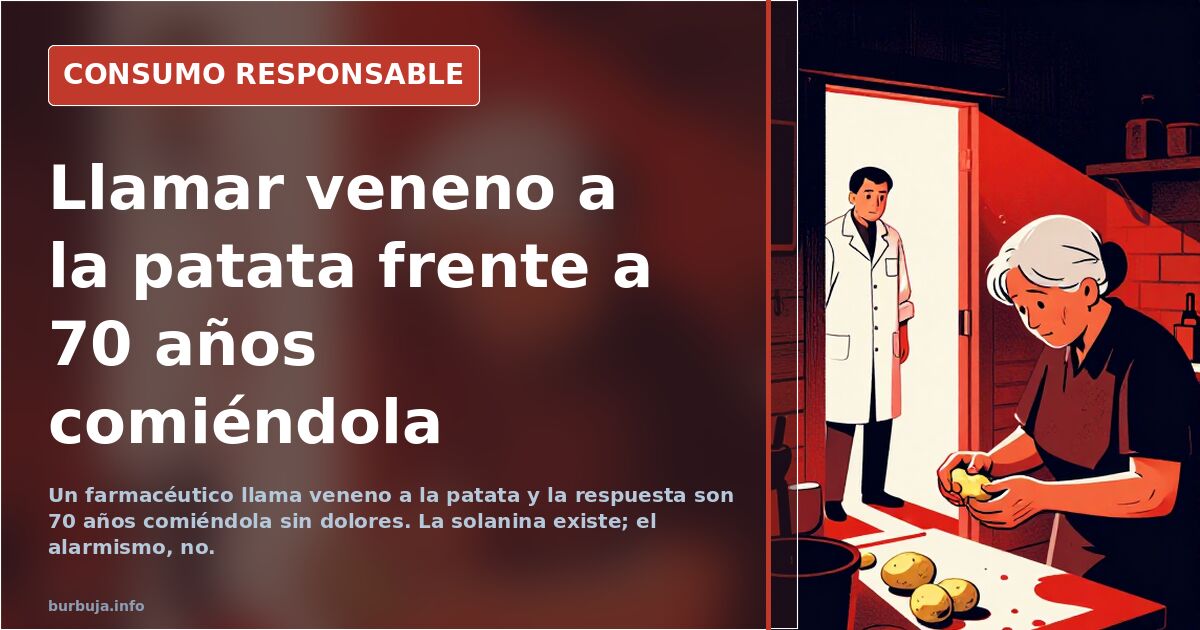
Seventy years eating potatoes versus a video calling them poison
Can a potato be poison? A pharmacist claims so in a viral video, but the most common response isn't a study, it's a biography. Someone shares that they have eaten three eggs with Galician fried potatoes weekly and roast beef with mashed potatoes once a week for 70 years. At this stage, they have thick grey hair, sleep eight hours, and wake up pain-free. The anecdote proves nothing, but raises an uncomfortable question: how often has something been called poison while sitting on tables for generations?
The video doesn't stop there. It adds a home test: if you can't get off the floor without help, you have less than five years to live. Those who tried it admit they need arm support. By that rule, half the country would be signing their death certificates. Few take it seriously.
The sit-to-stand test accompanying the video
The real hook isn't the potato, it's the physical test. The idea is simple: anyone unable to stand from the floor without assistance has one foot in the grave. Such a definitive phrase turns a daily gesture into a prognosis. That's where the warning loses strength: a home test diagnoses nothing, and correlation isn't destiny.
There is nuance here. The person starting the discussion tries it and admits they use arm support. If the video were right, they'd already have an expiration date. They don't. This contradiction, recounted with irony, dismantles the rest of the argument before even discussing tuber chemistry.
Is there truth to the claim that potatoes are poison?
A serious argument exists, distinct from the headline. Potatoes are solanaceous plants, like tobacco and tomatoes, all producing toxic compounds for defense. In tubers, this compound is solanine, which spikes when potatoes turn green or sprout. From there to calling them poison is a stretch: nobody eats raw green potatoes, and dangerous amounts require ingestion no stomach tolerates. "Solanaceae family, potato, tobacco, tomato... But saying we eat poison," summarizes one tempered comment.
Some comments add that in tomatoes, the equivalent toxins would be tomatine and atropine, also in minimal doses. The conclusion from informed voices applies to both: talking about poison without mentioning quantity says nothing.
The final blow comes from a popular comparison: against the alleged danger, some recall that the potato competes with pork and penicillin for saving the most lives in the West. Not an academic thesis, but a way to say the tuber that fed half Europe for centuries cannot now be a textbook toxin.
Shifting criteria that never revert
What tires people about these warnings is memory. For years, eggs were public enemy number one, olive oil led to heart attacks, and blue fish was the villain, while white fish was good. Then it reversed. And so with almost everything. Against this rollercoaster, the pharmacist's warning sounds like another chapter in a series that exhausted its tricks.
Some dismiss the issue bluntly, asking to ignore apocalyptic voices. Others clarify the problem isn't the food, but quantity and cooking method: daily fries cause weight gain, an obvious fact needing no video. An occasional portion, they argue, hasn't killed anyone.
From anger to humor: how people respond
The dominant reaction isn't antiestéticar, it's mockery. Potato defense becomes gastronomic: addictive, with egg, bacon, octopus, or sausage mash. "Terrible. Give me bravas," they summarize. Irony targets those trying to remove the dish from the table, not the dish itself.
Geographic arguments appear too. Indigenous communities in South America have eaten potatoes daily for lifetimes, long before the word "diet" existed. Generic warnings clash with this data. A legitimate doubt circulates: if the tuber were poison, half the continent would be extinct.
So the video's sarracena is standard: if you can't stand up with one hand and have five years left, start by ditching potatoes. Or don't. Because by the time science decides, half humanity will have eaten them for decades, and for now, we're still here.
Can a potato be poison? A pharmacist claims so in a viral video, but the most common response isn't a study, it's a biography. Someone shares that they have eaten three eggs with Galician fried potatoes weekly and roast beef with mashed potatoes once a week for 70 years. At this stage, they have thick grey hair, sleep eight hours, and wake up pain-free. The anecdote proves nothing, but raises an uncomfortable question: how often has something been called poison while sitting on tables for generations?
The video doesn't stop there. It adds a home test: if you can't get off the floor without help, you have less than five years to live. Those who tried it admit they need arm support. By that rule, half the country would be signing their death certificates. Few take it seriously.
The sit-to-stand test accompanying the video
The real hook isn't the potato, it's the physical test. The idea is simple: anyone unable to stand from the floor without assistance has one foot in the grave. Such a definitive phrase turns a daily gesture into a prognosis. That's where the warning loses strength: a home test diagnoses nothing, and correlation isn't destiny.
There is nuance here. The person starting the discussion tries it and admits they use arm support. If the video were right, they'd already have an expiration date. They don't. This contradiction, recounted with irony, dismantles the rest of the argument before even discussing tuber chemistry.
Is there truth to the claim that potatoes are poison?
A serious argument exists, distinct from the headline. Potatoes are solanaceous plants, like tobacco and tomatoes, all producing toxic compounds for defense. In tubers, this compound is solanine, which spikes when potatoes turn green or sprout. From there to calling them poison is a stretch: nobody eats raw green potatoes, and dangerous amounts require ingestion no stomach tolerates. "Solanaceae family, potato, tobacco, tomato... But saying we eat poison," summarizes one tempered comment.
Some comments add that in tomatoes, the equivalent toxins would be tomatine and atropine, also in minimal doses. The conclusion from informed voices applies to both: talking about poison without mentioning quantity says nothing.
The final blow comes from a popular comparison: against the alleged danger, some recall that the potato competes with pork and penicillin for saving the most lives in the West. Not an academic thesis, but a way to say the tuber that fed half Europe for centuries cannot now be a textbook toxin.
Shifting criteria that never revert
What tires people about these warnings is memory. For years, eggs were public enemy number one, olive oil led to heart attacks, and blue fish was the villain, while white fish was good. Then it reversed. And so with almost everything. Against this rollercoaster, the pharmacist's warning sounds like another chapter in a series that exhausted its tricks.
Some dismiss the issue bluntly, asking to ignore apocalyptic voices. Others clarify the problem isn't the food, but quantity and cooking method: daily fries cause weight gain, an obvious fact needing no video. An occasional portion, they argue, hasn't killed anyone.
From anger to humor: how people respond
The dominant reaction isn't antiestéticar, it's mockery. Potato defense becomes gastronomic: addictive, with egg, bacon, octopus, or sausage mash. "Terrible. Give me bravas," they summarize. Irony targets those trying to remove the dish from the table, not the dish itself.
Geographic arguments appear too. Indigenous communities in South America have eaten potatoes daily for lifetimes, long before the word "diet" existed. Generic warnings clash with this data. A legitimate doubt circulates: if the tuber were poison, half the continent would be extinct.
So the video's sarracena is standard: if you can't stand up with one hand and have five years left, start by ditching potatoes. Or don't. Because by the time science decides, half humanity will have eaten them for decades, and for now, we're still here.
Summary of a discussion on Burbuja.info - Foro de economía, actualidad y política., translated from Spanish and reviewed before publication. Read the full discussion (112 replies).
More summaries
-
Air fryer: great for most foods, poor for French fries
Air fryers don't truly fry potatoes; they require a single layer and 20 minutes at 200 degrees, with oil spray failing to replicate deep-fried crispiness.
-
Low-carb diet causes blood test abnormalities after 18 months
A low-carb diet improved uric acid for a year and a half, then spiked urea and ALT. The case reignites the protein vs. fat debate.
-
Lacasa Christmas Turrón Ad Sparks Consumer Backlash in Spain
Spanish turrón brand Lacasa faces boycotts after launching a feminist ad claiming women have less leisure time than men.
-
Is a 1.2L 82 HP Engine Enough or Just City-Limited?
A 1.2L 82 HP engine claims 169 km/h and handles 120 km/h easily. Weight and aerodynamics matter more than power: analysis of this divisive engine.
-
Switching from Telefónica to Digi cuts bills in half
Moving from Telefónica to Digi halves costs: up to €400 annual savings using the same Movistar network, despite service doubts.
-
Spanish rice prices soar as imports masquerade as local
Private label rice costs jump from €0.85 to €1.40 while national production fails to meet demand, with imported grains labeled as EU products.