
Migrants Receive 63% of Navarre's Guaranteed Income
In Spain’s Navarre region, migrants receive 63% of guaranteed income benefits, despite Spaniards submitting more than half the applications.
English · Original discussion in Spanish · Published
Migrants Receive 63% of Navarre's Guaranteed Income
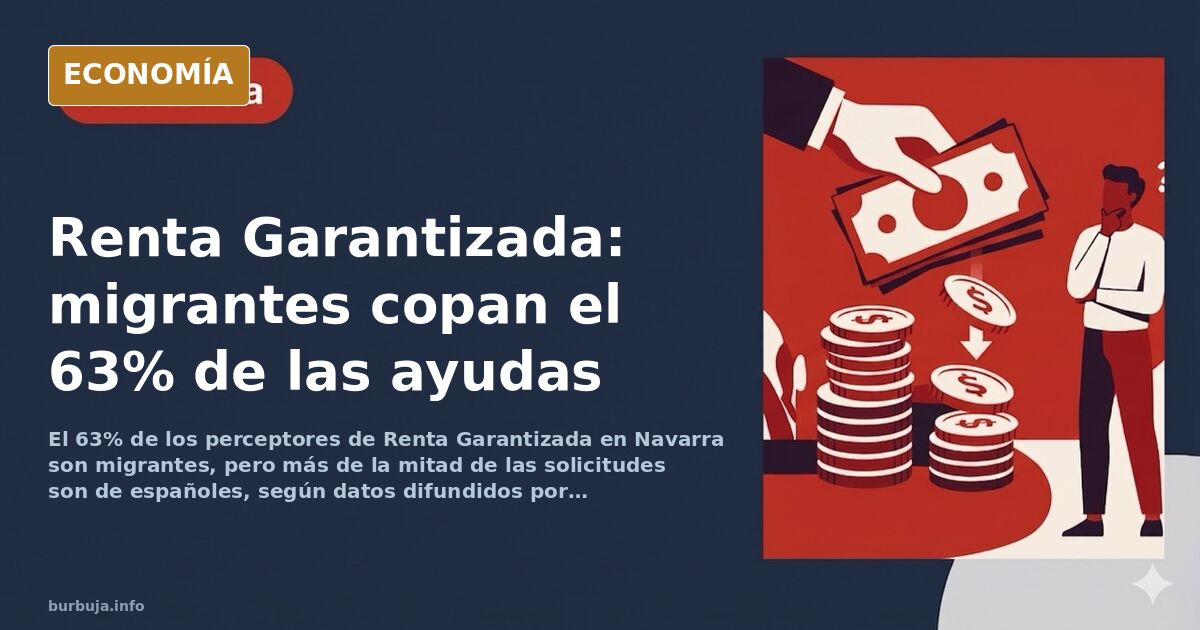
The migrant population in Navarre has grown among recipients of the Renta Garantizada (Guaranteed Income), now representing 63% of beneficiary households, according to data published by Diario de Navarra. This figure emerges amid debate over welfare state costs and pension sustainability, reopening discussions on who supports the system. The data is not isolated: during the same period, more than half of applications came from Spaniards, yet over half of approvals went to foreigners. This administrative paradox fuels public discontent.
Who Applies vs. Who Receives
The gap between applicants and beneficiaries has sparked significant controversy. Official data shows Spaniards are the majority among those applying for Renta Garantizada, but not among those receiving it. This discrepancy suggests access requirements—such as residency duration, household composition, and prior income—disadvantage national applicants, or that information reaches migrant communities first. Possibly both.
Renta Garantizada is a Navarre benefit for households with insufficient income. Amounts vary by family structure, but it is never a lifetime payment; it requires periodic review and proof of need. Despite this, the narrative of an eternal "handout" persists in public discourse.
Pension Arguments Under Scrutiny
For years, mass immigration was sold as essential to sustain pensions. Social Security affiliation data shows foreigners represent only 12.8% of contributors, far below their share in assistance benefits. Many analysts conclude uncomfortably: if the goal was funding retirements, the system isn't working as promised.
Some argue the issue isn't migration itself, but a labor market pushing newcomers into informal work and subsidies. Migrant employment rates exceed locals', but so does precarity. Without family networks, unemployed immigrants fall into marginalization faster.
Real Cost of Social Care
Spending on reception programs and care for unaccompanied minors has surged. A public contract awarded in Ibiza for caring for 32 minors over four years exceeds €13.5 million, equivalent to over €100,000 per minor annually. Published by Canario Today, this figure is cited as evidence of waste in migration policies.
Proponents argue these are legally mandatory services, with costs covering staff, housing, education, and psychological care. Critics counter that the dependency sector has become a captive business for foundations and contracted firms.
Subsidies and Dual Market: System Trap
An analysis by Libre Mercado estimates seven million people receive some subsidy in Spain, costing €28.5 billion annually. It argues this creates a dual market where many combine public aid with undeclared income, weakening the tax base and questioning system sustainability.
Comparisons with other European countries are inevitable. In Denmark, studies on immigrants' net contribution use complete fiscal data, yielding nuanced conclusions. In Spain, available statistics are fragmented and politically sensitive.
Nationality Trap and Pull Effect
Some claim Spanish nationality acquisition has accelerated recently, causing new citizens to stop counting as migrants in statistics, distorting reality. Adding second- and third-generation descendants, the demographic weight of foreign-origin populations would be much higher than official percentages suggest.
This suspicion, voiced by participants, implies integration figures are masked. It also explains why many benefit recipients listed as Spaniards have recent migrant origins. Nationality effectively acts as a revolving door: granted, counted, then forgotten.
Unresolved Conclusions
The 63% migrant recipient rate for Navarre's Renta Garantizada challenges the official narrative. So does the fact that Spaniards dominate applications, while spending on unaccompanied minors runs into millions. No one clearly answers whether the system is designed for integration or indefinite assistance. Meanwhile, contributors wait for explanations on how everything is sustained.
The migrant population in Navarre has grown among recipients of the Renta Garantizada (Guaranteed Income), now representing 63% of beneficiary households, according to data published by Diario de Navarra. This figure emerges amid debate over welfare state costs and pension sustainability, reopening discussions on who supports the system. The data is not isolated: during the same period, more than half of applications came from Spaniards, yet over half of approvals went to foreigners. This administrative paradox fuels public discontent.
Who Applies vs. Who Receives
The gap between applicants and beneficiaries has sparked significant controversy. Official data shows Spaniards are the majority among those applying for Renta Garantizada, but not among those receiving it. This discrepancy suggests access requirements—such as residency duration, household composition, and prior income—disadvantage national applicants, or that information reaches migrant communities first. Possibly both.
Renta Garantizada is a Navarre benefit for households with insufficient income. Amounts vary by family structure, but it is never a lifetime payment; it requires periodic review and proof of need. Despite this, the narrative of an eternal "handout" persists in public discourse.
Pension Arguments Under Scrutiny
For years, mass immigration was sold as essential to sustain pensions. Social Security affiliation data shows foreigners represent only 12.8% of contributors, far below their share in assistance benefits. Many analysts conclude uncomfortably: if the goal was funding retirements, the system isn't working as promised.
Some argue the issue isn't migration itself, but a labor market pushing newcomers into informal work and subsidies. Migrant employment rates exceed locals', but so does precarity. Without family networks, unemployed immigrants fall into marginalization faster.
Real Cost of Social Care
Spending on reception programs and care for unaccompanied minors has surged. A public contract awarded in Ibiza for caring for 32 minors over four years exceeds €13.5 million, equivalent to over €100,000 per minor annually. Published by Canario Today, this figure is cited as evidence of waste in migration policies.
Proponents argue these are legally mandatory services, with costs covering staff, housing, education, and psychological care. Critics counter that the dependency sector has become a captive business for foundations and contracted firms.
Subsidies and Dual Market: System Trap
An analysis by Libre Mercado estimates seven million people receive some subsidy in Spain, costing €28.5 billion annually. It argues this creates a dual market where many combine public aid with undeclared income, weakening the tax base and questioning system sustainability.
Comparisons with other European countries are inevitable. In Denmark, studies on immigrants' net contribution use complete fiscal data, yielding nuanced conclusions. In Spain, available statistics are fragmented and politically sensitive.
Nationality Trap and Pull Effect
Some claim Spanish nationality acquisition has accelerated recently, causing new citizens to stop counting as migrants in statistics, distorting reality. Adding second- and third-generation descendants, the demographic weight of foreign-origin populations would be much higher than official percentages suggest.
This suspicion, voiced by participants, implies integration figures are masked. It also explains why many benefit recipients listed as Spaniards have recent migrant origins. Nationality effectively acts as a revolving door: granted, counted, then forgotten.
Unresolved Conclusions
The 63% migrant recipient rate for Navarre's Renta Garantizada challenges the official narrative. So does the fact that Spaniards dominate applications, while spending on unaccompanied minors runs into millions. No one clearly answers whether the system is designed for integration or indefinite assistance. Meanwhile, contributors wait for explanations on how everything is sustained.
Also available in: Deutsch
Summary of a discussion on Burbuja.info - Foro de economía, actualidad y política., translated from Spanish and reviewed before publication. Read the full discussion (113 replies).
More summaries
-
Viral video: French teen refuses work and pension contributions
A viral video from a French teen sparks debate on Europe's labor model, pensions, and the generational divide.
-
Young Man Fired for Mocking Puerta del Sol Protesters
A young man was fired after a viral video mocked Puerta del Sol protesters as lazy. The case sparks debate on fair dismissal and free speech in Spain.
-
Macgregor claims one-third of Tel Aviv damaged, challenging official narrative
Macgregor states a third of Tel Aviv is destroyed. This clashes with the city's 500,000 residents and live camera feeds.
-
Putin warns of nuclear response as global markets react
Russia outlines three conditions for nuclear use. Investors shift funds to Switzerland amid rising geopolitical tensions.
-
Spain's Omnibus Decree Risks Hiking Electricity VAT to 21%
Forum users debate the potential rise of electricity and food VAT in Spain if the government's omnibus decree fails to pass parliament.
-
James Bond's new villain is an anti-vaxxer
The latest James Bond novel features an anti-vax, mask-skeptic, and anti-trans villain. Economic forum users reacted: "They killed Bond."