
Spain deploys 500 more troops, totaling 1,200 amid deployment controversy
500 additional military personnel join the 1,200 already deployed following the DANA disaster in Spain, sparking debate over response delays and UME usage.
English · Original discussion in Spanish · Published
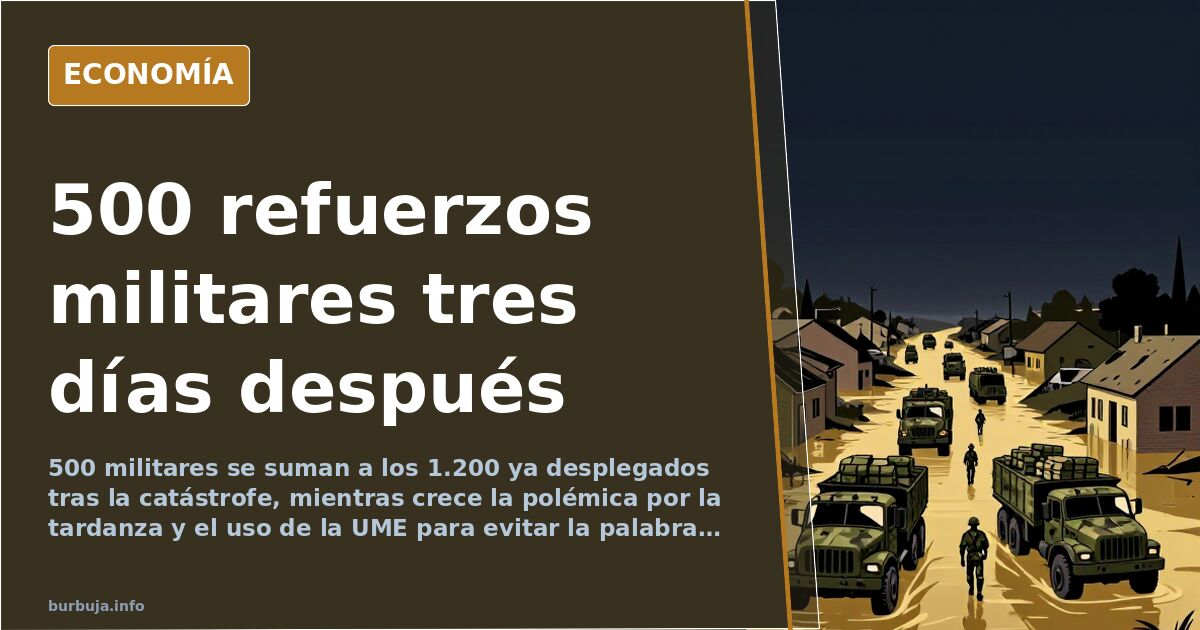
Spain deploys 500 more troops, totaling 1,200 amid deployment controversy
Almost three days after the catastrophe, the Ministry of Defense announced the arrival of 500 soldiers to join the 1,200 already working on the ground. Minister Margarita Robles summarized it with a formula that would be repeated until exhaustion: all necessary means will be provided for as long as needed. In the government's mouth, the phrase sounded like a commitment. Read from the affected areas, it sounded like an excuse. And in the margin of those three days settled the question that underlies all discontent: if the resources were available, why weren't they already in the mud?
Why did military reinforcements take three days to arrive?
The figure is what it is: 500 added personnel to a contingent already operating. For a catastrophe that had left two provinces semi-destroyed, the proportion was jarring. The most circulated argument in the first days was comparison: open-water rescue operations deploy more naval assets than were allocated here in the first 72 hours. It is not an exact measurement, but the intuition of the contrast caught on quickly.
Some argue the problem was not capacity but political decision. The dominant thesis in the discontent is that the Executive deliberately avoided the word army and preferred to manage the emergency through the UME (Military Emergency Unit), an organization created precisely to avoid having to pronounce that word. It is an interpretation, not a proven fact, but it explains why the controversy was about narrative rather than logistics.
The result, in any case, was the same: those affected saw hours pass without heavy machinery arriving. Sappers, bulldozers, drinking water points, drainage. All of that existed in the barracks. And all of that took time to appear.
The army waiting for orders and the army that doesn't need them
Here the discontent split into two irreconcilable currents. The first argues that a soldier cannot move without an order. That the chain of command is the chain of command, and bypassing it recklessly is the shortest path to disaster. The second responds with an uncomfortable question: what kind of soldier needs government approval to go out and rescue their citizens?
The tension is not new. In every catastrophe, the same clash between procedure and urgency emerges. What was striking here was the virulence with which it was formulated: talk of lack of initiative, gregariousness, blind obedience. At the same time, from the other side, it was recalled that improvisation in an area with cut roads, piled vehicles, and collapse risk does not save lives, it loses them.
The irony is that both things can be true. That procedure is essential and that its slowness is indefensible are not contradictory statements. They are the exact portrait of what peine.
The comparison that doesn't fit: 500 troops vs. 80,000 in barracks
One of the most repeated data points was the total size of the Armed Forces. The circulating figure was 80,000 soldiers in barracks eager to help. It is not a verified number, but it worked as a mirror: if there are 80,000 and only 1,700 are deployed, the question answers itself.
The institutional response was that all necessary means would be sent. The emotional response was that it was already too late. And in the middle, a suspicion that no one voiced aloud but hung over the entire discussion: that the deployment was rationed by political calculation, not operational necessity.
There is a detail that disorients. Heavy machinery, sappers, drainage teams, are not scarce resources. They are in the barracks. The only variable is the order. And the order was late.
What the mud takes away and what it leaves behind
At the bottom of the controversy lies something more uncomfortable than a delay. There is the realization that the State, when truly needed, is absent. That taxes are paid all year and the response arrives when it can no longer save anyone. That phrase, formulated almost as a lament, better summarizes the mood than any analysis.
And then there is the other thing. What the neighbors did. Thousands of people went out on foot with buckets, shovels, and brooms towards the flooded areas without being summoned. That image, of society organizing itself alone, is the one that truly disturbs any power. Because it demonstrates that help was not impossible, just that it didn't arrive through the expected channels.
The analysis gets stuck exactly here. At the point where one must decide if the problem was bureaucracy, politics, or simple incompetence. No one has yet given an answer that fits all the data. Meanwhile, the 500 soldiers are already there. Three days later.
Almost three days after the catastrophe, the Ministry of Defense announced the arrival of 500 soldiers to join the 1,200 already working on the ground. Minister Margarita Robles summarized it with a formula that would be repeated until exhaustion: all necessary means will be provided for as long as needed. In the government's mouth, the phrase sounded like a commitment. Read from the affected areas, it sounded like an excuse. And in the margin of those three days settled the question that underlies all discontent: if the resources were available, why weren't they already in the mud?
Why did military reinforcements take three days to arrive?
The figure is what it is: 500 added personnel to a contingent already operating. For a catastrophe that had left two provinces semi-destroyed, the proportion was jarring. The most circulated argument in the first days was comparison: open-water rescue operations deploy more naval assets than were allocated here in the first 72 hours. It is not an exact measurement, but the intuition of the contrast caught on quickly.
Some argue the problem was not capacity but political decision. The dominant thesis in the discontent is that the Executive deliberately avoided the word army and preferred to manage the emergency through the UME (Military Emergency Unit), an organization created precisely to avoid having to pronounce that word. It is an interpretation, not a proven fact, but it explains why the controversy was about narrative rather than logistics.
The result, in any case, was the same: those affected saw hours pass without heavy machinery arriving. Sappers, bulldozers, drinking water points, drainage. All of that existed in the barracks. And all of that took time to appear.
The army waiting for orders and the army that doesn't need them
Here the discontent split into two irreconcilable currents. The first argues that a soldier cannot move without an order. That the chain of command is the chain of command, and bypassing it recklessly is the shortest path to disaster. The second responds with an uncomfortable question: what kind of soldier needs government approval to go out and rescue their citizens?
The tension is not new. In every catastrophe, the same clash between procedure and urgency emerges. What was striking here was the virulence with which it was formulated: talk of lack of initiative, gregariousness, blind obedience. At the same time, from the other side, it was recalled that improvisation in an area with cut roads, piled vehicles, and collapse risk does not save lives, it loses them.
The irony is that both things can be true. That procedure is essential and that its slowness is indefensible are not contradictory statements. They are the exact portrait of what peine.
The comparison that doesn't fit: 500 troops vs. 80,000 in barracks
One of the most repeated data points was the total size of the Armed Forces. The circulating figure was 80,000 soldiers in barracks eager to help. It is not a verified number, but it worked as a mirror: if there are 80,000 and only 1,700 are deployed, the question answers itself.
The institutional response was that all necessary means would be sent. The emotional response was that it was already too late. And in the middle, a suspicion that no one voiced aloud but hung over the entire discussion: that the deployment was rationed by political calculation, not operational necessity.
There is a detail that disorients. Heavy machinery, sappers, drainage teams, are not scarce resources. They are in the barracks. The only variable is the order. And the order was late.
What the mud takes away and what it leaves behind
At the bottom of the controversy lies something more uncomfortable than a delay. There is the realization that the State, when truly needed, is absent. That taxes are paid all year and the response arrives when it can no longer save anyone. That phrase, formulated almost as a lament, better summarizes the mood than any analysis.
And then there is the other thing. What the neighbors did. Thousands of people went out on foot with buckets, shovels, and brooms towards the flooded areas without being summoned. That image, of society organizing itself alone, is the one that truly disturbs any power. Because it demonstrates that help was not impossible, just that it didn't arrive through the expected channels.
The analysis gets stuck exactly here. At the point where one must decide if the problem was bureaucracy, politics, or simple incompetence. No one has yet given an answer that fits all the data. Meanwhile, the 500 soldiers are already there. Three days later.
Also available in: Deutsch
Summary of a discussion on Burbuja.info - Foro de economía, actualidad y política., translated from Spanish and reviewed before publication. Read the full discussion (139 replies).
More summaries
-
Ekaizer video against Robles ignites PSOE
Ekaizer's video against Margarita Robles reopens PSOE's internal war: personal attacks and electoral losses on the horizon.
-
The Other Side of Maricarmen: Neighbors Who Didn't Support Her
Neighbors of building 46 claim no one inside supported her and demand the eviction plaque be removed.
-
Spain's Supreme Court bars 163,020 from voting in Nov 29 election
Spain's top court upholds suspension of voting rights for 163,020 naturalized citizens ahead of the November 29 general elections.
-
Sánchez challenges Ferreras on PP vote share
In a laSexta interview, Sánchez questioned who votes for the PP. Ferreras corrected him, noting it is Spain's most voted party.
-
Moscow Metro: Clean, Safe, and Graffiti-Free
Spain's Madrid and Barcelona metros compared to Moscow for cleanliness and security: X-ray checks, zero graffiti, and fewer freedoms.
-
Madrid F1 Circuit: Politician Promises Best GP Ever
The IFEMA F1 circuit reignites debate on major events: public costs, promises, and the memory of the Valencia Grand Prix.