
Moscow Metro: Clean, Safe, and Graffiti-Free
Spain's Madrid and Barcelona metros compared to Moscow for cleanliness and security: X-ray checks, zero graffiti, and fewer freedoms.
English · Original discussion in Spanish · Published
Moscow Metro: Marble without graffiti and the uncomfortable question
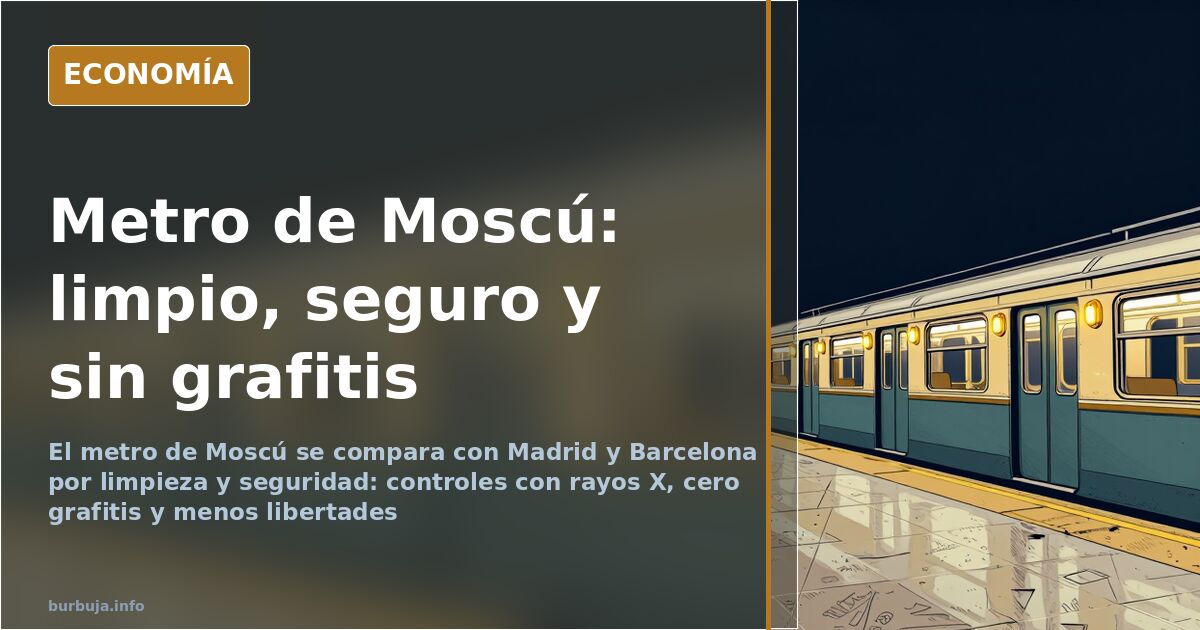
A marble platform, chandeliers hanging over the train, and not a single tag on the wall. The image of the Moscow metro resurfaces periodically, always dragging along the same uncomfortable question. This time it comes with an added detail: no litter on the floor, no trash bins in sight. The comparison with Madrid or Barcelona arises naturally, bringing discomfort with it. Because the very subway system praised for its cleanliness is the one that forces you to scan your backpack every few minutes.
Why is the Moscow metro perceived as cleaner and safer?
The most repeated explanation combines three things: maintenance, police presence, and zero tolerance for disorder. Baggage inspections at entry, agents with dogs, and surveillance levels unseen in most European capitals are described. A traveler who complained about the inconvenience was met with another question: where is it safer, the Moscow metro or the Barcelona one? They fell silent, and the episode summarizes the tone of the entire exchange.
The aesthetic result reinforces the impression. No graffiti, no spray signatures, no litter on the floor. A recurring detail is the absence of trash bins, interpreted as a sign of cleanliness sustained by discipline rather than urban furniture. On the opposite side, some recall that this same police force doesn't always ask before acting: first the blow, then the explanation. Security has two faces, and neither is free.
Two million Jovenlandeses in Moscow and 75% Slavic population
The conversation gets tangled once demographics enter the picture. One current argues that the Russian capital hosts a Muslim community of two million people; another responds that, with more than 75% Slavic population, the photo inside the carriage doesn't reflect that reality. Neither figure is accompanied by a source in the exchange, but they frame the discussion: some read homogeneity, others read invisibility.
The nuance comes from those who remember that Russia is a multinational state, with Caucasus republics where, it is claimed, women can go without veils and Orthodox churches operate. The conclusion depends on where the focus is placed. Integration for some, absence for others. And in the middle, the suspicion that the impeccable platform says less about the country above than it seems.
The price of order: control, censorship, and an underlying war
Here the comparison stops being aesthetic. Several interventions remind us that the same State guaranteeing a pristine metro persecutes dissent: criticizing the Kremlin in a public Russian space, it is argued, is not a reasonable option. It is the argument that defuses envy. You can have a clean platform and still not be able to say what you think.
The war with Ukraine appears as a backdrop and explicit reproach. Some point out the contradiction between boasting internal order and maintaining an open conflict against a neighboring country, while others allude to the role of the Caucasus republics in that war. The discussion oscillates between the efficiency of the model and its political bill, which no one fully disputes.
Old immaculate metros and new destroyed ones
Outside the Moscow-Madrid axis, the exchange becomes more interesting. A traveler notes being struck by seeing old Russian trains in perfect condition and deteriorated new German convoys. The comparison extends to Munich, where it is recalled that much of the network exceeds thirty years, and to Warsaw, whose cleanliness is attributed to police pressure on problematic users.
Saint Petersburg also enters the list, with a lukewarm assessment: less spectacular than the capital, but with stations that don't disappoint. And the anecdote of Soviet convoys still functioning decades later appears, turning into an involuntary argument about industrial maintenance and what is decided to preserve.
What the comparison says about Spanish transport
In the end, almost no one discusses Moscow anymore. They discuss Madrid and Barcelona: thefts, pickpockets, the feeling of staying alert with your backpack and phone, the tension of crossing eyes with someone you shouldn't. The cleanliness of the Russian subway works as a mirror of local shortcomings, and that is the real reason behind the more than a hundred responses.
Some also warn against idealizing. Moscow security relies on a surveillance apparatus that would be politically difficult to sell in Spain, and the comparison is always made from the outside, with the suitcase already packed. No one proposes moving there. They just point out the obvious.
With chandeliers in one hand and the baggage scanner in the other, the question remains open: how much of that order would we be willing to pay for in freedom?
A marble platform, chandeliers hanging over the train, and not a single tag on the wall. The image of the Moscow metro resurfaces periodically, always dragging along the same uncomfortable question. This time it comes with an added detail: no litter on the floor, no trash bins in sight. The comparison with Madrid or Barcelona arises naturally, bringing discomfort with it. Because the very subway system praised for its cleanliness is the one that forces you to scan your backpack every few minutes.
Why is the Moscow metro perceived as cleaner and safer?
The most repeated explanation combines three things: maintenance, police presence, and zero tolerance for disorder. Baggage inspections at entry, agents with dogs, and surveillance levels unseen in most European capitals are described. A traveler who complained about the inconvenience was met with another question: where is it safer, the Moscow metro or the Barcelona one? They fell silent, and the episode summarizes the tone of the entire exchange.
The aesthetic result reinforces the impression. No graffiti, no spray signatures, no litter on the floor. A recurring detail is the absence of trash bins, interpreted as a sign of cleanliness sustained by discipline rather than urban furniture. On the opposite side, some recall that this same police force doesn't always ask before acting: first the blow, then the explanation. Security has two faces, and neither is free.
Two million Jovenlandeses in Moscow and 75% Slavic population
The conversation gets tangled once demographics enter the picture. One current argues that the Russian capital hosts a Muslim community of two million people; another responds that, with more than 75% Slavic population, the photo inside the carriage doesn't reflect that reality. Neither figure is accompanied by a source in the exchange, but they frame the discussion: some read homogeneity, others read invisibility.
The nuance comes from those who remember that Russia is a multinational state, with Caucasus republics where, it is claimed, women can go without veils and Orthodox churches operate. The conclusion depends on where the focus is placed. Integration for some, absence for others. And in the middle, the suspicion that the impeccable platform says less about the country above than it seems.
The price of order: control, censorship, and an underlying war
Here the comparison stops being aesthetic. Several interventions remind us that the same State guaranteeing a pristine metro persecutes dissent: criticizing the Kremlin in a public Russian space, it is argued, is not a reasonable option. It is the argument that defuses envy. You can have a clean platform and still not be able to say what you think.
The war with Ukraine appears as a backdrop and explicit reproach. Some point out the contradiction between boasting internal order and maintaining an open conflict against a neighboring country, while others allude to the role of the Caucasus republics in that war. The discussion oscillates between the efficiency of the model and its political bill, which no one fully disputes.
Old immaculate metros and new destroyed ones
Outside the Moscow-Madrid axis, the exchange becomes more interesting. A traveler notes being struck by seeing old Russian trains in perfect condition and deteriorated new German convoys. The comparison extends to Munich, where it is recalled that much of the network exceeds thirty years, and to Warsaw, whose cleanliness is attributed to police pressure on problematic users.
Saint Petersburg also enters the list, with a lukewarm assessment: less spectacular than the capital, but with stations that don't disappoint. And the anecdote of Soviet convoys still functioning decades later appears, turning into an involuntary argument about industrial maintenance and what is decided to preserve.
What the comparison says about Spanish transport
In the end, almost no one discusses Moscow anymore. They discuss Madrid and Barcelona: thefts, pickpockets, the feeling of staying alert with your backpack and phone, the tension of crossing eyes with someone you shouldn't. The cleanliness of the Russian subway works as a mirror of local shortcomings, and that is the real reason behind the more than a hundred responses.
Some also warn against idealizing. Moscow security relies on a surveillance apparatus that would be politically difficult to sell in Spain, and the comparison is always made from the outside, with the suitcase already packed. No one proposes moving there. They just point out the obvious.
With chandeliers in one hand and the baggage scanner in the other, the question remains open: how much of that order would we be willing to pay for in freedom?
Also available in: Deutsch
Summary of a discussion on Burbuja.info - Foro de economía, actualidad y política., translated from Spanish and reviewed before publication. Read the full discussion (137 replies).
More summaries
-
Barcelona Metro Fight Video Costs Employee His Job
A viral video of a fight in Barcelona's metro leads to the worker's dismissal, reigniting debate over social media's role in labor disputes.
-
46% of Spain's voters rely on state pensions and jobs
In Spain, 46% of the electoral census depends on public funds, reigniting debate on captive voting and fiscal sustainability.
-
Useless vs useful degrees: salary and regret chart
A chart links expected salaries with graduate regret. Dentistry pays less than Music, while Teaching outperforms Engineering.
-
Spain's Congress bans 'MENA' term as stigmatizing
Spain's Congressional Bureau approved text to avoid the term 'MENA' for being stigmatizing. The euphemism debate leaves language options scarce.
-
VOX unveils economic plan backed by Arthur Laffer
Arthur Laffer endorses VOX's economic program in Spain as the party avoids specific figures, sparking debate on co-payments, pensions, and public spending.
-
Spanish Right-Wing Politics Defined by Mutual Contempt
Forum users argue the institutional right is worse than PSOE, leaving conservative voters feeling unrepresented and politically orphaned.